🔑 Key Takeaways: Luxury vs Mass-Market Auto Manufacturers
🚗 Luxury vs mass-market cars serve completely different ownership goals
Luxury automakers like BMW Group (BMWYY) and Mercedes-Benz Group (MBGYY) prioritize performance, comfort, and advanced technology. Mass-market brands like Toyota Motor Corporation (TM) and Honda (HMC) focus on affordability, durability, and everyday usability. The key difference is experience vs long-term efficiency.
💰 Mass-market vehicles typically win on long-term cost and reliability
Mass-market brands are engineered for simplicity and scale, which leads to lower maintenance costs, easier repairs, and stronger long-term reliability. Toyota (TM) and Honda (HMC) are especially known for durable platforms that reduce total cost of ownership over time.
📉 Luxury vehicles often depreciate faster due to complexity and repair costs
Luxury vehicles use advanced systems, premium materials, and fast technology cycles. While this improves driving experience, it also increases depreciation. Brands like Mercedes-Benz Group (MBGYY) and BMW Group (BMWYY) often lose value faster in the used market due to higher expected maintenance costs.
⚖️ The best choice depends on whether you prioritize experience or efficiency
Luxury and mass-market automakers are optimized for different outcomes. Luxury brands maximize comfort, prestige, and performance. Mass-market brands maximize cost efficiency, reliability, and accessibility. The better choice depends on whether you value driving experience or long-term ownership savings.
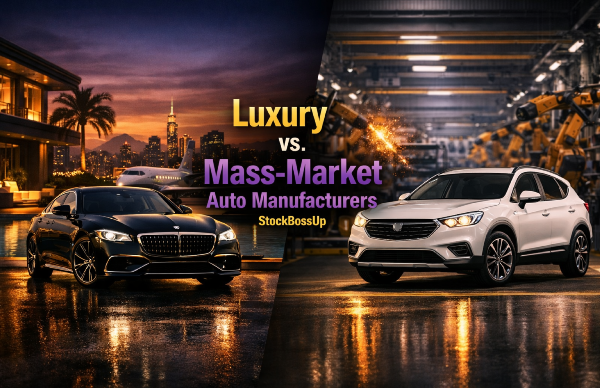
Luxury vs Mass-Market Auto Manufacturers
At first glance, the auto market looks simple. Luxury brands build expensive cars with better materials. Mass-market brands build affordable cars for everyday drivers.
But this explanation misses a deeper issue.
Many buyers assume higher price means better long-term value. Many investors assume luxury brands always perform better financially. That is not always true.
A car that feels impressive on day one can become expensive over time. A “simple” mass-market car can sometimes outperform expectations in reliability and total cost.
So what actually separates luxury and mass-market automakers in a way that matters years after purchase?
The answer becomes clear only when you compare engineering, ownership cost, and business strategy.
Why Do Luxury and Mass-Market Brands Compete in the Same Industry?
Luxury and mass-market automakers operate in the same industry but serve very different goals.
Luxury manufacturers focus on:
- Premium pricing
- Brand identity
- Advanced engineering
- Comfort and performance
Mass-market manufacturers focus on:
- Affordability
- Reliability
- Efficiency at scale
- Practical features
Major luxury automakers:
- BMW Group (BMWYY)
- Mercedes-Benz Group (MBGYY)
- Audi (Volkswagen Group)
- Lexus (Toyota)
Major mass-market automakers:
- Toyota Motor Corporation (TM)
- Honda (HMC)
- Ford Motor Company (F)
- General Motors (GM)
- Hyundai Motor Company (HYMTF)
These companies are not just building different cars. They are building different ownership expectations.
Why Do Luxury Cars Feel Better But Cost More Over Time?
Luxury vehicles prioritize experience first and cost second.
BMW Group focuses on driving performance. Mercedes-Benz focuses on comfort and technology. Audi focuses on design and digital integration.
This creates:
- Higher performance engines
- More advanced electronics
- Premium interior materials
- Smoother ride quality
However, more complexity often leads to higher maintenance costs over time.
A key issue is that luxury vehicles often use tightly integrated systems that are harder and more expensive to repair outside dealerships.
Why Do Mass-Market Cars Dominate Reliability Rankings?
Mass-market automakers prioritize long-term durability over premium features.
Toyota Motor Corporation is known for conservative engineering and long product cycles. Honda focuses on efficiency and mechanical simplicity. Hyundai Motor Company has improved quickly through strong warranties and simplified systems.
These brands tend to:
- Use proven engine designs longer
- Reduce system complexity
- Focus on manufacturing consistency
- Improve repair accessibility
One notable detail is that Toyota’s production system is so consistent that component variation is extremely low across manufacturing batches.
How Do Ownership Costs Compare Between Luxury and Mass-Market Cars?
| Category |
Luxury Brands |
Mass-Market Brands |
| Purchase Price |
High |
Lower |
| Maintenance Cost |
High |
Lower |
| Repair Complexity |
High |
Lower |
| Depreciation |
Faster |
Slower |
| Technology Level |
Advanced |
Practical |
| Reliability |
Moderate |
High |
Luxury cars tend to depreciate faster because repair costs are higher and technology cycles move quickly.
Why Do Luxury Cars Lose Value Faster?
Luxury vehicles often lose value faster due to rapid technology upgrades and higher maintenance expectations.
BMW Group and Mercedes-Benz Group frequently introduce new systems that make older models feel outdated.
Another factor is repair cost expectations. Buyers in the used market often discount luxury vehicles due to potential maintenance expenses.
Some luxury vehicles lose more than half their value within five years, even if they are still in good mechanical condition.
Why Do Mass-Market Cars Hold Value Better?
Mass-market vehicles maintain value better because they are easier and cheaper to own.
Toyota Motor Corporation and Honda benefit from:
- Lower repair costs
- Wider service availability
- Strong reliability reputation
Hyundai Motor Company also offers strong value retention due to long warranty coverage and improving quality perception.
How Do Engineering Approaches Differ?
| Factor |
Luxury Brands |
Mass-Market Brands |
| Engine Design |
Performance-focused |
Efficiency-focused |
| Suspension |
Comfort + handling |
Balanced durability |
| Electronics |
Advanced systems |
Functional systems |
| Materials |
Premium finishes |
Cost-efficient materials |
| Update Cycle |
Fast redesigns |
Slow refinements |
Luxury focuses on refinement. Mass-market focuses on long-term usability.
Why Do Luxury Cars Feel More Advanced?
Luxury automakers introduce new technology earlier than mass-market brands.
Features include:
- Adaptive suspension systems
- Advanced driver assistance systems
- Digital cockpit displays
- High-end interior lighting
BMW Group and Mercedes-Benz Group often lead in introducing these technologies.
However, early adoption can increase long-term repair complexity.
Why Do Mass-Market Cars Last Longer in Real Use?
Real-world durability depends more on simplicity than innovation.
Toyota Motor Corporation and Honda often outperform in long-term use because they:
- Use proven platforms
- Limit unnecessary redesigns
- Focus on mechanical durability
Mass-market vehicles are also easier to repair outside dealership systems, lowering total ownership cost.
How Do Luxury and Mass-Market Brands Compete in EVs?
Electric vehicles have changed competition between both segments.
Luxury brands focus on:
- Performance EVs
- Premium interiors
- High-tech systems
Mass-market brands focus on:
- Affordability
- Range efficiency
- Scalable production
Hyundai Motor Company has become competitive in EV value offerings, while BMW Group and Mercedes-Benz Group focus on premium electric performance.
Why Do Mass-Market Brands Sell More Cars?
Mass-market automakers sell more vehicles because they are accessible to more buyers.
Toyota Motor Corporation, Honda, and Hyundai Motor Company benefit from:
- Lower pricing
- Strong global networks
- Broad product ranges
Luxury brands sell fewer vehicles but earn more profit per unit.
This creates two business models:
- High volume, low margin (mass-market)
- Low volume, high margin (luxury)
How Do Investors View Luxury vs Mass-Market Stocks?
Luxury automaker stocks behave differently from mass-market stocks.
Luxury stocks are more sensitive to:
- Global wealth trends
- Currency fluctuations
- High-income consumer demand
Mass-market stocks are more sensitive to:
- Interest rates
- Fuel prices
- Employment levels
This leads to different risk and return profiles in each category.
Why Do Repair Networks Matter So Much?
Repair accessibility strongly affects long-term ownership costs.
Mass-market brands offer:
- Wide independent repair networks
- Lower-cost parts
- Simpler diagnostics
Luxury brands often require:
- Dealer-only diagnostics
- Specialized parts
- Higher labor costs
This difference compounds over time.
Final Answer: Which Is Better?
Luxury brands like BMW Group and Mercedes-Benz Group focus on performance, comfort, and technology.
Mass-market brands like Toyota Motor Corporation and Honda focus on affordability, durability, and long-term reliability.
The real difference is not quality—it is purpose.
Luxury is designed for experience. Mass-market is designed for efficiency.
The best choice depends on whether the priority is driving experience or long-term cost and reliability.













🔑 Key Takeaways: Luxury vs Mass-Market Auto Manufacturers
🚗 Luxury vs mass-market cars serve completely different ownership goals
Luxury automakers like BMW Group (BMWYY) and Mercedes-Benz Group (MBGYY) prioritize performance, comfort, and advanced technology. Mass-market brands like Toyota Motor Corporation (TM) and Honda (HMC) focus on affordability, durability, and everyday usability. The key difference is experience vs long-term efficiency.
💰 Mass-market vehicles typically win on long-term cost and reliability
Mass-market brands are engineered for simplicity and scale, which leads to lower maintenance costs, easier repairs, and stronger long-term reliability. Toyota (TM) and Honda (HMC) are especially known for durable platforms that reduce total cost of ownership over time.
📉 Luxury vehicles often depreciate faster due to complexity and repair costs
Luxury vehicles use advanced systems, premium materials, and fast technology cycles. While this improves driving experience, it also increases depreciation. Brands like Mercedes-Benz Group (MBGYY) and BMW Group (BMWYY) often lose value faster in the used market due to higher expected maintenance costs.
⚖️ The best choice depends on whether you prioritize experience or efficiency
Luxury and mass-market automakers are optimized for different outcomes. Luxury brands maximize comfort, prestige, and performance. Mass-market brands maximize cost efficiency, reliability, and accessibility. The better choice depends on whether you value driving experience or long-term ownership savings.
Luxury vs Mass-Market Auto Manufacturers
At first glance, the auto market looks simple. Luxury brands build expensive cars with better materials. Mass-market brands build affordable cars for everyday drivers.
But this explanation misses a deeper issue.
Many buyers assume higher price means better long-term value. Many investors assume luxury brands always perform better financially. That is not always true.
A car that feels impressive on day one can become expensive over time. A “simple” mass-market car can sometimes outperform expectations in reliability and total cost.
So what actually separates luxury and mass-market automakers in a way that matters years after purchase?
The answer becomes clear only when you compare engineering, ownership cost, and business strategy.
Why Do Luxury and Mass-Market Brands Compete in the Same Industry?
Luxury and mass-market automakers operate in the same industry but serve very different goals.
Luxury manufacturers focus on:
Mass-market manufacturers focus on:
Major luxury automakers:
Major mass-market automakers:
These companies are not just building different cars. They are building different ownership expectations.
Why Do Luxury Cars Feel Better But Cost More Over Time?
Luxury vehicles prioritize experience first and cost second.
BMW Group focuses on driving performance. Mercedes-Benz focuses on comfort and technology. Audi focuses on design and digital integration.
This creates:
However, more complexity often leads to higher maintenance costs over time.
A key issue is that luxury vehicles often use tightly integrated systems that are harder and more expensive to repair outside dealerships.
Why Do Mass-Market Cars Dominate Reliability Rankings?
Mass-market automakers prioritize long-term durability over premium features.
Toyota Motor Corporation is known for conservative engineering and long product cycles. Honda focuses on efficiency and mechanical simplicity. Hyundai Motor Company has improved quickly through strong warranties and simplified systems.
These brands tend to:
One notable detail is that Toyota’s production system is so consistent that component variation is extremely low across manufacturing batches.
How Do Ownership Costs Compare Between Luxury and Mass-Market Cars?
Luxury cars tend to depreciate faster because repair costs are higher and technology cycles move quickly.
Why Do Luxury Cars Lose Value Faster?
Luxury vehicles often lose value faster due to rapid technology upgrades and higher maintenance expectations.
BMW Group and Mercedes-Benz Group frequently introduce new systems that make older models feel outdated.
Another factor is repair cost expectations. Buyers in the used market often discount luxury vehicles due to potential maintenance expenses.
Some luxury vehicles lose more than half their value within five years, even if they are still in good mechanical condition.
Why Do Mass-Market Cars Hold Value Better?
Mass-market vehicles maintain value better because they are easier and cheaper to own.
Toyota Motor Corporation and Honda benefit from:
Hyundai Motor Company also offers strong value retention due to long warranty coverage and improving quality perception.
How Do Engineering Approaches Differ?
Luxury focuses on refinement. Mass-market focuses on long-term usability.
Why Do Luxury Cars Feel More Advanced?
Luxury automakers introduce new technology earlier than mass-market brands.
Features include:
BMW Group and Mercedes-Benz Group often lead in introducing these technologies.
However, early adoption can increase long-term repair complexity.
Why Do Mass-Market Cars Last Longer in Real Use?
Real-world durability depends more on simplicity than innovation.
Toyota Motor Corporation and Honda often outperform in long-term use because they:
Mass-market vehicles are also easier to repair outside dealership systems, lowering total ownership cost.
How Do Luxury and Mass-Market Brands Compete in EVs?
Electric vehicles have changed competition between both segments.
Luxury brands focus on:
Mass-market brands focus on:
Hyundai Motor Company has become competitive in EV value offerings, while BMW Group and Mercedes-Benz Group focus on premium electric performance.
Why Do Mass-Market Brands Sell More Cars?
Mass-market automakers sell more vehicles because they are accessible to more buyers.
Toyota Motor Corporation, Honda, and Hyundai Motor Company benefit from:
Luxury brands sell fewer vehicles but earn more profit per unit.
This creates two business models:
How Do Investors View Luxury vs Mass-Market Stocks?
Luxury automaker stocks behave differently from mass-market stocks.
Luxury stocks are more sensitive to:
Mass-market stocks are more sensitive to:
This leads to different risk and return profiles in each category.
Why Do Repair Networks Matter So Much?
Repair accessibility strongly affects long-term ownership costs.
Mass-market brands offer:
Luxury brands often require:
This difference compounds over time.
Final Answer: Which Is Better?
Luxury brands like BMW Group and Mercedes-Benz Group focus on performance, comfort, and technology.
Mass-market brands like Toyota Motor Corporation and Honda focus on affordability, durability, and long-term reliability.
The real difference is not quality—it is purpose.
Luxury is designed for experience. Mass-market is designed for efficiency.
The best choice depends on whether the priority is driving experience or long-term cost and reliability.