The Top Value Investments

Top value stocks for October 2026
Chipotle Mexican Grill, Inc. (CMG)
analysis by Value Investing With Sven Carlin, Ph.d.Deckers Outdoor Corporation (DECK)
analysis by Value Investing With Sven Carlin, Ph.d.UnitedHealth Group Inc. (UNH)
analysis by Intrinsic Value Only On YoutubeCanadian National Railway Company (CNI)
analysis by Trading Fundamentals On YoutubeNVIDIA Corporation (NVDA) Adobe Inc. (ADBE) Microsoft Corporation Common Stock (MSFT) American Express Company (AXP) lululemon athletica inc. (LULU) Micron Technology, Inc. (MU)
The Top Value Investing Stocks
The top value stocks are contributed by our community. Value stocks are potentially undervalued versus their intrinsic value due to being misvalued by the market. This mispricing may lead to investment gains as the stock price reverts up to its intrinsic value.
Stock prices typically follow the intrinsic value of a stock. However, the market will place a risk factor on stocks, keeping them above or below the intrinsic value. A famous example is bank stocks like JP Morgan.
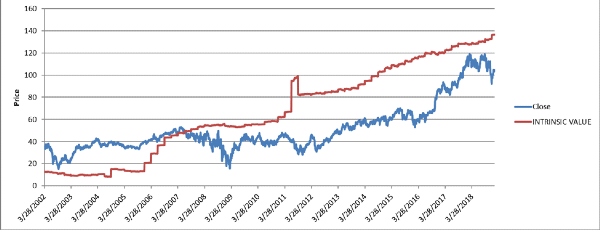
JP Morgan price versus intrinsic value per share
After the 2009 financial crisis, the market placed a risk factor on all bank stocks. Before the crash, JP Morgan enjoyed a premium for buying its stocks. After the financial crisis, the stock price would follow underneath the intrinsic value.
Why are these the Best Value Investment Stocks?
The list above is a compilation of stock analysis from our community. Our system uses multiple criteria to create the top value investing stock list. This criterion includes:
- Performance - Historical performance of the content writer’s stock ratings. The better they are at predicting future performance, the higher we rate their stock picks.
- Diversity – Sometimes you just get lucky, and your first stock pick is a winner. Top content writers will make multiple ratings.
- Volatility – The volatility of the writer’s stock picks is considered, especially for specific investment strategies. For growth stocks, high volatility isn’t too important; however, for value investments, high volatility and high drawdown may indicate the stocks suggestion provided by the content creator isn’t suitable for a value investing strategy.
Besides these quantitative factors, our system also looks at the content written. This includes how well received the content is by the community, search engines and social media. This is an indication that the content is of high quality.
We also check the article or post for content that backs up their argument for or against buying the stock. These metrics are proprietary and are based in patterns that show correlation to stock performance.
What are the Best Value Stocks?
The best value stocks change every day as the market prices change. There are no “value stocks”, but there are stocks that value investors prefer due to certain qualitative factors such as a company’s moat around their market, quality of management, and proof of performance.
But even these quality stocks can be overvalued. This is why it’s important to calculate the intrinsic value of a stock before making an investment.
The top value stock listed above changes regularly as new value investment analyses are published and the value of the market changes. What was a great value investment today could be overvalued weeks later if it jumps 50% in value. Our list updates daily to take into consideration the dynamics of the stock market.
What are Cheap Value Stocks?
With the advent of fractional shares, the actual price of a stock has no bearing on if a stock is cheap or not. Even a stock worth $1000 per share can be purchased as a fractional share for $1.
A cheap value stock is significantly undervalued versus its intrinsic value. There are many ways to calculate the intrinsic value of a stock, but calculating the intrinsic value using earnings growth, book value and interest rates shows a correlation to future price appreciation.
How do You Pick Good Value Stocks?
The first step in picking a good value investment is choosing which stocks to research. You can filter a list of stocks with different metrics. Some of these value investment ratios include:
- The price to earnings ratio
- Return on Capital and earnings yield
- Dividend yield and dividend policy
- Price to Book Ratio
The next step is to determine the intrinsic value of the stock and an appropriate risk factor to place on the stock. It’s also critical to remember that a stock that is undervalued on paper may be an underperforming company in real life. Be sure to check the quality of the company before investing.

Value Investing for Beginners
Value investing is a great strategy for beginning investors to learn as value investing creates grounded expectations, teaches patience, and reduces anxiety.
New investors should learn the strategy because value investing is an evergreen concept.
The concept of value investing fundamentally moves the market in the long term. Even traders who focus on intraday movements would compliment their analysis with value investing.
Value investing is not for everyone. Value investing has its pros and cons. In general, value investing requires patience. You must also have confidence in your own assessment of stocks. It can take years for your assessment to come to fruition.
Are Value Stocks Still Worth It?
Though the strategy has lost popularity over time, value investing is still relevant and profitable today. Over the last decade, pundits have pointed to growth investing as the superior investing strategy; however, value and growth have differences and similarities that make it hard to directly compare them.
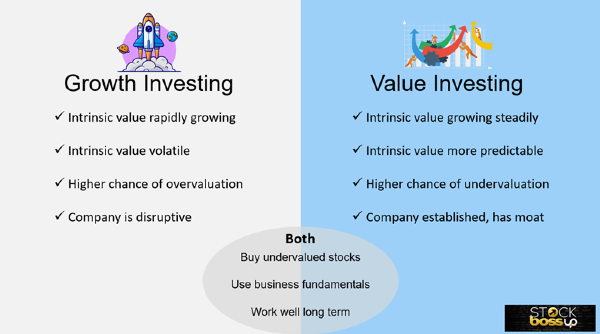
Growth investing versus value investing
Ultimately, the difference comes down to the growth rate of the company’s intrinsic value. A faster growth rate adds more volatility to the analysis.
What is an Example of a Value Stock Analysis?
A stock can be undervalued one day and overvalued the next day. Hence, there is no real value stock. There are stocks that value investors prefer as the companies provide quality and consistent business returns.
One example of a stock that was historically undervalued is Southern Company. The stock has historically been a quality stock with consistent growth in earnings, dividends, and revenue. The price of the stock follows the calculated intrinsic value of the stock.
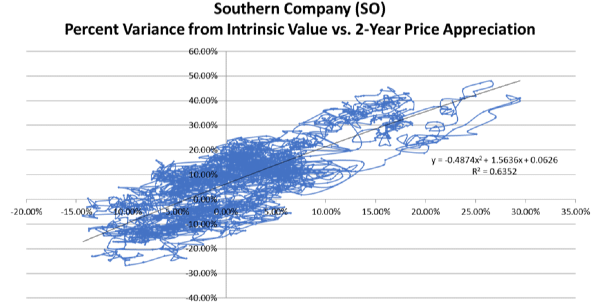
Southern Company intrinsic value vs future price appreciation
How Can New Investors Avoid a Value Trap?
Even value investing is risky. A value trap occurs when you get a false positive to buy a stock from your value analysis alone. You did not take into consideration the quality and health of the company before buying.
Many times, new investors are lured into value traps by high dividend yields or unnatural price to book ratios. Sometimes, these are opportunities for investors to jump in; however, these ratios can be skewed by unhealthy activities occurring in the company.
For example, a high dividend yield may be a temporary blip that is using the previous dividend but not the next dividend. If earnings are falling, then the price falling. The board of directors may have to cut their dividend when earnings fall enough versus the dividend policy.
How Many Value Stocks Should I Own?
The number of value stocks you own depend on your account value. In general:
- New Investors – Buy at least one stock right now. You can start investing for one dollar
- The average investor – At least 13 stocks.
- $10k portfolio – 13 to 30 stocks or more.
- $100k portfolio – 30 to 50 stocks