🔑 Key Takeaways: EV vs Gas Auto Manufacturers
🚗 EV vs gas auto stocks operate on completely different financial timelines
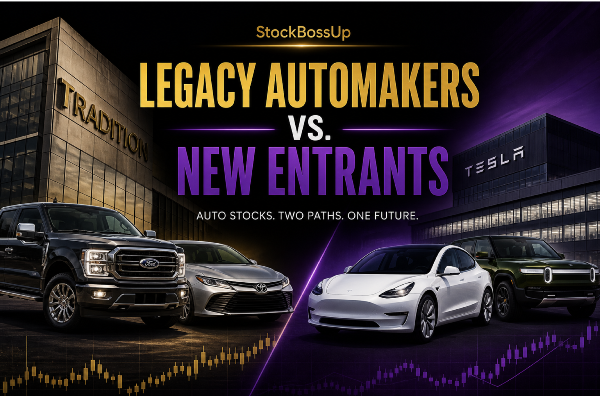
EV manufacturers like Tesla, Inc. (TSLA) focus on future growth, scaling, and technology adoption, while gas automakers like Toyota Motor Corporation (TM) and Ford Motor Company (F) rely on current profitability and stable cash flow. This creates a clear divide between growth-focused and value-focused investment strategies.
📈 Gas-powered automakers still lead in profits and cash flow stability
Despite EV momentum, traditional automakers such as General Motors (GM) and Toyota Motor Corporation (TM) continue to generate stronger and more consistent profits due to mature supply chains, high-margin trucks and SUVs, and established global demand.
⚡ EV manufacturers offer higher growth potential but come with greater volatility
EV companies like Rivian Automotive (RIVN) and Lucid Group (LCID) tend to experience sharper stock swings due to production scaling challenges, battery cost changes, and dependence on future demand expectations rather than current earnings.
⚖️ The best investment choice depends on risk tolerance and time horizon
EV stocks favor long-term growth investors willing to accept volatility, while gas automakers appeal to those seeking stability, dividends, and predictable earnings. The real decision is not technology vs tradition, but growth potential vs financial consistency.
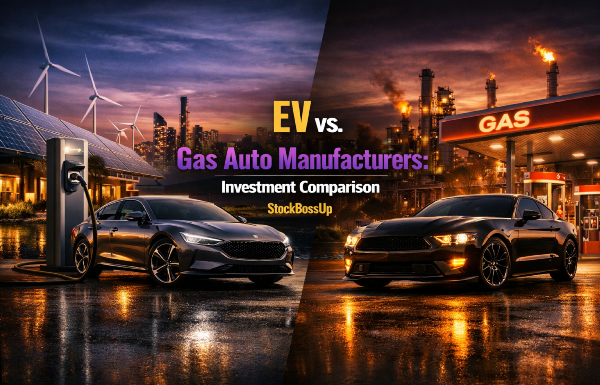
EV vs Gas Auto Manufacturers: Investment Comparison
At first glance, the debate between EV and gas-powered auto manufacturers looks simple. Electric vehicles are the future. Gas vehicles are the past.
But that view creates a hidden problem for investors.
Many assume “future technology” automatically means better returns. At the same time, traditional gas automakers still generate most of the industry’s real profits today. This creates a mismatch between narrative and financial reality.
Some investors enter EV stocks too early and face volatility. Others stay in gas-powered companies too long and miss long-term transition growth.
So which side actually performs better as an investment: EV manufacturers or traditional gas automakers?
The answer depends on profitability cycles, infrastructure limits, and how fast real adoption actually happens.
Why Are EV and Gas Auto Manufacturers Compared So Closely?
EV and gas automakers compete because they operate in the same core industry: transportation. But their business models are very different.
Gas-powered manufacturers:
- Rely on mature global supply chains
- Generate strong and stable cash flow
- Depend on trucks and SUVs for profit
- Have established repair and service networks
EV manufacturers:
- Rely heavily on battery technology
- Require large upfront capital investment
- Focus on scaling production capacity
- Compete on software and efficiency
Key EV companies:
- Tesla, Inc. (TSLA)
- Rivian Automotive (RIVN)
- Lucid Group (LCID)
- NIO Inc. (NIO)
Key gas-powered automakers:
- Toyota Motor Corporation (TM)
- Ford Motor Company (F)
- General Motors (GM)
- Volkswagen Group (VWAGY)
These companies are not just competing on vehicles. They are competing on completely different financial timelines.
Why Do Gas Automakers Still Dominate Profits?
Gas-powered automakers still generate the majority of global auto profits.
Companies like Toyota Motor Corporation and Ford Motor Company benefit from:
- Mature production systems
- High-margin truck and SUV sales
- Lower production risk
- Established global supply chains
A key insight is that pickup trucks in North America often generate higher profit margins than many luxury vehicles, which helps traditional automakers remain highly profitable.
Why Are EV Manufacturers Growing So Quickly?
EV manufacturers are growing rapidly due to structural changes in the global auto market.
Growth drivers include:
- Government emissions regulations
- Falling battery costs over time
- Expansion of charging infrastructure
- Consumer interest in lower fuel costs
Tesla, Inc. leads this shift by combining vehicle sales with software-based revenue streams.
However, growth does not always mean profitability. Many EV companies are still investing heavily to scale production.
How Do EV and Gas Stocks Compare?
| Category |
EV Manufacturers |
Gas Manufacturers |
| Growth Rate |
High |
Moderate |
| Profitability |
Low to developing |
Strong and stable |
| Volatility |
High |
Moderate |
| Cash Flow |
Often negative |
Consistently positive |
| Market Stage |
Early |
Mature |
EV stocks behave more like high-growth technology companies. Gas automakers behave more like industrial dividend stocks.
Why Are EV Stocks More Volatile?
EV stocks are more volatile because they depend on future expectations instead of current profits.
Tesla, Inc. and Rivian Automotive are often valued based on projected future demand.
Volatility is driven by:
- Battery material price swings
- Production scaling risks
- Policy changes
- Competition in new technology
A key example is lithium price fluctuations, which directly impact EV production costs.
Why Do Gas Vehicles Still Dominate Global Sales?
Gas-powered vehicles still dominate global sales due to existing infrastructure.
Toyota Motor Corporation and Volkswagen Group continue to sell millions of vehicles annually because:
- Fuel stations are widely available
- Vehicles are cheaper upfront
- Repair networks are established
- Consumers are familiar with the technology
In many developing regions, EV adoption is still limited by charging infrastructure.
How Do Profit Models Differ?
EV companies depend on:
- Rapid vehicle growth
- Future software revenue
- Battery technology improvements
Gas companies depend on:
- Engine efficiency improvements
- Truck and SUV margins
- Aftermarket services
- Stable global demand
| Factor |
EV Companies |
Gas Companies |
| Revenue Source |
Growth-driven sales |
Mature vehicle sales |
| Margin Stability |
Low |
High |
| Capital Cost |
Very high |
Moderate |
| Risk Profile |
High |
Lower |
Why Do EV Companies Burn More Cash?
EV companies require large upfront investments in:
- Battery factories
- Software systems
- Manufacturing plants
- Charging infrastructure
Companies like Lucid Group and Rivian Automotive spend heavily before reaching consistent profitability.
This creates a delay between revenue growth and actual earnings.
Why Are Gas Vehicles Still Strong Investments?
Gas automakers remain attractive because they generate consistent cash flow.
Ford Motor Company and General Motors continue to earn strong profits from trucks and SUVs.
They offer:
- Dividends in many cases
- Stable production cycles
- Lower operational risk
- Predictable earnings patterns
Why Do EV Companies Innovate Faster?
EV companies lead in innovation because they are building new systems.
Tesla, Inc. focuses heavily on:
- Software updates
- Autonomous driving
- Battery efficiency
Gas companies improve more slowly, focusing on:
- Engine efficiency
- Hybrid systems
- Emissions reduction
Toyota Motor Corporation is a leader in hybrid systems, which act as a bridge between gas and EV technology.
Why Do Hybrids Matter in This Transition?
Hybrids are an important middle stage between gas and EV vehicles.
Toyota Motor Corporation dominates this segment.
Hybrids offer:
- Better fuel efficiency than gas vehicles
- Lower dependence on charging infrastructure
- Lower cost than full EV systems
Hybrids remain strong in markets where EV infrastructure is still developing.
How Do Regulations Affect Both Industries?
Government policies heavily influence EV adoption.
EV companies benefit from:
- Tax incentives
- Emissions regulations
- Infrastructure spending
Gas companies face:
- Emissions restrictions
- Long-term phase-out pressure
- Regulatory compliance costs
Volkswagen Group has invested heavily in EV platforms due to strict European emissions rules.
Why Is Timing So Important in EV Investing?
Timing is critical in EV investing because the industry is still evolving.
Early EV investors experienced:
- High volatility
- Long profitability delays
- Rapid technological changes
Meanwhile, gas automakers offered more stable returns during the same period.
Final Answer: Which Is the Better Investment?
EV and gas automakers operate on very different financial timelines.
EV companies like Tesla, Inc. and Rivian Automotive focus on future growth and transformation. Gas companies like Toyota Motor Corporation and Ford Motor Company focus on current profitability and stable cash flow.
The key insight is that both models can succeed, but under different conditions.
EV investing rewards long-term growth expectations. Gas investing rewards current financial stability.
The best choice depends on whether the goal is future growth exposure or consistent near-term returns.














🔑 Key Takeaways: EV vs Gas Auto Manufacturers
🚗 EV vs gas auto stocks operate on completely different financial timelines
EV manufacturers like Tesla, Inc. (TSLA) focus on future growth, scaling, and technology adoption, while gas automakers like Toyota Motor Corporation (TM) and Ford Motor Company (F) rely on current profitability and stable cash flow. This creates a clear divide between growth-focused and value-focused investment strategies.
📈 Gas-powered automakers still lead in profits and cash flow stability
Despite EV momentum, traditional automakers such as General Motors (GM) and Toyota Motor Corporation (TM) continue to generate stronger and more consistent profits due to mature supply chains, high-margin trucks and SUVs, and established global demand.
⚡ EV manufacturers offer higher growth potential but come with greater volatility
EV companies like Rivian Automotive (RIVN) and Lucid Group (LCID) tend to experience sharper stock swings due to production scaling challenges, battery cost changes, and dependence on future demand expectations rather than current earnings.
⚖️ The best investment choice depends on risk tolerance and time horizon
EV stocks favor long-term growth investors willing to accept volatility, while gas automakers appeal to those seeking stability, dividends, and predictable earnings. The real decision is not technology vs tradition, but growth potential vs financial consistency.
EV vs Gas Auto Manufacturers: Investment Comparison
At first glance, the debate between EV and gas-powered auto manufacturers looks simple. Electric vehicles are the future. Gas vehicles are the past.
But that view creates a hidden problem for investors.
Many assume “future technology” automatically means better returns. At the same time, traditional gas automakers still generate most of the industry’s real profits today. This creates a mismatch between narrative and financial reality.
Some investors enter EV stocks too early and face volatility. Others stay in gas-powered companies too long and miss long-term transition growth.
So which side actually performs better as an investment: EV manufacturers or traditional gas automakers?
The answer depends on profitability cycles, infrastructure limits, and how fast real adoption actually happens.
Why Are EV and Gas Auto Manufacturers Compared So Closely?
EV and gas automakers compete because they operate in the same core industry: transportation. But their business models are very different.
Gas-powered manufacturers:
EV manufacturers:
Key EV companies:
Key gas-powered automakers:
These companies are not just competing on vehicles. They are competing on completely different financial timelines.
Why Do Gas Automakers Still Dominate Profits?
Gas-powered automakers still generate the majority of global auto profits.
Companies like Toyota Motor Corporation and Ford Motor Company benefit from:
A key insight is that pickup trucks in North America often generate higher profit margins than many luxury vehicles, which helps traditional automakers remain highly profitable.
Why Are EV Manufacturers Growing So Quickly?
EV manufacturers are growing rapidly due to structural changes in the global auto market.
Growth drivers include:
Tesla, Inc. leads this shift by combining vehicle sales with software-based revenue streams.
However, growth does not always mean profitability. Many EV companies are still investing heavily to scale production.
How Do EV and Gas Stocks Compare?
EV stocks behave more like high-growth technology companies. Gas automakers behave more like industrial dividend stocks.
Why Are EV Stocks More Volatile?
EV stocks are more volatile because they depend on future expectations instead of current profits.
Tesla, Inc. and Rivian Automotive are often valued based on projected future demand.
Volatility is driven by:
A key example is lithium price fluctuations, which directly impact EV production costs.
Why Do Gas Vehicles Still Dominate Global Sales?
Gas-powered vehicles still dominate global sales due to existing infrastructure.
Toyota Motor Corporation and Volkswagen Group continue to sell millions of vehicles annually because:
In many developing regions, EV adoption is still limited by charging infrastructure.
How Do Profit Models Differ?
EV companies depend on:
Gas companies depend on:
Why Do EV Companies Burn More Cash?
EV companies require large upfront investments in:
Companies like Lucid Group and Rivian Automotive spend heavily before reaching consistent profitability.
This creates a delay between revenue growth and actual earnings.
Why Are Gas Vehicles Still Strong Investments?
Gas automakers remain attractive because they generate consistent cash flow.
Ford Motor Company and General Motors continue to earn strong profits from trucks and SUVs.
They offer:
Why Do EV Companies Innovate Faster?
EV companies lead in innovation because they are building new systems.
Tesla, Inc. focuses heavily on:
Gas companies improve more slowly, focusing on:
Toyota Motor Corporation is a leader in hybrid systems, which act as a bridge between gas and EV technology.
Why Do Hybrids Matter in This Transition?
Hybrids are an important middle stage between gas and EV vehicles.
Toyota Motor Corporation dominates this segment.
Hybrids offer:
Hybrids remain strong in markets where EV infrastructure is still developing.
How Do Regulations Affect Both Industries?
Government policies heavily influence EV adoption.
EV companies benefit from:
Gas companies face:
Volkswagen Group has invested heavily in EV platforms due to strict European emissions rules.
Why Is Timing So Important in EV Investing?
Timing is critical in EV investing because the industry is still evolving.
Early EV investors experienced:
Meanwhile, gas automakers offered more stable returns during the same period.
Final Answer: Which Is the Better Investment?
EV and gas automakers operate on very different financial timelines.
EV companies like Tesla, Inc. and Rivian Automotive focus on future growth and transformation. Gas companies like Toyota Motor Corporation and Ford Motor Company focus on current profitability and stable cash flow.
The key insight is that both models can succeed, but under different conditions.
EV investing rewards long-term growth expectations. Gas investing rewards current financial stability.
The best choice depends on whether the goal is future growth exposure or consistent near-term returns.