🔑 Key Takeaways: EV Startup Competition and Legacy Automakers
⚡ EV startups are reshaping the auto industry with faster innovation and software-first vehicle design
Electric vehicle startups focus entirely on EV technology, allowing them to move faster than legacy automakers. Their software-driven approach enables frequent updates, rapid product cycles, and more flexible vehicle development, creating strong competitive pressure across the auto industry.
🏭 Legacy automakers face structural challenges that slow EV adoption and innovation speed
Traditional automakers must manage gas and electric vehicle production at the same time, along with complex supply chains and high fixed costs. These limitations reduce flexibility and make it harder to compete with agile EV startups.
💻 Software, battery technology, and pricing strategies are key battlegrounds between EV startups and legacy brands
Competition is increasingly driven by software capabilities, battery cost efficiency, and pricing models. EV startups often lead in software integration and pricing flexibility, while legacy automakers rely on scale and manufacturing strength to stay competitive.
📉 Legacy automakers are responding through partnerships, acquisitions, and rapid EV investment to stay competitive long-term
To keep up with EV startups, traditional automakers are investing heavily in electric platforms, forming technology partnerships, and acquiring startups. These strategies help close the innovation gap but require time and structural change to be fully effective.
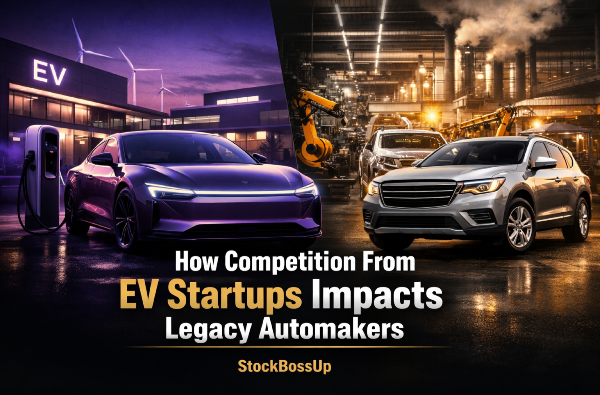
How Competition From EV Startups Impacts Legacy Automakers
The auto industry is going through one of the biggest shifts in its history. Legacy automakers that once dominated global markets are now facing intense pressure from electric vehicle startups. These newer companies are faster, more focused, and often built entirely around electric technology.
The problem is not just competition. It is speed. EV startups move quickly, launch new models faster, and rely heavily on software-driven innovation. Traditional automakers, on the other hand, are built around large factories, complex supply chains, and slower development cycles.
This creates a growing gap between agility and scale. Investors and consumers are noticing the difference. Some legacy brands are adapting well, while others are struggling to keep pace.
The real question is whether established automakers can transform fast enough to stay competitive, or whether EV startups will permanently reshape the industry hierarchy.
Why Are EV Startups Growing So Quickly?
EV startups are growing quickly because they are built for a single purpose: electric mobility. They do not need to manage gas engine production, legacy supply chains, or older manufacturing systems.
This gives them a structural advantage in speed and focus.
They also rely heavily on software, which allows faster updates and feature improvements after launch. Traditional automakers must often redesign hardware systems to achieve similar results.
A key factor is investor funding. Many EV startups receive large amounts of capital early, allowing them to scale aggressively before becoming profitable.
One lesser-known detail is that some EV startups design vehicles entirely around software-first architecture, meaning nearly every feature in the car can be updated remotely without physical changes.
Why Are Legacy Automakers Under Pressure?
Legacy automakers face pressure because they must operate two systems at once. They continue producing gas-powered vehicles while also investing heavily in electric platforms.
This dual structure increases complexity and slows decision-making.
They also carry legacy costs such as large factories, union agreements, and established supplier networks. These systems were built for a different era of manufacturing.
EV startups do not have these constraints, which allows them to move faster in product development and pricing strategy.
| Factor |
EV Startups |
Legacy Automakers |
| Production speed |
High |
Medium–Low |
| Product focus |
Single (EV only) |
Mixed (ICE + EV) |
| Cost structure |
Flexible |
High fixed costs |
| Software integration |
Native |
Developing |
Why Is Software the Biggest Competitive Advantage?
Software has become the core battleground between EV startups and legacy automakers.
Modern EVs are not just mechanical products. They are digital platforms.
Software controls:
- Battery performance
- Driver assistance systems
- Entertainment features
- Vehicle diagnostics
EV startups design these systems from the ground up. Legacy automakers often add software on top of older systems.
This difference affects speed and innovation.
A surprising shift in the industry is that some EV startups now push over-the-air updates that can improve vehicle acceleration without any hardware changes at all.
Why Are Legacy Automakers Slower to Adapt?
Legacy automakers face structural challenges that slow adaptation.
Factories are optimized for internal combustion engines. Supply chains are built around decades-old supplier relationships. Engineering teams are divided between traditional and electric platforms.
This creates internal complexity.
Decision-making can also be slower due to large organizational structures.
However, legacy companies do have advantages in scale, global distribution, and brand trust.
| Constraint Area |
Impact on Legacy Automakers |
Startup Advantage |
| Factory design |
High switching cost |
Flexible |
| Supply chain |
Complex and global |
Simplified |
| Product cycle speed |
Slow |
Fast |
| Capital requirements |
High fixed costs |
VC-funded growth |
Why Are EV Startups Disrupting Pricing Models?
EV startups often use aggressive pricing strategies to gain market share quickly.
Some enter markets with lower price points or simplified vehicle configurations.
This forces legacy automakers to respond with discounts or new entry-level models.
Pricing pressure reduces profit margins across the industry.
It also changes consumer expectations about what a modern vehicle should cost.
A unique trend is that some EV startups are using direct-to-consumer sales models that eliminate dealership markups entirely, allowing more flexible pricing control.
Why Are Battery Costs Central to the Competition?
Battery costs are one of the biggest factors in EV competition.
EV startups often rely on partnerships or external suppliers, while legacy automakers invest in long-term battery production strategies.
Battery pricing directly affects vehicle affordability and profit margins.
As battery costs decline, competition intensifies.
| Battery Factor |
Impact on EV Startups |
Impact on Legacy Firms |
| Cost volatility |
High risk |
Medium risk |
| Supply dependency |
High |
Medium |
| Production control |
Low–Medium |
Medium–High |
| Scaling advantage |
Medium |
High |
Why Are Investors Paying More Attention to EV Startups?
Investors are attracted to EV startups because they represent high-growth potential.
These companies are often valued based on future expectations rather than current earnings.
Legacy automakers, in contrast, are valued more on stable cash flow and dividends.
This creates different investment profiles.
EV startups are seen as high-risk, high-reward opportunities.
Legacy automakers are seen as stable but slower-growth investments.
Why Are Legacy Automakers Buying or Partnering With Startups?
Many legacy automakers are responding to competition by acquiring or partnering with EV startups.
This allows them to gain access to technology, talent, and software systems faster than building internally.
It also reduces time-to-market for new electric platforms.
However, integration is not always smooth. Cultural and operational differences can slow progress.
| Strategy Type |
Benefit |
Risk Level |
| Acquisition |
Fast technology access |
High |
| Partnership |
Shared development |
Medium |
| Internal development |
Full control |
High time |
Why Is Brand Loyalty Changing in the EV Market?
Brand loyalty is weaker in the EV market compared to traditional auto markets.
Consumers are more focused on technology, range, software features, and price rather than legacy brand history.
This benefits EV startups that can compete on innovation rather than reputation.
Legacy automakers must work harder to maintain customer loyalty through product quality and digital experience.
Why Are Manufacturing Models Changing?
EV startups often use simpler manufacturing models compared to legacy automakers.
They design vehicles with fewer parts and more modular systems.
This reduces complexity and allows faster production scaling.
Legacy automakers are now adopting similar approaches, but transition takes time.
A notable industry shift is that some EV factories operate with significantly fewer assembly stages than traditional plants, reducing production time per vehicle.
Why Are Supply Chains a Competitive Battlefield?
Supply chains are a major point of competition between EV startups and legacy automakers.
Startups often rely on external suppliers, while legacy firms control larger portions of their supply chain.
This gives legacy companies more stability but less flexibility.
EV startups gain speed but face higher dependency risks.
Why Are Technology Partnerships Becoming Essential?
Technology partnerships are increasingly important in the EV industry.
Both startups and legacy automakers rely on external companies for:
- Battery technology
- Autonomous driving systems
- Software platforms
- Semiconductor supply
These partnerships shape competitiveness and innovation speed.
What Is the Real Long-Term Impact of EV Startup Competition?
The long-term impact of EV startups is not just disruption. It is transformation.
The auto industry is shifting from mechanical engineering to software-driven mobility systems.
Legacy automakers are under pressure to adapt quickly or risk losing market share in key segments.
EV startups are forcing faster innovation cycles across the entire industry.
The solution for legacy automakers is not to compete on every front. It is to focus on strengths such as scale, manufacturing efficiency, and global distribution while accelerating software and EV integration.
In the end, the competition is reshaping the industry into a faster, more digital, and more flexible ecosystem where success depends on adaptability rather than history.











🔑 Key Takeaways: EV Startup Competition and Legacy Automakers
⚡ EV startups are reshaping the auto industry with faster innovation and software-first vehicle design
Electric vehicle startups focus entirely on EV technology, allowing them to move faster than legacy automakers. Their software-driven approach enables frequent updates, rapid product cycles, and more flexible vehicle development, creating strong competitive pressure across the auto industry.
🏭 Legacy automakers face structural challenges that slow EV adoption and innovation speed
Traditional automakers must manage gas and electric vehicle production at the same time, along with complex supply chains and high fixed costs. These limitations reduce flexibility and make it harder to compete with agile EV startups.
💻 Software, battery technology, and pricing strategies are key battlegrounds between EV startups and legacy brands
Competition is increasingly driven by software capabilities, battery cost efficiency, and pricing models. EV startups often lead in software integration and pricing flexibility, while legacy automakers rely on scale and manufacturing strength to stay competitive.
📉 Legacy automakers are responding through partnerships, acquisitions, and rapid EV investment to stay competitive long-term
To keep up with EV startups, traditional automakers are investing heavily in electric platforms, forming technology partnerships, and acquiring startups. These strategies help close the innovation gap but require time and structural change to be fully effective.
How Competition From EV Startups Impacts Legacy Automakers
The auto industry is going through one of the biggest shifts in its history. Legacy automakers that once dominated global markets are now facing intense pressure from electric vehicle startups. These newer companies are faster, more focused, and often built entirely around electric technology.
The problem is not just competition. It is speed. EV startups move quickly, launch new models faster, and rely heavily on software-driven innovation. Traditional automakers, on the other hand, are built around large factories, complex supply chains, and slower development cycles.
This creates a growing gap between agility and scale. Investors and consumers are noticing the difference. Some legacy brands are adapting well, while others are struggling to keep pace.
The real question is whether established automakers can transform fast enough to stay competitive, or whether EV startups will permanently reshape the industry hierarchy.
Why Are EV Startups Growing So Quickly?
EV startups are growing quickly because they are built for a single purpose: electric mobility. They do not need to manage gas engine production, legacy supply chains, or older manufacturing systems.
This gives them a structural advantage in speed and focus.
They also rely heavily on software, which allows faster updates and feature improvements after launch. Traditional automakers must often redesign hardware systems to achieve similar results.
A key factor is investor funding. Many EV startups receive large amounts of capital early, allowing them to scale aggressively before becoming profitable.
One lesser-known detail is that some EV startups design vehicles entirely around software-first architecture, meaning nearly every feature in the car can be updated remotely without physical changes.
Why Are Legacy Automakers Under Pressure?
Legacy automakers face pressure because they must operate two systems at once. They continue producing gas-powered vehicles while also investing heavily in electric platforms.
This dual structure increases complexity and slows decision-making.
They also carry legacy costs such as large factories, union agreements, and established supplier networks. These systems were built for a different era of manufacturing.
EV startups do not have these constraints, which allows them to move faster in product development and pricing strategy.
Why Is Software the Biggest Competitive Advantage?
Software has become the core battleground between EV startups and legacy automakers.
Modern EVs are not just mechanical products. They are digital platforms.
Software controls:
EV startups design these systems from the ground up. Legacy automakers often add software on top of older systems.
This difference affects speed and innovation.
A surprising shift in the industry is that some EV startups now push over-the-air updates that can improve vehicle acceleration without any hardware changes at all.
Why Are Legacy Automakers Slower to Adapt?
Legacy automakers face structural challenges that slow adaptation.
Factories are optimized for internal combustion engines. Supply chains are built around decades-old supplier relationships. Engineering teams are divided between traditional and electric platforms.
This creates internal complexity.
Decision-making can also be slower due to large organizational structures.
However, legacy companies do have advantages in scale, global distribution, and brand trust.
Why Are EV Startups Disrupting Pricing Models?
EV startups often use aggressive pricing strategies to gain market share quickly.
Some enter markets with lower price points or simplified vehicle configurations.
This forces legacy automakers to respond with discounts or new entry-level models.
Pricing pressure reduces profit margins across the industry.
It also changes consumer expectations about what a modern vehicle should cost.
A unique trend is that some EV startups are using direct-to-consumer sales models that eliminate dealership markups entirely, allowing more flexible pricing control.
Why Are Battery Costs Central to the Competition?
Battery costs are one of the biggest factors in EV competition.
EV startups often rely on partnerships or external suppliers, while legacy automakers invest in long-term battery production strategies.
Battery pricing directly affects vehicle affordability and profit margins.
As battery costs decline, competition intensifies.
Why Are Investors Paying More Attention to EV Startups?
Investors are attracted to EV startups because they represent high-growth potential.
These companies are often valued based on future expectations rather than current earnings.
Legacy automakers, in contrast, are valued more on stable cash flow and dividends.
This creates different investment profiles.
EV startups are seen as high-risk, high-reward opportunities.
Legacy automakers are seen as stable but slower-growth investments.
Why Are Legacy Automakers Buying or Partnering With Startups?
Many legacy automakers are responding to competition by acquiring or partnering with EV startups.
This allows them to gain access to technology, talent, and software systems faster than building internally.
It also reduces time-to-market for new electric platforms.
However, integration is not always smooth. Cultural and operational differences can slow progress.
Why Is Brand Loyalty Changing in the EV Market?
Brand loyalty is weaker in the EV market compared to traditional auto markets.
Consumers are more focused on technology, range, software features, and price rather than legacy brand history.
This benefits EV startups that can compete on innovation rather than reputation.
Legacy automakers must work harder to maintain customer loyalty through product quality and digital experience.
Why Are Manufacturing Models Changing?
EV startups often use simpler manufacturing models compared to legacy automakers.
They design vehicles with fewer parts and more modular systems.
This reduces complexity and allows faster production scaling.
Legacy automakers are now adopting similar approaches, but transition takes time.
A notable industry shift is that some EV factories operate with significantly fewer assembly stages than traditional plants, reducing production time per vehicle.
Why Are Supply Chains a Competitive Battlefield?
Supply chains are a major point of competition between EV startups and legacy automakers.
Startups often rely on external suppliers, while legacy firms control larger portions of their supply chain.
This gives legacy companies more stability but less flexibility.
EV startups gain speed but face higher dependency risks.
Why Are Technology Partnerships Becoming Essential?
Technology partnerships are increasingly important in the EV industry.
Both startups and legacy automakers rely on external companies for:
These partnerships shape competitiveness and innovation speed.
What Is the Real Long-Term Impact of EV Startup Competition?
The long-term impact of EV startups is not just disruption. It is transformation.
The auto industry is shifting from mechanical engineering to software-driven mobility systems.
Legacy automakers are under pressure to adapt quickly or risk losing market share in key segments.
EV startups are forcing faster innovation cycles across the entire industry.
The solution for legacy automakers is not to compete on every front. It is to focus on strengths such as scale, manufacturing efficiency, and global distribution while accelerating software and EV integration.
In the end, the competition is reshaping the industry into a faster, more digital, and more flexible ecosystem where success depends on adaptability rather than history.