🔑 Key Takeaways: How Recalls Affect Auto Manufacturer Stock Prices
📉 Auto recalls often cause immediate stock price drops due to investor uncertainty and fear
When a recall is announced, investors quickly react to uncertainty about safety risks, repair costs, and brand damage. Even minor recalls can trigger short-term volatility as markets price in worst-case scenarios before full details are known.
🚗 The severity and type of recall determine how much long-term impact it has on stock performance
Safety-related and large-scale recalls tend to cause deeper and longer-lasting stock declines than minor or software-based issues. The more severe the recall, the greater the impact on investor confidence and future earnings expectations.
💻 Software-based recalls are reducing long-term damage but increasing short-term market sensitivity
Modern vehicles allow many recalls to be fixed through over-the-air software updates, which lowers repair costs and recovery time. However, frequent software issues still create short-term volatility as investors adjust to new digital risk factors in vehicles.
🏭 Strong brands recover faster from recalls due to higher trust and better quality perception
Established automakers with strong reputations tend to see quicker stock recovery after recalls. Investor confidence, brand strength, and effective communication play a major role in limiting long-term financial damage.
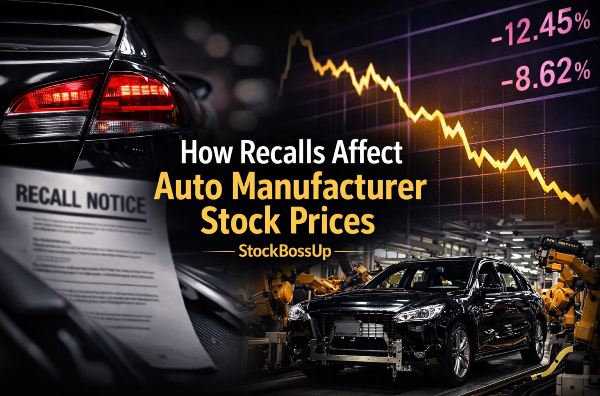
How Recalls Affect Auto Manufacturer Stock Prices
Auto recalls are one of the most disruptive events in the automotive industry. They happen when a vehicle or part is found to have a safety defect or performance issue. While recalls are common, their impact on stock prices can vary widely.
The problem for investors is not just the recall itself. It is how the market reacts to it. Some recalls cause only short-term dips in stock prices. Others lead to long-term damage in investor confidence.
The real issue is uncertainty. Investors must quickly judge whether a recall is minor or a sign of deeper quality problems.
Understanding how recalls affect auto manufacturer stock prices helps explain why some companies recover quickly while others struggle for months or even years.
Why Do Auto Recalls Happen So Often?
Auto recalls happen because modern vehicles are extremely complex. A single car can contain thousands of parts from multiple suppliers. Even small defects can create safety risks.
Recalls are usually triggered by:
- Manufacturing defects
- Software glitches
- Supplier quality issues
- Regulatory safety tests
- Customer complaints
Most recalls are not catastrophic. Many are precautionary and fixed through software updates or minor repairs.
However, the market does not always react calmly. Investors often respond first and analyze later.
A lesser-known fact is that software-related recalls now make up a growing share of total vehicle recalls, especially in electric and connected cars.
Why Do Stock Prices Drop Immediately After a Recall?
Stock prices often drop immediately after a recall announcement because investors react to uncertainty.
The market tends to assume worst-case scenarios before full details are available.
This reaction is driven by fear of:
- Brand damage
- Repair costs
- Legal liability
- Lost sales
Even if a recall is minor, the initial reaction can still cause a sharp decline.
| Recall Type |
Typical Stock Reaction |
Recovery Speed |
Investor Concern Level |
| Minor software issue |
Low drop |
Fast |
Low |
| Mechanical defect |
Moderate drop |
Medium |
Medium |
| Safety-related issue |
High drop |
Slow |
High |
| Large-scale recall |
Severe drop |
Very slow |
Very High |
Why Are Safety Recalls More Damaging Than Others?
Safety-related recalls are more damaging because they affect consumer trust.
If a defect could cause injury or danger, the reputational impact is much greater.
Investors worry not only about repair costs but also long-term brand perception.
A surprising detail is that some automakers spend more on reputation recovery after a major safety recall than on the actual repair costs themselves.
This shows how important trust is in the automotive industry.
Why Do Investors React Differently to Each Automaker?
Not all companies are treated equally after a recall.
Stronger brands often recover faster because they have established trust and a history of quality.
Weaker brands may experience longer stock declines because investors expect recurring issues.
The size of the company also matters. Larger automakers can absorb recall costs more easily than smaller firms.
| Factor |
Strong Brand Impact |
Weak Brand Impact |
| Stock decline size |
Moderate |
High |
| Recovery time |
Fast |
Slow |
| Investor confidence |
Stable |
Fragile |
| Media attention |
Balanced |
Intense |
Why Are Electric Vehicles Increasing Recall Complexity?
Electric vehicles add new layers of complexity to recalls.
EVs rely heavily on software systems, batteries, and advanced electronics. This means recalls are not just mechanical anymore.
Many EV recalls can be fixed with over-the-air software updates, reducing physical repair costs.
However, battery-related recalls can be more serious and expensive.
A key shift in the industry is that some EV recalls now involve remotely disabling or adjusting vehicle performance until updates are installed.
Why Do Large Recalls Affect Long-Term Stock Performance?
Large recalls can affect long-term stock performance because they raise concerns about manufacturing quality and oversight.
Investors begin to question whether the issue is isolated or systemic.
This can lead to:
- Lower future earnings expectations
- Reduced investor confidence
- Increased regulatory scrutiny
- Higher insurance costs
| Recall Scale |
Short-Term Impact |
Long-Term Impact |
Investor Sentiment |
| Small (single model) |
Low |
Minimal |
Neutral |
| Medium (multiple models) |
Moderate |
Noticeable |
Cautious |
| Large (brand-wide) |
High |
Significant |
Negative |
| Global recall |
Very high |
Long-lasting |
Severe concern |
Why Do Software Recalls Change Market Reactions?
Software recalls are becoming more common as vehicles become more connected.
Unlike mechanical recalls, software issues can often be fixed quickly.
This reduces long-term financial damage but still creates short-term volatility.
Investors now differentiate between hardware and software recalls when evaluating risk.
A unique trend is that some automakers can deploy software fixes to millions of vehicles within hours, reducing downtime and repair costs dramatically.
Why Do Media Reports Amplify Stock Reactions?
Media coverage plays a major role in how stocks react to recalls.
Even minor recalls can receive significant attention if they involve well-known brands.
This increases investor fear and can exaggerate stock movements.
The faster news spreads, the more immediate the market reaction becomes.
Why Do Legal Risks Matter After a Recall?
Recalls can lead to legal action, including lawsuits and regulatory fines.
These risks add financial uncertainty beyond repair costs.
Investors often price in potential legal exposure immediately after a recall announcement.
The scale of legal risk depends on the severity of the issue and the number of affected vehicles.
Why Are Supply Chains Linked to Recall Frequency?
Supply chain complexity directly affects recall frequency.
Automakers rely on hundreds of suppliers across multiple countries.
If one supplier produces defective parts, it can trigger large-scale recalls.
| Supply Chain Factor |
Recall Risk Level |
Industry Impact |
| Single-source parts |
High |
High recall risk |
| Multi-supplier parts |
Medium |
Balanced risk |
| In-house production |
Low |
Lower recall risk |
| Global sourcing |
High |
Complex recall management |
Why Do Brand Reputation and Recalls Stay Connected Long-Term?
Even after repairs are completed, recalls can leave a lasting impact on brand reputation.
Consumers may remember past issues when deciding on future purchases.
This can influence long-term sales trends and brand loyalty.
Investors track this closely because sales performance ultimately drives stock value.
Why Are Some Recalls Considered “Normal” by the Market?
Not all recalls are treated as negative events.
Minor recalls are often seen as part of normal operations in a complex manufacturing industry.
Investors may even ignore small recalls if they are quickly resolved.
The market typically reacts more to scale and severity than to the existence of a recall itself.
Why Do Recalls Affect Investor Confidence More Than Costs?
The financial cost of recalls is often predictable and manageable for large automakers.
The bigger issue is uncertainty about quality control and future risk.
Investors fear repeat issues more than one-time expenses.
Confidence plays a larger role in stock valuation than immediate financial loss.
What Is the Real Long-Term Impact of Recalls on Auto Stocks?
The long-term impact of recalls depends on how companies respond.
Fast and transparent responses often limit stock damage. Slow or unclear responses tend to increase investor concern.
The solution is not avoiding recalls entirely, as they are part of the industry. The solution is strong quality control, fast communication, and efficient repair systems.
In the end, recalls do not define a company. The response to recalls does.
Auto manufacturers that manage recalls effectively can maintain investor trust and long-term stock stability, even in a high-risk and highly complex industry.














🔑 Key Takeaways: How Recalls Affect Auto Manufacturer Stock Prices
📉 Auto recalls often cause immediate stock price drops due to investor uncertainty and fear
When a recall is announced, investors quickly react to uncertainty about safety risks, repair costs, and brand damage. Even minor recalls can trigger short-term volatility as markets price in worst-case scenarios before full details are known.
🚗 The severity and type of recall determine how much long-term impact it has on stock performance
Safety-related and large-scale recalls tend to cause deeper and longer-lasting stock declines than minor or software-based issues. The more severe the recall, the greater the impact on investor confidence and future earnings expectations.
💻 Software-based recalls are reducing long-term damage but increasing short-term market sensitivity
Modern vehicles allow many recalls to be fixed through over-the-air software updates, which lowers repair costs and recovery time. However, frequent software issues still create short-term volatility as investors adjust to new digital risk factors in vehicles.
🏭 Strong brands recover faster from recalls due to higher trust and better quality perception
Established automakers with strong reputations tend to see quicker stock recovery after recalls. Investor confidence, brand strength, and effective communication play a major role in limiting long-term financial damage.
How Recalls Affect Auto Manufacturer Stock Prices
Auto recalls are one of the most disruptive events in the automotive industry. They happen when a vehicle or part is found to have a safety defect or performance issue. While recalls are common, their impact on stock prices can vary widely.
The problem for investors is not just the recall itself. It is how the market reacts to it. Some recalls cause only short-term dips in stock prices. Others lead to long-term damage in investor confidence.
The real issue is uncertainty. Investors must quickly judge whether a recall is minor or a sign of deeper quality problems.
Understanding how recalls affect auto manufacturer stock prices helps explain why some companies recover quickly while others struggle for months or even years.
Why Do Auto Recalls Happen So Often?
Auto recalls happen because modern vehicles are extremely complex. A single car can contain thousands of parts from multiple suppliers. Even small defects can create safety risks.
Recalls are usually triggered by:
Most recalls are not catastrophic. Many are precautionary and fixed through software updates or minor repairs.
However, the market does not always react calmly. Investors often respond first and analyze later.
A lesser-known fact is that software-related recalls now make up a growing share of total vehicle recalls, especially in electric and connected cars.
Why Do Stock Prices Drop Immediately After a Recall?
Stock prices often drop immediately after a recall announcement because investors react to uncertainty.
The market tends to assume worst-case scenarios before full details are available.
This reaction is driven by fear of:
Even if a recall is minor, the initial reaction can still cause a sharp decline.
Why Are Safety Recalls More Damaging Than Others?
Safety-related recalls are more damaging because they affect consumer trust.
If a defect could cause injury or danger, the reputational impact is much greater.
Investors worry not only about repair costs but also long-term brand perception.
A surprising detail is that some automakers spend more on reputation recovery after a major safety recall than on the actual repair costs themselves.
This shows how important trust is in the automotive industry.
Why Do Investors React Differently to Each Automaker?
Not all companies are treated equally after a recall.
Stronger brands often recover faster because they have established trust and a history of quality.
Weaker brands may experience longer stock declines because investors expect recurring issues.
The size of the company also matters. Larger automakers can absorb recall costs more easily than smaller firms.
Why Are Electric Vehicles Increasing Recall Complexity?
Electric vehicles add new layers of complexity to recalls.
EVs rely heavily on software systems, batteries, and advanced electronics. This means recalls are not just mechanical anymore.
Many EV recalls can be fixed with over-the-air software updates, reducing physical repair costs.
However, battery-related recalls can be more serious and expensive.
A key shift in the industry is that some EV recalls now involve remotely disabling or adjusting vehicle performance until updates are installed.
Why Do Large Recalls Affect Long-Term Stock Performance?
Large recalls can affect long-term stock performance because they raise concerns about manufacturing quality and oversight.
Investors begin to question whether the issue is isolated or systemic.
This can lead to:
Why Do Software Recalls Change Market Reactions?
Software recalls are becoming more common as vehicles become more connected.
Unlike mechanical recalls, software issues can often be fixed quickly.
This reduces long-term financial damage but still creates short-term volatility.
Investors now differentiate between hardware and software recalls when evaluating risk.
A unique trend is that some automakers can deploy software fixes to millions of vehicles within hours, reducing downtime and repair costs dramatically.
Why Do Media Reports Amplify Stock Reactions?
Media coverage plays a major role in how stocks react to recalls.
Even minor recalls can receive significant attention if they involve well-known brands.
This increases investor fear and can exaggerate stock movements.
The faster news spreads, the more immediate the market reaction becomes.
Why Do Legal Risks Matter After a Recall?
Recalls can lead to legal action, including lawsuits and regulatory fines.
These risks add financial uncertainty beyond repair costs.
Investors often price in potential legal exposure immediately after a recall announcement.
The scale of legal risk depends on the severity of the issue and the number of affected vehicles.
Why Are Supply Chains Linked to Recall Frequency?
Supply chain complexity directly affects recall frequency.
Automakers rely on hundreds of suppliers across multiple countries.
If one supplier produces defective parts, it can trigger large-scale recalls.
Why Do Brand Reputation and Recalls Stay Connected Long-Term?
Even after repairs are completed, recalls can leave a lasting impact on brand reputation.
Consumers may remember past issues when deciding on future purchases.
This can influence long-term sales trends and brand loyalty.
Investors track this closely because sales performance ultimately drives stock value.
Why Are Some Recalls Considered “Normal” by the Market?
Not all recalls are treated as negative events.
Minor recalls are often seen as part of normal operations in a complex manufacturing industry.
Investors may even ignore small recalls if they are quickly resolved.
The market typically reacts more to scale and severity than to the existence of a recall itself.
Why Do Recalls Affect Investor Confidence More Than Costs?
The financial cost of recalls is often predictable and manageable for large automakers.
The bigger issue is uncertainty about quality control and future risk.
Investors fear repeat issues more than one-time expenses.
Confidence plays a larger role in stock valuation than immediate financial loss.
What Is the Real Long-Term Impact of Recalls on Auto Stocks?
The long-term impact of recalls depends on how companies respond.
Fast and transparent responses often limit stock damage. Slow or unclear responses tend to increase investor concern.
The solution is not avoiding recalls entirely, as they are part of the industry. The solution is strong quality control, fast communication, and efficient repair systems.
In the end, recalls do not define a company. The response to recalls does.
Auto manufacturers that manage recalls effectively can maintain investor trust and long-term stock stability, even in a high-risk and highly complex industry.