🔑 Key Takeaways: Regional Regulations Impacting Auto Manufacturers
🌍 Global auto manufacturers must constantly adapt to different regional regulations
Automakers like Toyota Motor Corporation, Volkswagen Group, Ford Motor Company, and General Motors must design vehicles that comply with different emissions, safety, and trade rules in each market. A car approved in one region often requires redesigns to be sold in another, making regulation a core driver of global auto strategy.
🚗 Emissions and EV mandates are reshaping the entire automotive industry
Strict emissions standards in Europe, fuel economy rules in the U.S., and aggressive EV policies in China are forcing automakers to shift toward hybrids and electric vehicles. These regulations are accelerating industry-wide electrification faster than consumer demand alone would dictate.
⚖️ Safety and trade laws significantly increase vehicle development costs
Crash testing standards, pedestrian safety rules, and regional trade policies add major engineering and production costs. Companies like BMW Group and Mercedes-Benz Group often build region-specific models to meet compliance requirements, increasing complexity but ensuring global market access.
📊 Regulation differences create uneven global competition across auto stocks
European automakers face stricter emissions rules, Chinese automakers face rapid EV mandates, and U.S. automakers experience more policy shifts. This uneven regulatory pressure leads to different speeds of innovation, profitability, and electrification across global auto manufacturers.
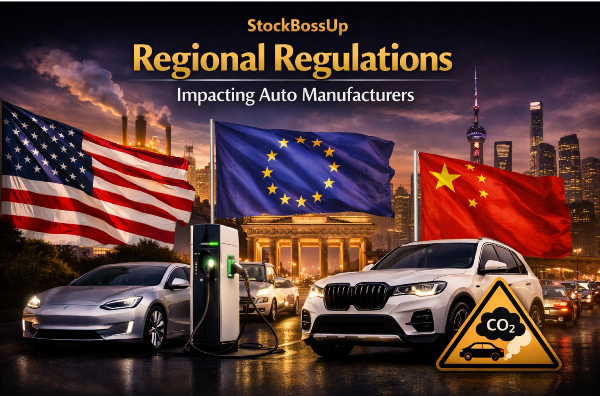
Regional Regulations Impacting Auto Manufacturers: How Laws Shape the Global Car Industry
At first glance, car companies seem like global businesses that sell the same vehicles everywhere. A Toyota in Japan looks similar to a Toyota in the United States. A BMW in Germany looks similar to one in the Middle East.
But that view hides a major problem.
Auto manufacturers do not operate under one set of rules. They operate under dozens of regional regulations that directly shape what cars they can build, how much they cost, and how fast they evolve. These rules often matter more than consumer demand.
Many investors and buyers focus on design or brand strength, but ignore regulation differences. That leads to confusion when vehicles are restricted, redesigned, or phased out in certain markets.
So how deeply do regional regulations actually impact auto manufacturers—and why do they change the entire direction of the industry?
The answer becomes clear only when you look at emissions rules, safety laws, trade restrictions, and electrification mandates across major global markets.
Why Do Regional Regulations Matter So Much in the Auto Industry?
Auto manufacturing is one of the most heavily regulated industries in the world. Every vehicle must meet strict requirements before it can be sold.
Key regulatory areas include:
- Emissions standards
- Safety requirements
- Fuel efficiency rules
- Import and export restrictions
- Electric vehicle adoption mandates
Global automakers such as Toyota Motor Corporation, Volkswagen Group, Ford Motor Company, General Motors, Stellantis, BMW Group, and Mercedes-Benz Group are all forced to adapt continuously.
These companies must constantly redesign vehicles to meet different regional rules. A car approved in one market may require major changes before it can be sold in another.
One overlooked reality is that regulatory compliance costs can account for a significant portion of total vehicle development budgets, even before production begins.
Why Do Emissions Regulations Change Vehicle Design So Much?
Emissions laws are one of the most powerful forces shaping modern car design.
Europe enforces some of the strictest emissions rules in the world. The United States applies fuel economy standards. China enforces emissions limits that vary between national and city levels.
These rules force automakers to:
- Reduce engine size
- Add hybrid systems
- Improve fuel efficiency
- Accelerate electric vehicle development
Volkswagen Group has invested heavily in electric platforms due to strict European emissions targets. Toyota Motor Corporation has leaned heavily on hybrid systems as a transitional solution. Ford Motor Company and General Motors are rapidly shifting toward electrification to meet tightening standards.
A lesser-known detail is that emissions testing methods differ by region, meaning the same engine can produce different official results depending on where it is certified.
How Do Safety Regulations Differ Across Regions?
Safety regulations vary widely between markets, especially in crash testing and pedestrian protection standards.
Common differences include:
- Crash test speed requirements
- Airbag deployment rules
- Pedestrian impact protection design
- Driver assistance system mandates
BMW Group and Mercedes-Benz Group often design vehicles that meet both European and American safety standards, which increases engineering complexity and cost.
| Region |
Safety Focus |
Design Impact |
| United States |
High-speed crash survival |
Larger, stronger vehicle frames |
| Europe |
Pedestrian safety |
Softer front-end designs |
| China |
Urban safety and driver assistance |
Advanced sensor integration |
One surprising regulatory influence is that European pedestrian safety laws have reshaped front-end vehicle designs globally, even in markets without the same rules.
Why Do EV Mandates Reshape Entire Auto Strategies?
Electric vehicle mandates are forcing one of the fastest industry transitions in history.
Europe and China have aggressive EV adoption targets. The United States is increasing incentives and infrastructure support, though at a more gradual pace.
This affects automakers in different ways:
- Toyota Motor Corporation balances hybrids and EV development
- Ford Motor Company invests heavily in electric trucks
- General Motors is shifting toward full EV lineups
- Volkswagen Group is rapidly scaling EV platforms
- Tesla, Inc. continues expanding global production
EV mandates influence:
- Factory investments
- Battery supply chains
- Product development timelines
- Long-term platform design decisions
A key insight is that regulation often forces EV investment before consumer demand fully aligns with it.
How Do Trade Policies Impact Auto Manufacturing Costs?
Trade policies and tariffs significantly affect where vehicles are built and sold.
Automakers adjust production based on:
- Import tariffs
- Local content requirements
- Supply chain restrictions
- Regional tax incentives
Ford Motor Company and General Motors frequently adjust production across North America to optimize cost efficiency. Volkswagen Group manages global production networks to reduce tariff exposure and currency risk.
| Factor |
Impact on Automakers |
| Tariffs |
Increase vehicle cost |
| Local production rules |
Force regional manufacturing |
| Trade agreements |
Enable cost optimization |
| Export restrictions |
Limit market flexibility |
A lesser-known reality is that some vehicles are designed specifically for certain trade regions to avoid tariff penalties, even when they share platforms with global models.
Why Do Regional Fuel Standards Still Matter in a Hybrid World?
Even with EV growth, fuel efficiency rules still strongly influence vehicle design.
The United States uses Corporate Average Fuel Economy standards. Europe regulates CO₂ emissions. China enforces fuel consumption targets that vary by vehicle class.
These rules push automakers to:
- Develop hybrid powertrains
- Reduce engine size
- Improve aerodynamics
- Lower overall vehicle weight
Toyota Motor Corporation has remained a leader in hybrid technology largely because hybrids satisfy multiple regulatory systems at once.
How Do Regulations Affect EV Competition?
EV regulations vary widely across global markets.
China focuses on:
- Rapid EV adoption
- Domestic battery supply chains
- Urban emissions reduction
Europe focuses on:
- Strict emissions deadlines
- Environmental policy alignment
- Charging infrastructure expansion
The United States focuses on:
- Market-driven adoption
- Incentive-based EV growth
- Gradual infrastructure scaling
These differences shape how companies like Tesla, Inc. expand globally.
A unique insight is that in some Chinese cities, restrictions on gas-powered license plates have accelerated EV adoption faster than direct subsidies.
Why Do Regulations Create Uneven Global Competition?
Not all automakers face the same regulatory pressure.
European automakers often face the strictest emissions requirements. U.S. automakers face shifting policy cycles. Asian automakers operate under mixed hybrid and EV-focused frameworks.
| Region |
Regulatory Pressure |
Industry Effect |
| Europe |
Very high |
Rapid EV transition |
| United States |
Moderate |
Mixed adoption pace |
| China |
High |
Fast EV scaling |
| Japan |
Moderate |
Hybrid leadership |
This uneven pressure creates different speeds of innovation across global markets.
Why Do Regulations Increase Development Costs?
Every new regulation adds engineering complexity and cost.
Costs rise due to:
- Engine redesign requirements
- New safety system integration
- Multi-region testing
- Certification processes
Mercedes-Benz Group and BMW Group often build region-specific versions of vehicles to comply with different standards, increasing development costs but ensuring global market access.
How Do Regulations Shape Long-Term Industry Direction?
Regulations often determine the long-term direction of the auto industry more than consumer preference.
Examples include:
- Hybrid adoption driven by emissions limits
- EV acceleration driven by policy mandates
- Safety improvements driven by crash testing laws
One important reality is that regulatory change often forces innovation ahead of consumer demand.
Why Do Some Automakers Adapt Better to Regulations?
Automakers that succeed in highly regulated environments tend to:
- Diversify powertrain options
- Invest early in compliance technology
- Maintain flexible global production systems
Toyota Motor Corporation has historically benefited from hybrid systems that satisfy multiple regulatory environments. Volkswagen Group has responded with large-scale EV investment to align with European policy shifts.
Final Answer: Why Regional Regulations Matter More Than Most People Realize
Regional regulations are one of the most powerful forces shaping the global auto industry.
Companies such as Toyota Motor Corporation, Ford Motor Company, Volkswagen Group, General Motors, BMW Group, and Mercedes-Benz Group must constantly adjust to emissions rules, safety standards, trade policies, and electrification mandates.
The surprising reality is that many vehicles are not designed primarily around consumer preference. They are designed around regulatory compliance across multiple regions.
In the end, the auto industry is not just competing on innovation or branding. It is competing on how well it can adapt to constantly changing rules around the world.










🔑 Key Takeaways: Regional Regulations Impacting Auto Manufacturers
🌍 Global auto manufacturers must constantly adapt to different regional regulations
Automakers like Toyota Motor Corporation, Volkswagen Group, Ford Motor Company, and General Motors must design vehicles that comply with different emissions, safety, and trade rules in each market. A car approved in one region often requires redesigns to be sold in another, making regulation a core driver of global auto strategy.
🚗 Emissions and EV mandates are reshaping the entire automotive industry
Strict emissions standards in Europe, fuel economy rules in the U.S., and aggressive EV policies in China are forcing automakers to shift toward hybrids and electric vehicles. These regulations are accelerating industry-wide electrification faster than consumer demand alone would dictate.
⚖️ Safety and trade laws significantly increase vehicle development costs
Crash testing standards, pedestrian safety rules, and regional trade policies add major engineering and production costs. Companies like BMW Group and Mercedes-Benz Group often build region-specific models to meet compliance requirements, increasing complexity but ensuring global market access.
📊 Regulation differences create uneven global competition across auto stocks
European automakers face stricter emissions rules, Chinese automakers face rapid EV mandates, and U.S. automakers experience more policy shifts. This uneven regulatory pressure leads to different speeds of innovation, profitability, and electrification across global auto manufacturers.
Regional Regulations Impacting Auto Manufacturers: How Laws Shape the Global Car Industry
At first glance, car companies seem like global businesses that sell the same vehicles everywhere. A Toyota in Japan looks similar to a Toyota in the United States. A BMW in Germany looks similar to one in the Middle East.
But that view hides a major problem.
Auto manufacturers do not operate under one set of rules. They operate under dozens of regional regulations that directly shape what cars they can build, how much they cost, and how fast they evolve. These rules often matter more than consumer demand.
Many investors and buyers focus on design or brand strength, but ignore regulation differences. That leads to confusion when vehicles are restricted, redesigned, or phased out in certain markets.
So how deeply do regional regulations actually impact auto manufacturers—and why do they change the entire direction of the industry?
The answer becomes clear only when you look at emissions rules, safety laws, trade restrictions, and electrification mandates across major global markets.
Why Do Regional Regulations Matter So Much in the Auto Industry?
Auto manufacturing is one of the most heavily regulated industries in the world. Every vehicle must meet strict requirements before it can be sold.
Key regulatory areas include:
Global automakers such as Toyota Motor Corporation, Volkswagen Group, Ford Motor Company, General Motors, Stellantis, BMW Group, and Mercedes-Benz Group are all forced to adapt continuously.
These companies must constantly redesign vehicles to meet different regional rules. A car approved in one market may require major changes before it can be sold in another.
One overlooked reality is that regulatory compliance costs can account for a significant portion of total vehicle development budgets, even before production begins.
Why Do Emissions Regulations Change Vehicle Design So Much?
Emissions laws are one of the most powerful forces shaping modern car design.
Europe enforces some of the strictest emissions rules in the world. The United States applies fuel economy standards. China enforces emissions limits that vary between national and city levels.
These rules force automakers to:
Volkswagen Group has invested heavily in electric platforms due to strict European emissions targets. Toyota Motor Corporation has leaned heavily on hybrid systems as a transitional solution. Ford Motor Company and General Motors are rapidly shifting toward electrification to meet tightening standards.
A lesser-known detail is that emissions testing methods differ by region, meaning the same engine can produce different official results depending on where it is certified.
How Do Safety Regulations Differ Across Regions?
Safety regulations vary widely between markets, especially in crash testing and pedestrian protection standards.
Common differences include:
BMW Group and Mercedes-Benz Group often design vehicles that meet both European and American safety standards, which increases engineering complexity and cost.
One surprising regulatory influence is that European pedestrian safety laws have reshaped front-end vehicle designs globally, even in markets without the same rules.
Why Do EV Mandates Reshape Entire Auto Strategies?
Electric vehicle mandates are forcing one of the fastest industry transitions in history.
Europe and China have aggressive EV adoption targets. The United States is increasing incentives and infrastructure support, though at a more gradual pace.
This affects automakers in different ways:
EV mandates influence:
A key insight is that regulation often forces EV investment before consumer demand fully aligns with it.
How Do Trade Policies Impact Auto Manufacturing Costs?
Trade policies and tariffs significantly affect where vehicles are built and sold.
Automakers adjust production based on:
Ford Motor Company and General Motors frequently adjust production across North America to optimize cost efficiency. Volkswagen Group manages global production networks to reduce tariff exposure and currency risk.
A lesser-known reality is that some vehicles are designed specifically for certain trade regions to avoid tariff penalties, even when they share platforms with global models.
Why Do Regional Fuel Standards Still Matter in a Hybrid World?
Even with EV growth, fuel efficiency rules still strongly influence vehicle design.
The United States uses Corporate Average Fuel Economy standards. Europe regulates CO₂ emissions. China enforces fuel consumption targets that vary by vehicle class.
These rules push automakers to:
Toyota Motor Corporation has remained a leader in hybrid technology largely because hybrids satisfy multiple regulatory systems at once.
How Do Regulations Affect EV Competition?
EV regulations vary widely across global markets.
China focuses on:
Europe focuses on:
The United States focuses on:
These differences shape how companies like Tesla, Inc. expand globally.
A unique insight is that in some Chinese cities, restrictions on gas-powered license plates have accelerated EV adoption faster than direct subsidies.
Why Do Regulations Create Uneven Global Competition?
Not all automakers face the same regulatory pressure.
European automakers often face the strictest emissions requirements. U.S. automakers face shifting policy cycles. Asian automakers operate under mixed hybrid and EV-focused frameworks.
This uneven pressure creates different speeds of innovation across global markets.
Why Do Regulations Increase Development Costs?
Every new regulation adds engineering complexity and cost.
Costs rise due to:
Mercedes-Benz Group and BMW Group often build region-specific versions of vehicles to comply with different standards, increasing development costs but ensuring global market access.
How Do Regulations Shape Long-Term Industry Direction?
Regulations often determine the long-term direction of the auto industry more than consumer preference.
Examples include:
One important reality is that regulatory change often forces innovation ahead of consumer demand.
Why Do Some Automakers Adapt Better to Regulations?
Automakers that succeed in highly regulated environments tend to:
Toyota Motor Corporation has historically benefited from hybrid systems that satisfy multiple regulatory environments. Volkswagen Group has responded with large-scale EV investment to align with European policy shifts.
Final Answer: Why Regional Regulations Matter More Than Most People Realize
Regional regulations are one of the most powerful forces shaping the global auto industry.
Companies such as Toyota Motor Corporation, Ford Motor Company, Volkswagen Group, General Motors, BMW Group, and Mercedes-Benz Group must constantly adjust to emissions rules, safety standards, trade policies, and electrification mandates.
The surprising reality is that many vehicles are not designed primarily around consumer preference. They are designed around regulatory compliance across multiple regions.
In the end, the auto industry is not just competing on innovation or branding. It is competing on how well it can adapt to constantly changing rules around the world.