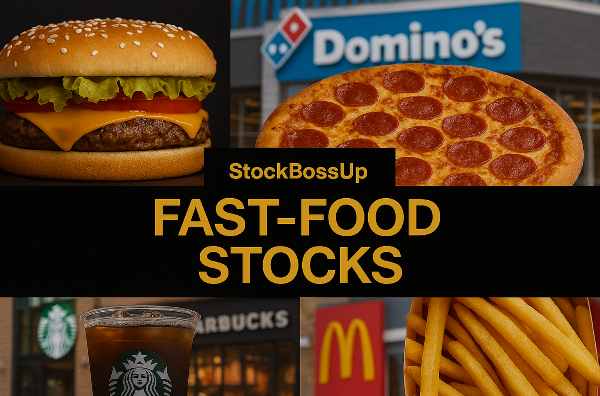
Fast-food stocks are more than just burger chains and coffee shops — they’re a global investment engine built on convenience, brand power, and operational efficiency. Whether you're tracking giants like McDonald’s and Starbucks or scouting high-growth players like Wingstop and CAVA, fast food stocks offers a rare blend of stability and upside.
🍔 Every Fast Food Stock You can Buy on the NYSE and NASDAQ
| Company |
Ticker |
Why It’s Relevant |
Market‑Cap Tier |
| McDonald’s |
MCD |
Largest global fast‑food chain |
Large‑Cap |
| Starbucks |
SBUX |
Global coffee QSR |
Large‑Cap |
| Restaurant Brands International (Burger King, Popeyes, Tim Hortons) |
QSR |
Major global QSR franchisor |
Large‑Cap |
| Yum! Brands (KFC, Taco Bell, Pizza Hut) |
YUM |
Global QSR operator |
Large‑Cap |
| Yum China |
YUMC |
KFC/Taco Bell operator in China |
Large‑Cap |
| Chipotle |
CMG |
Fast‑casual leader |
Large‑Cap |
| Domino’s Pizza |
DPZ |
Largest pizza delivery chain |
Large‑Cap |
| Wingstop |
WING |
High‑growth chicken wing QSR |
Mid‑Cap |
| CAVA Group |
CAVA |
Fast‑casual Mediterranean chain |
Mid‑Cap |
| Dutch Bros |
BROS |
Drive‑thru coffee QSR |
Mid‑Cap |
| Shake Shack |
SHAK |
Premium fast‑casual burger chain |
Mid‑Cap |
| Arcos Dorados |
ARCO |
Largest McDonald’s franchisee in Latin America |
Mid‑Cap |
| Wendy’s |
WEN |
Major U.S. burger QSR |
Small‑Cap |
| Papa John’s |
PZZA |
Major pizza delivery chain |
Small‑Cap |
| Carrols Restaurant Group |
TAST |
Largest U.S. Burger King franchisee |
Small‑Cap |
| Biglari Holdings (Steak ’n Shake) |
BH |
Owns Steak ’n Shake |
Small‑Cap |
| Ark Restaurants |
ARKR |
Operates fast‑casual & QSR concepts |
Small‑Cap |
| Bojangles’ |
NA |
Regional chicken & biscuits QSR (Acquired) |
Small‑Cap |
| Jack in the Box |
JACK |
Acquired Del Taco, a QSR Mexican chain |
Small‑Cap |
| Hamilton Beach Brands |
HBB |
Included in fast‑food stock screeners (equipment supplier) |
Small‑Cap |
| Farmer Brothers |
FARM |
Coffee supplier to QSR chains |
Small‑Cap |
| Cal‑Maine Foods |
CALM |
Egg supplier to QSR chains |
Mid‑Cap |
Quick Fact: QSR stands for "Quick Service Restaurant". It is also the stock ticker for Restaurant Brands International, who runs Burger King, Popeyes, and other quick service brands
🍔 Fast‑Food Stocks: How the QSR Industry Became One of the Market’s Most Resilient Performers
Fast‑food stocks have quietly become one of the most durable and strategically important corners of the restaurant sector and stock market as a whole. While technology and biotech tend to dominate headlines, the quick‑service restaurant (QSR) industry continues to deliver something investors crave even more than hype: predictable cash flow, global brand power, and steady long‑term growth.
From global giants like McDonald’s and Starbucks to fast‑casual disruptors like Chipotle and CAVA, the fast‑food sector offers a rare blend of stability and innovation. And with the rise of digital ordering, loyalty programs, and delivery platforms, the industry is evolving faster than ever.
This article lays the groundwork for comparing and rating fast‑food stocks against one another. We’ll explore what makes the sector unique, how different companies compete, and why market‑cap tiers matter when evaluating long‑term potential. At the end, you’ll find a special section explaining three unique tickers—CALM, FARM, and HBB—and why they appear in fast‑food stock lists despite not being restaurant operators.
🍟 Why Fast‑Food Stocks Stand Out
Fast‑food companies operate in a rare sweet spot between consumer staples and consumer discretionary. People don’t need fast food, but they behave as if they do. Even during recessions, consumers continue to buy burgers, pizza, coffee, and chicken because the price point is low and the convenience is unmatched.
This creates a powerful combination:
- High brand loyalty
- Consistent demand across economic cycles
- Strong franchise economics
- Global expansion opportunities
- Recurring revenue from digital ordering and loyalty programs
The result is a sector that tends to outperform during downturns while still offering growth during expansions.
🍕 The Big Players: Large‑Cap Fast‑Food Stocks
Large‑cap fast‑food companies dominate the global landscape. These brands benefit from scale, supply‑chain efficiency, and massive marketing budgets. They also tend to have strong dividend histories and predictable earnings.
McDonald’s (MCD) remains the gold standard. Its franchise model generates high-margin revenue, and its global footprint gives it unmatched stability. Starbucks (SBUX) has become the world’s most successful coffee chain, with a digital ecosystem that rivals top tech companies. Restaurant Brands International (QSR) and Yum! Brands (YUM) control some of the most iconic fast‑food brands on the planet, from Burger King to Taco Bell.
Chipotle (CMG) is the standout fast‑casual giant, proving that premium ingredients and higher price points can still scale globally. Domino’s (DPZ) continues to dominate pizza delivery through technology, logistics, and operational consistency.
These companies form the backbone of the fast‑food investment universe. They are stable, widely followed, and often serve as benchmarks for the rest of the industry.
🥙 The Growth Engines: Mid‑Cap Fast‑Food Stocks
Mid‑cap fast‑food companies offer a compelling mix of stability and growth. They’re large enough to be established but small enough to expand rapidly.
Wingstop (WING) is one of the fastest‑growing restaurant chains in America, driven by a simple menu and a highly efficient franchise model. CAVA Group (CAVA) is the newest fast‑casual star, bringing Mediterranean cuisine into the mainstream. Dutch Bros (BROS) is building a cult following with its drive‑thru coffee model, while Shake Shack (SHAK) continues to expand its premium burger concept.
Arcos Dorados (ARCO) is a unique mid‑cap because it operates McDonald’s restaurants across Latin America. It’s not a brand owner—it’s a franchise powerhouse. That makes it a strategic way to gain exposure to emerging‑market consumer growth through a proven QSR model.
Mid‑caps tend to be more volatile than large‑caps, but they also offer more upside. For investors seeking growth, this tier is where the action is.
🍗 The Underdogs: Small‑Cap Fast‑Food Stocks
Small‑cap fast‑food companies are often overlooked, but they can be some of the most interesting opportunities. They include regional chains, franchise groups, and niche operators.
Wendy’s (WEN) and Papa John’s (PZZA) are the most recognizable names in this tier. Both have strong brand recognition but operate at a smaller scale than the mega‑caps. Carrols Restaurant Group (TAST) is the largest Burger King franchisee in the U.S., giving investors a unique way to gain exposure to the Burger King system without owning QSR.
Biglari Holdings (BH) owns Steak ’n Shake, a once‑iconic brand undergoing a long‑term turnaround. Ark Restaurants (ARKR) operates a mix of fast‑casual and QSR concepts, while Bojangles’ (BOJA) and Del Taco (TACO) offer regional flavor with loyal customer bases.
Sonic (SONC) remains a recognizable drive‑in brand, and Hamilton Beach Brands (HBB) appears in fast‑food stock lists because of its deep ties to restaurant equipment.
Small‑caps tend to be more sensitive to economic conditions, but they also offer the highest potential for re‑rating if a turnaround succeeds or expansion accelerates.
📊 Why Market‑Cap Tiers Matter for Rating Fast‑Food Stocks
When comparing fast‑food companies, market‑cap tiers help frame expectations:
Large‑Caps
- Lower risk
- Strong dividends
- Global scale
- Slower but steady growth
Mid‑Caps
- Balanced risk
- Faster expansion
- Strong unit economics
- Potential to graduate into large‑cap status
Small‑Caps
- Higher volatility
- Regional concentration
- Turnaround potential
- Opportunity for outsized gains
🧩 Why CALM, FARM, and HBB Appear in Fast‑Food Stock Lists
These three companies are not restaurant operators, yet they we added them to our fast‑food list. Here’s why they matter.
🥚 Cal‑Maine Foods (CALM)
Category: Mid‑Cap
Relevance: Largest egg supplier in the United States
Cal‑Maine Foods is the backbone of the American breakfast supply chain. Many fast‑food chains—from McDonald’s to Dunkin’—depend on eggs for breakfast sandwiches, wraps, and bowls. CALM’s pricing power and production scale make it a strategic supplier to the QSR industry. When egg prices spike, fast‑food margins feel it. That makes CALM a critical upstream player in the fast‑food ecosystem.
☕ Farmer Brothers (FARM)
Category: Small‑Cap
Relevance: Coffee supplier to QSR chains
Farmer Brothers is a major wholesale coffee roaster and distributor. It supplies coffee to restaurants, convenience stores, and foodservice operators—including many fast‑food chains. As coffee remains one of the highest‑margin items in QSR, FARM plays a quiet but essential role in keeping beverage programs running smoothly.
⚙️ Hamilton Beach Brands (HBB)
Category: Small‑Cap
Relevance: Equipment supplier used in fast‑food operations
Hamilton Beach manufactures commercial blenders, mixers, and food‑prep equipment widely used in fast‑food kitchens. While it’s not a restaurant operator, its products are embedded in the daily operations of smoothie shops, coffee chains, and QSR kitchens. Its inclusion in fast‑food stock lists reflects its importance to the industry’s infrastructure.
Final Thoughts
Fast-food stocks offer a rare combination of brand power, operational efficiency, and consumer resilience. Whether you're investing in global giants or scouting high-growth regional players, the QSR sector provides a rich landscape for strategic analysis and long-term positioning. As we move forward with rating these companies, understanding their market-cap tiers, business models, and supply chain dependencies will be key to separating the leaders from the laggards. And for investors looking beyond the storefront, companies like CALM, FARM, and HBB remind us that the fast-food ecosystem extends far beyond the counter — into the suppliers, roasters, and equipment makers that keep the industry running.
🔥 Read More: Explore Restaurant Stock Battles

Fast-food stocks are more than just burger chains and coffee shops — they’re a global investment engine built on convenience, brand power, and operational efficiency. Whether you're tracking giants like McDonald’s and Starbucks or scouting high-growth players like Wingstop and CAVA, fast food stocks offers a rare blend of stability and upside.
🍔 Every Fast Food Stock You can Buy on the NYSE and NASDAQ
🍔 Fast‑Food Stocks: How the QSR Industry Became One of the Market’s Most Resilient Performers
Fast‑food stocks have quietly become one of the most durable and strategically important corners of the restaurant sector and stock market as a whole. While technology and biotech tend to dominate headlines, the quick‑service restaurant (QSR) industry continues to deliver something investors crave even more than hype: predictable cash flow, global brand power, and steady long‑term growth.
From global giants like McDonald’s and Starbucks to fast‑casual disruptors like Chipotle and CAVA, the fast‑food sector offers a rare blend of stability and innovation. And with the rise of digital ordering, loyalty programs, and delivery platforms, the industry is evolving faster than ever.
This article lays the groundwork for comparing and rating fast‑food stocks against one another. We’ll explore what makes the sector unique, how different companies compete, and why market‑cap tiers matter when evaluating long‑term potential. At the end, you’ll find a special section explaining three unique tickers—CALM, FARM, and HBB—and why they appear in fast‑food stock lists despite not being restaurant operators.
🍟 Why Fast‑Food Stocks Stand Out
Fast‑food companies operate in a rare sweet spot between consumer staples and consumer discretionary. People don’t need fast food, but they behave as if they do. Even during recessions, consumers continue to buy burgers, pizza, coffee, and chicken because the price point is low and the convenience is unmatched.
This creates a powerful combination:
The result is a sector that tends to outperform during downturns while still offering growth during expansions.
🍕 The Big Players: Large‑Cap Fast‑Food Stocks
Large‑cap fast‑food companies dominate the global landscape. These brands benefit from scale, supply‑chain efficiency, and massive marketing budgets. They also tend to have strong dividend histories and predictable earnings.
McDonald’s (MCD) remains the gold standard. Its franchise model generates high-margin revenue, and its global footprint gives it unmatched stability. Starbucks (SBUX) has become the world’s most successful coffee chain, with a digital ecosystem that rivals top tech companies. Restaurant Brands International (QSR) and Yum! Brands (YUM) control some of the most iconic fast‑food brands on the planet, from Burger King to Taco Bell.
Chipotle (CMG) is the standout fast‑casual giant, proving that premium ingredients and higher price points can still scale globally. Domino’s (DPZ) continues to dominate pizza delivery through technology, logistics, and operational consistency.
These companies form the backbone of the fast‑food investment universe. They are stable, widely followed, and often serve as benchmarks for the rest of the industry.
🥙 The Growth Engines: Mid‑Cap Fast‑Food Stocks
Mid‑cap fast‑food companies offer a compelling mix of stability and growth. They’re large enough to be established but small enough to expand rapidly.
Wingstop (WING) is one of the fastest‑growing restaurant chains in America, driven by a simple menu and a highly efficient franchise model. CAVA Group (CAVA) is the newest fast‑casual star, bringing Mediterranean cuisine into the mainstream. Dutch Bros (BROS) is building a cult following with its drive‑thru coffee model, while Shake Shack (SHAK) continues to expand its premium burger concept.
Arcos Dorados (ARCO) is a unique mid‑cap because it operates McDonald’s restaurants across Latin America. It’s not a brand owner—it’s a franchise powerhouse. That makes it a strategic way to gain exposure to emerging‑market consumer growth through a proven QSR model.
Mid‑caps tend to be more volatile than large‑caps, but they also offer more upside. For investors seeking growth, this tier is where the action is.
🍗 The Underdogs: Small‑Cap Fast‑Food Stocks
Small‑cap fast‑food companies are often overlooked, but they can be some of the most interesting opportunities. They include regional chains, franchise groups, and niche operators.
Wendy’s (WEN) and Papa John’s (PZZA) are the most recognizable names in this tier. Both have strong brand recognition but operate at a smaller scale than the mega‑caps. Carrols Restaurant Group (TAST) is the largest Burger King franchisee in the U.S., giving investors a unique way to gain exposure to the Burger King system without owning QSR.
Biglari Holdings (BH) owns Steak ’n Shake, a once‑iconic brand undergoing a long‑term turnaround. Ark Restaurants (ARKR) operates a mix of fast‑casual and QSR concepts, while Bojangles’ (BOJA) and Del Taco (TACO) offer regional flavor with loyal customer bases.
Sonic (SONC) remains a recognizable drive‑in brand, and Hamilton Beach Brands (HBB) appears in fast‑food stock lists because of its deep ties to restaurant equipment.
Small‑caps tend to be more sensitive to economic conditions, but they also offer the highest potential for re‑rating if a turnaround succeeds or expansion accelerates.
📊 Why Market‑Cap Tiers Matter for Rating Fast‑Food Stocks
When comparing fast‑food companies, market‑cap tiers help frame expectations:
Large‑Caps
Mid‑Caps
Small‑Caps
🧩 Why CALM, FARM, and HBB Appear in Fast‑Food Stock Lists
These three companies are not restaurant operators, yet they we added them to our fast‑food list. Here’s why they matter.
🥚 Cal‑Maine Foods (CALM)
Category: Mid‑Cap
Relevance: Largest egg supplier in the United States
Cal‑Maine Foods is the backbone of the American breakfast supply chain. Many fast‑food chains—from McDonald’s to Dunkin’—depend on eggs for breakfast sandwiches, wraps, and bowls. CALM’s pricing power and production scale make it a strategic supplier to the QSR industry. When egg prices spike, fast‑food margins feel it. That makes CALM a critical upstream player in the fast‑food ecosystem.
☕ Farmer Brothers (FARM)
Category: Small‑Cap
Relevance: Coffee supplier to QSR chains
Farmer Brothers is a major wholesale coffee roaster and distributor. It supplies coffee to restaurants, convenience stores, and foodservice operators—including many fast‑food chains. As coffee remains one of the highest‑margin items in QSR, FARM plays a quiet but essential role in keeping beverage programs running smoothly.
⚙️ Hamilton Beach Brands (HBB)
Category: Small‑Cap
Relevance: Equipment supplier used in fast‑food operations
Hamilton Beach manufactures commercial blenders, mixers, and food‑prep equipment widely used in fast‑food kitchens. While it’s not a restaurant operator, its products are embedded in the daily operations of smoothie shops, coffee chains, and QSR kitchens. Its inclusion in fast‑food stock lists reflects its importance to the industry’s infrastructure.
Final Thoughts
Fast-food stocks offer a rare combination of brand power, operational efficiency, and consumer resilience. Whether you're investing in global giants or scouting high-growth regional players, the QSR sector provides a rich landscape for strategic analysis and long-term positioning. As we move forward with rating these companies, understanding their market-cap tiers, business models, and supply chain dependencies will be key to separating the leaders from the laggards. And for investors looking beyond the storefront, companies like CALM, FARM, and HBB remind us that the fast-food ecosystem extends far beyond the counter — into the suppliers, roasters, and equipment makers that keep the industry running.
🔥 Read More: Explore Restaurant Stock Battles