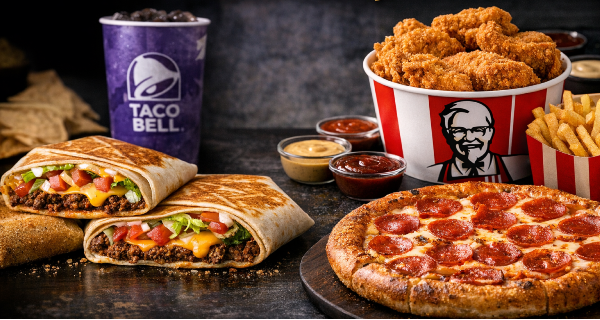
Yum Brands has always lived in a unique corner of the restaurant universe. When the company is firing on all cylinders, the market rewards it with a premium valuation. That premium historically came from two pillars: consistent global unit growth through franchising and strong same‑store sales driven by brand momentum at Taco Bell and KFC. Those were the years when the model looked unstoppable — steady EPS growth, asset‑light economics, and predictable cash generation.
But the mistake investors often make is assuming that premium status is permanent. Yum’s valuation compresses quickly when comps soften or when one brand — usually Pizza Hut — drags down confidence. That’s the tension investors must manage today.
Right now, the stock trades around $165, hovering near an all‑time high. That alone tells you the market is pricing Yum like a high‑confidence compounder. The expectation is clear: continued execution, continued consistency, and continued global expansion.
Recent results support part of that narrative. Worldwide same‑store sales grew roughly 3%, beating expectations and reinforcing the idea that Yum’s brands still have momentum. But the quarter also missed EPS estimates slightly, a reminder that even strong global franchisers can have noisy periods. The real engine behind the stock strength is the company’s execution of its core playbook — digital scaling, international expansion, and franchise‑driven unit growth.
Valuation Snapshot
Below is a simple view of the valuation framework referenced in the analysis:
| Metric |
Value |
| Current Share Price |
~$165 |
| Fair Value Band |
~15x earnings |
| Normal/Premium Band |
~24x earnings |
| Same‑Store Sales (Latest Quarter) |
~3% growth |
| Digital Mix |
Approaching 60% |
The current price sitting so far above the conservative fair‑value band signals that the market is paying for durability, brand strength, and the asset‑light model. But it also means the stock is more sensitive to disappointment. When a company trades near its premium band, downside often comes from multiple compression rather than earnings deterioration.
The upside case is straightforward. If Yum maintains mid‑single‑digit system sales growth through new units and steady comps, and if digital continues to lift frequency, EPS can compound enough to justify today’s valuation. Taco Bell remains the standout engine, and KFC’s international expansion continues to be a major contributor.
But the swing factor is Pizza Hut. Even with strong results from Taco Bell and KFC, persistent Pizza Hut weakness caps the long‑term narrative. Recent reporting suggests Yum is exploring strategic alternatives for the brand — a sign that management knows exactly where the drag is coming from.
If execution stays clean, the premium multiple holds. If comps soften or portfolio issues reemerge, the reset can be fast.
Key Risks Heading Into 2026
For a premium‑valued global franchiser, the biggest risk isn’t collapse — it’s subtle deterioration. Small cracks in comps or franchise economics can trigger a valuation reset long before earnings actually decline.
The most immediate risk is consumer trade‑down. While Yum’s brands tend to hold up better than many restaurant peers, a stretched consumer can still reduce frequency or shift toward lower‑priced items. The system may still grow, but the quality of that growth weakens, and the market stops paying a premium.
Pizza Hut remains the chronic weak link. If it continues to underperform in key markets, it drags on investor confidence even when Taco Bell and KFC are strong. Yum can’t fully escape that narrative until Pizza Hut becomes neutral or improves.
Competitive intensity is another major factor. QSR is a brutal arena. Pricing power never lasts forever, and if peers ramp up promotions or value menus, Yum’s brands may need to respond. That pressures franchisee margins and reduces the operating leverage investors expect.
Risk Overview Table
| Risk Category |
Description |
| Consumer Trade‑Down |
Traffic softness and value‑seeking behavior |
| Pizza Hut Underperformance |
Persistent drag on portfolio confidence |
| Competitive Pressure |
Promotions and value menus reducing margins |
| International Exposure |
Macro swings in major markets like China |
| Franchisee Health |
Rising labor, rent, or food costs |
| Delivery Economics |
Complexity and profitability challenges |
| Valuation Risk |
Premium multiple vulnerable to comp softness |
International exposure is especially meaningful. KFC has massive global reach, and results can swing with local macro conditions. China is a major variable — any slowdown in demand or shift in consumer behavior can hit comps and slow unit momentum.
Franchisee health also matters. Yum is asset‑light, but the system depends on franchisee returns. If costs rise faster than sales, franchisees become cautious, slowing new unit development and remodels.
Finally, valuation risk is real. When a stock is priced like a high‑confidence compounder, even mild disappointment can compress the multiple quickly.
Opportunities: The Case for Long‑Term Compounding
Despite the risks, the opportunity set for Yum remains compelling. The company doesn’t need explosive growth to win — it needs consistency. Consistent comps, steady unit expansion, and digital scaling are enough to drive attractive long‑term returns.
In the near term, traffic stabilization through value and innovation is a major lever. Taco Bell, in particular, has a long history of outperforming during cautious consumer cycles thanks to creative menu innovation and strong value platforms. If traffic holds and mix improves, the royalty model produces clean, predictable earnings growth.
KFC’s international momentum is another powerful engine. It is one of the most scalable QSR brands globally, and even modest same‑store sales growth combined with unit expansion can compound system sales meaningfully.
Digital and loyalty remain major opportunities. With digital mix approaching 60%, Yum is building a more personalized, data‑driven ecosystem. Higher frequency, better forecasting, and improved ticket sizes all flow naturally from digital adoption.
Opportunity Snapshot
| Opportunity |
Impact |
| Value + Innovation |
Supports traffic in cautious environments |
| KFC International |
Large, diversified global growth engine |
| Digital Scaling |
Higher frequency and better personalization |
| Delivery Optimization |
Potential shift from cost center to profit driver |
| Pizza Hut Stabilization |
Removes a major narrative overhang |
| Global Unit Expansion |
Long runway in emerging markets |
| Tech‑Led Productivity |
Higher throughput and better margins |
Delivery is a swing factor. If Yum improves delivery economics — better batching, fewer refunds, smarter fees — the channel can shift from a necessary cost to a profitable growth driver.
Longer term, global unit expansion is the crown jewel. Emerging markets such as India, Southeast Asia, the Middle East, and Latin America offer long runways for growth as incomes rise and QSR penetration increases.
Tech‑led productivity, AI‑driven marketing, and ongoing buybacks and dividends round out the long‑term compounding story.
Analyst Sentiment: A Hold‑Heavy Consensus
Analyst ratings paint a clear picture of how Wall Street views Yum today. The breakdown is:
- 2 strong buys
- 10 buys
- 17 holds
- 0 sells
Sentiment is moderately positive but dominated by holds. Analysts generally agree that Yum is a high‑quality compounder with strong brands, a powerful franchise model, and global scale. But many also believe the stock is closer to fairly valued after its run‑up.
The absence of sells is notable. It signals that analysts don’t view Yum as structurally broken. The debate is about valuation and near‑term upside, not business quality.
Final Verdict: Buy, Hold, or Sell?
Based strictly on the data and narrative presented:
Yum Brands is a HOLD.
The business is strong, the model is durable, and the long‑term compounding engine is intact. But at ~$165 and trading near a premium valuation band, the stock requires clean execution and steady comps to justify further upside. Until Pizza Hut stabilizes and valuation becomes more attractive, the risk‑reward skews toward holding rather than aggressively buying.
If execution remains strong, the stock can continue compounding. If comps soften or portfolio issues reappear, the multiple can reset quickly.
https://youtu.be/oP7rp8I-e8s?si=CGoo0uVkBnXF8Zrj











Yum Brands has always lived in a unique corner of the restaurant universe. When the company is firing on all cylinders, the market rewards it with a premium valuation. That premium historically came from two pillars: consistent global unit growth through franchising and strong same‑store sales driven by brand momentum at Taco Bell and KFC. Those were the years when the model looked unstoppable — steady EPS growth, asset‑light economics, and predictable cash generation.
But the mistake investors often make is assuming that premium status is permanent. Yum’s valuation compresses quickly when comps soften or when one brand — usually Pizza Hut — drags down confidence. That’s the tension investors must manage today.
Right now, the stock trades around $165, hovering near an all‑time high. That alone tells you the market is pricing Yum like a high‑confidence compounder. The expectation is clear: continued execution, continued consistency, and continued global expansion.
Recent results support part of that narrative. Worldwide same‑store sales grew roughly 3%, beating expectations and reinforcing the idea that Yum’s brands still have momentum. But the quarter also missed EPS estimates slightly, a reminder that even strong global franchisers can have noisy periods. The real engine behind the stock strength is the company’s execution of its core playbook — digital scaling, international expansion, and franchise‑driven unit growth.
Valuation Snapshot
Below is a simple view of the valuation framework referenced in the analysis:
The current price sitting so far above the conservative fair‑value band signals that the market is paying for durability, brand strength, and the asset‑light model. But it also means the stock is more sensitive to disappointment. When a company trades near its premium band, downside often comes from multiple compression rather than earnings deterioration.
The upside case is straightforward. If Yum maintains mid‑single‑digit system sales growth through new units and steady comps, and if digital continues to lift frequency, EPS can compound enough to justify today’s valuation. Taco Bell remains the standout engine, and KFC’s international expansion continues to be a major contributor.
But the swing factor is Pizza Hut. Even with strong results from Taco Bell and KFC, persistent Pizza Hut weakness caps the long‑term narrative. Recent reporting suggests Yum is exploring strategic alternatives for the brand — a sign that management knows exactly where the drag is coming from.
If execution stays clean, the premium multiple holds. If comps soften or portfolio issues reemerge, the reset can be fast.
Key Risks Heading Into 2026
For a premium‑valued global franchiser, the biggest risk isn’t collapse — it’s subtle deterioration. Small cracks in comps or franchise economics can trigger a valuation reset long before earnings actually decline.
The most immediate risk is consumer trade‑down. While Yum’s brands tend to hold up better than many restaurant peers, a stretched consumer can still reduce frequency or shift toward lower‑priced items. The system may still grow, but the quality of that growth weakens, and the market stops paying a premium.
Pizza Hut remains the chronic weak link. If it continues to underperform in key markets, it drags on investor confidence even when Taco Bell and KFC are strong. Yum can’t fully escape that narrative until Pizza Hut becomes neutral or improves.
Competitive intensity is another major factor. QSR is a brutal arena. Pricing power never lasts forever, and if peers ramp up promotions or value menus, Yum’s brands may need to respond. That pressures franchisee margins and reduces the operating leverage investors expect.
Risk Overview Table
International exposure is especially meaningful. KFC has massive global reach, and results can swing with local macro conditions. China is a major variable — any slowdown in demand or shift in consumer behavior can hit comps and slow unit momentum.
Franchisee health also matters. Yum is asset‑light, but the system depends on franchisee returns. If costs rise faster than sales, franchisees become cautious, slowing new unit development and remodels.
Finally, valuation risk is real. When a stock is priced like a high‑confidence compounder, even mild disappointment can compress the multiple quickly.
Opportunities: The Case for Long‑Term Compounding
Despite the risks, the opportunity set for Yum remains compelling. The company doesn’t need explosive growth to win — it needs consistency. Consistent comps, steady unit expansion, and digital scaling are enough to drive attractive long‑term returns.
In the near term, traffic stabilization through value and innovation is a major lever. Taco Bell, in particular, has a long history of outperforming during cautious consumer cycles thanks to creative menu innovation and strong value platforms. If traffic holds and mix improves, the royalty model produces clean, predictable earnings growth.
KFC’s international momentum is another powerful engine. It is one of the most scalable QSR brands globally, and even modest same‑store sales growth combined with unit expansion can compound system sales meaningfully.
Digital and loyalty remain major opportunities. With digital mix approaching 60%, Yum is building a more personalized, data‑driven ecosystem. Higher frequency, better forecasting, and improved ticket sizes all flow naturally from digital adoption.
Opportunity Snapshot
Delivery is a swing factor. If Yum improves delivery economics — better batching, fewer refunds, smarter fees — the channel can shift from a necessary cost to a profitable growth driver.
Longer term, global unit expansion is the crown jewel. Emerging markets such as India, Southeast Asia, the Middle East, and Latin America offer long runways for growth as incomes rise and QSR penetration increases.
Tech‑led productivity, AI‑driven marketing, and ongoing buybacks and dividends round out the long‑term compounding story.
Analyst Sentiment: A Hold‑Heavy Consensus
Analyst ratings paint a clear picture of how Wall Street views Yum today. The breakdown is:
Sentiment is moderately positive but dominated by holds. Analysts generally agree that Yum is a high‑quality compounder with strong brands, a powerful franchise model, and global scale. But many also believe the stock is closer to fairly valued after its run‑up.
The absence of sells is notable. It signals that analysts don’t view Yum as structurally broken. The debate is about valuation and near‑term upside, not business quality.
Final Verdict: Buy, Hold, or Sell?
Based strictly on the data and narrative presented:
Yum Brands is a HOLD.
The business is strong, the model is durable, and the long‑term compounding engine is intact. But at ~$165 and trading near a premium valuation band, the stock requires clean execution and steady comps to justify further upside. Until Pizza Hut stabilizes and valuation becomes more attractive, the risk‑reward skews toward holding rather than aggressively buying.
If execution remains strong, the stock can continue compounding. If comps soften or portfolio issues reappear, the multiple can reset quickly.
https://youtu.be/oP7rp8I-e8s?si=CGoo0uVkBnXF8Zrj