Deere is in a fascinating position right now. It isn’t a distressed cyclical stock, but it also isn’t a pure secular growth story. Instead, it sits in the middle—an industrial franchise with real technology leadership, strong brand power, and undeniable exposure to the agricultural cycle. That mix creates a valuation debate centered on how much investors should pay for a company that blends premium quality with cyclical earnings pressure.
Today, Deere trades around $594, with a recent close at $594.04. The 52‑week range stretches from roughly $444 to $674, placing the stock well above its lows but still meaningfully below its peak. That alone tells you something important: the market is no longer pricing Deere at peak enthusiasm, but it continues to give the company a premium relative to a traditional machinery manufacturer.
Current Price Context
| Metric |
Value |
| Recent Price |
$594.04 |
| 52‑Week Low |
~$444 |
| 52‑Week High |
~$674 |
| Position vs. Peak |
Below peak, above lows |
The valuation picture reflects this middle ground. Deere’s price sits above conservative fair‑value estimates but below the highest valuation zone seen during its recent peak. It doesn’t look cheap in a bargain‑hunter sense, but it also isn’t priced for perfection. Instead, it resembles a high‑quality cyclical leader where investors still believe in the long‑term story even as near‑term earnings soften.
Historically, Deere’s success came from evolving beyond being “just a tractor company.” Over time, it built a precision agriculture and smart‑equipment platform powered by software, autonomy, and deep dealer relationships. Those strengths helped the company earn a premium multiple. But the biggest historical mistake was assuming Deere could fully escape the farm cycle. Even elite franchises face periods of lower farm income, cautious dealer ordering, and weaker equipment demand.
Recent Earnings Snapshot
| Period |
Net Income |
EPS |
| Q1 FY2026 |
$656M |
$2.42 |
| Q1 Prior Year |
$869M |
$3.19 |
Deere’s first quarter of fiscal 2026 was softer year‑over‑year, with net income falling from $869 million to $656 million. Earnings per share dropped from $3.19 to $2.42. That confirms the earnings cycle remains under pressure. But management maintained its full‑year 2026 net income outlook of $5.0 to $5.5 billion, signaling that conditions aren’t deteriorating beyond expectations.
This matters for valuation. Investors aren’t valuing Deere solely on current earnings—they’re valuing the company on the belief that its technology leadership, autonomy investments, and operational discipline make it structurally stronger across cycles than many industrial peers.
Risks Facing Deere in 2026
The biggest question for Deere this year isn’t whether it’s a great company. It is. The real question is whether a premium industrial franchise can defend earnings while the agricultural cycle remains weak.
The most significant risk is ongoing softness in large agriculture. Deere still expects production and precision agriculture sales to decline 5% to 10% in fiscal 2026, and management has described this year as the low point of the large‑AG cycle. Large equipment is one of Deere’s most important profit pools, so delays in big‑ticket purchases can pressure margins and earnings.
Another major risk is tariff‑related cost pressure. Reuters reported that Deere now expects about $1.2 billion in tariff‑related costs in 2026—up sharply from the prior year. Even with pricing actions and productivity improvements, that is a meaningful headwind.
Key 2026 Risk Metrics
| Risk Factor |
Data Point |
| Large AG Sales Outlook |
‑5% to ‑10% |
| Tariff Cost Pressure |
~$1.2B |
| Farm Income Trend |
Lower, weighing on demand |
| Pricing Power |
At risk if farmer economics stay tight |
Pricing power normalization is another concern. During stronger cycles, Deere benefited from solid pricing and favorable mix. But if crop prices remain weak and production costs stay high, Deere may have less room to push pricing without hurting demand.
Dealer inventory and production discipline also matter. In cyclical downturns, even best‑in‑class manufacturers can stumble if production doesn’t align with real demand. Deere has been actively managing this through cost reductions, production adjustments, and used‑equipment strategies, but execution risk remains.
Finally, valuation itself is a risk. Deere is not priced like a distressed cyclical. If the farm cycle stays weak longer than expected, or if tariffs and margins disappoint, the stock could derate even if the business remains fundamentally strong.
Opportunities: Technology, Precision Ag, and a Potential Cycle Bottom
Deere’s story today is no longer just about machinery. It’s increasingly about technology, precision agriculture, and the potential for a cycle recovery.
In the short term, parts of the business are already rebounding. Reuters reported that Deere raised its full‑year 2026 net income forecast to $4.5 to $5.0 billion, up from the prior $4.0 to $4.75 billion range, after stronger‑than‑expected demand in construction and small agriculture. The company also lifted its sales outlook in small agriculture, turf, construction, and forestry to about 15% growth.
Upward Revisions and Growth Areas
| Segment |
Outlook |
| FY2026 Net Income |
$4.5B–$5.0B (raised) |
| Small Ag & Turf |
~15% growth |
| Construction & Forestry |
~15% growth |
| Large AG |
‑5% to ‑10% (expected trough) |
Another opportunity is the belief that 2026 may represent the bottom of the large‑AG cycle. If that’s true, investors may begin looking ahead to 2027 and beyond, where better farm conditions could support stronger equipment demand. Cyclical leaders often rerate before earnings recover, and Deere could follow that pattern.
Operational discipline is also helping. Deere beat earnings expectations despite tariff pressure, suggesting cost control and execution are cushioning the downturn. Premium industrial franchises often distinguish themselves not by avoiding cycles, but by managing them better than peers.
Longer term, precision agriculture is Deere’s biggest opportunity. The company’s edge is shifting from horsepower to precision application, data automation, and retrofit upgrades that improve farmer economics. These tools deepen customer loyalty and increase the value of Deere’s installed base.
Autonomy is another long‑term lever. Deere has demonstrated autonomous capabilities beyond traditional farming, including heavy machinery applications showcased at CES 2026. If autonomy moves from demonstration to broader deployment, Deere’s competitive moat could widen significantly.
Analyst Ratings: Positive but Cautious
Analyst sentiment toward Deere is broadly positive but far from unanimous. The current breakdown includes:
Analyst Rating Distribution
| Rating |
Count |
| Strong Buy |
5 |
| Buy |
8 |
| Hold |
11 |
| Sell |
1 |
| Strong Sell |
0 |
This distribution shows that Wall Street respects Deere as a high‑quality industrial leader with strong long‑term positioning. Analysts appreciate its brand strength, dealer network, precision agriculture leadership, and autonomy potential.
But the large number of hold ratings highlights a key nuance: many analysts are waiting for clearer evidence that the agricultural cycle is turning strongly enough to support more upside. Deere’s long‑term story is compelling, but the near‑term setup still looks like a cyclical “wait and see.”
Final Verdict: Buy, Hold, or Sell?
Based strictly on the data presented, the stock appears to be a HOLD.
Deere remains a premium franchise with powerful long‑term advantages, but near‑term earnings pressure, tariff costs, and a weak large‑AG cycle create enough uncertainty that the stock does not yet look like a clear buy—or a sell. It sits in the middle, waiting for the next decisive turn in the agricultural cycle.
https://youtu.be/Cq61t_8ZpN8?si=ao4naLWuVtv6icE_
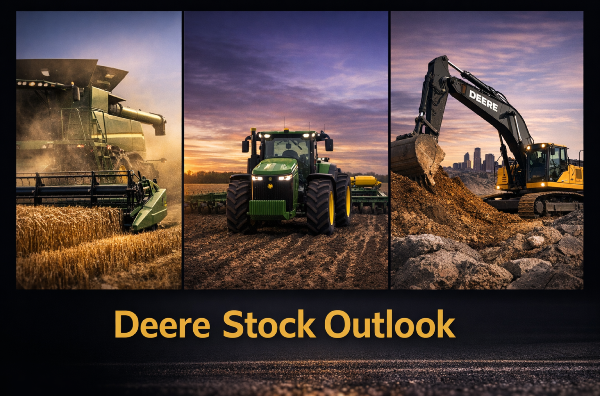























Deere is in a fascinating position right now. It isn’t a distressed cyclical stock, but it also isn’t a pure secular growth story. Instead, it sits in the middle—an industrial franchise with real technology leadership, strong brand power, and undeniable exposure to the agricultural cycle. That mix creates a valuation debate centered on how much investors should pay for a company that blends premium quality with cyclical earnings pressure.
Today, Deere trades around $594, with a recent close at $594.04. The 52‑week range stretches from roughly $444 to $674, placing the stock well above its lows but still meaningfully below its peak. That alone tells you something important: the market is no longer pricing Deere at peak enthusiasm, but it continues to give the company a premium relative to a traditional machinery manufacturer.
Current Price Context
The valuation picture reflects this middle ground. Deere’s price sits above conservative fair‑value estimates but below the highest valuation zone seen during its recent peak. It doesn’t look cheap in a bargain‑hunter sense, but it also isn’t priced for perfection. Instead, it resembles a high‑quality cyclical leader where investors still believe in the long‑term story even as near‑term earnings soften.
Historically, Deere’s success came from evolving beyond being “just a tractor company.” Over time, it built a precision agriculture and smart‑equipment platform powered by software, autonomy, and deep dealer relationships. Those strengths helped the company earn a premium multiple. But the biggest historical mistake was assuming Deere could fully escape the farm cycle. Even elite franchises face periods of lower farm income, cautious dealer ordering, and weaker equipment demand.
Recent Earnings Snapshot
Deere’s first quarter of fiscal 2026 was softer year‑over‑year, with net income falling from $869 million to $656 million. Earnings per share dropped from $3.19 to $2.42. That confirms the earnings cycle remains under pressure. But management maintained its full‑year 2026 net income outlook of $5.0 to $5.5 billion, signaling that conditions aren’t deteriorating beyond expectations.
This matters for valuation. Investors aren’t valuing Deere solely on current earnings—they’re valuing the company on the belief that its technology leadership, autonomy investments, and operational discipline make it structurally stronger across cycles than many industrial peers.
Risks Facing Deere in 2026
The biggest question for Deere this year isn’t whether it’s a great company. It is. The real question is whether a premium industrial franchise can defend earnings while the agricultural cycle remains weak.
The most significant risk is ongoing softness in large agriculture. Deere still expects production and precision agriculture sales to decline 5% to 10% in fiscal 2026, and management has described this year as the low point of the large‑AG cycle. Large equipment is one of Deere’s most important profit pools, so delays in big‑ticket purchases can pressure margins and earnings.
Another major risk is tariff‑related cost pressure. Reuters reported that Deere now expects about $1.2 billion in tariff‑related costs in 2026—up sharply from the prior year. Even with pricing actions and productivity improvements, that is a meaningful headwind.
Key 2026 Risk Metrics
Pricing power normalization is another concern. During stronger cycles, Deere benefited from solid pricing and favorable mix. But if crop prices remain weak and production costs stay high, Deere may have less room to push pricing without hurting demand.
Dealer inventory and production discipline also matter. In cyclical downturns, even best‑in‑class manufacturers can stumble if production doesn’t align with real demand. Deere has been actively managing this through cost reductions, production adjustments, and used‑equipment strategies, but execution risk remains.
Finally, valuation itself is a risk. Deere is not priced like a distressed cyclical. If the farm cycle stays weak longer than expected, or if tariffs and margins disappoint, the stock could derate even if the business remains fundamentally strong.
Opportunities: Technology, Precision Ag, and a Potential Cycle Bottom
Deere’s story today is no longer just about machinery. It’s increasingly about technology, precision agriculture, and the potential for a cycle recovery.
In the short term, parts of the business are already rebounding. Reuters reported that Deere raised its full‑year 2026 net income forecast to $4.5 to $5.0 billion, up from the prior $4.0 to $4.75 billion range, after stronger‑than‑expected demand in construction and small agriculture. The company also lifted its sales outlook in small agriculture, turf, construction, and forestry to about 15% growth.
Upward Revisions and Growth Areas
Another opportunity is the belief that 2026 may represent the bottom of the large‑AG cycle. If that’s true, investors may begin looking ahead to 2027 and beyond, where better farm conditions could support stronger equipment demand. Cyclical leaders often rerate before earnings recover, and Deere could follow that pattern.
Operational discipline is also helping. Deere beat earnings expectations despite tariff pressure, suggesting cost control and execution are cushioning the downturn. Premium industrial franchises often distinguish themselves not by avoiding cycles, but by managing them better than peers.
Longer term, precision agriculture is Deere’s biggest opportunity. The company’s edge is shifting from horsepower to precision application, data automation, and retrofit upgrades that improve farmer economics. These tools deepen customer loyalty and increase the value of Deere’s installed base.
Autonomy is another long‑term lever. Deere has demonstrated autonomous capabilities beyond traditional farming, including heavy machinery applications showcased at CES 2026. If autonomy moves from demonstration to broader deployment, Deere’s competitive moat could widen significantly.
Analyst Ratings: Positive but Cautious
Analyst sentiment toward Deere is broadly positive but far from unanimous. The current breakdown includes:
Analyst Rating Distribution
This distribution shows that Wall Street respects Deere as a high‑quality industrial leader with strong long‑term positioning. Analysts appreciate its brand strength, dealer network, precision agriculture leadership, and autonomy potential.
But the large number of hold ratings highlights a key nuance: many analysts are waiting for clearer evidence that the agricultural cycle is turning strongly enough to support more upside. Deere’s long‑term story is compelling, but the near‑term setup still looks like a cyclical “wait and see.”
Final Verdict: Buy, Hold, or Sell?
Based strictly on the data presented, the stock appears to be a HOLD.
Deere remains a premium franchise with powerful long‑term advantages, but near‑term earnings pressure, tariff costs, and a weak large‑AG cycle create enough uncertainty that the stock does not yet look like a clear buy—or a sell. It sits in the middle, waiting for the next decisive turn in the agricultural cycle.
https://youtu.be/Cq61t_8ZpN8?si=ao4naLWuVtv6icE_