🔑 Key Takeaways: Auto Manufacturers Expanding in Africa
🌍 Africa is a long-term growth opportunity for global auto manufacturers
Automakers like Toyota Motor Corporation, Volkswagen Group, Hyundai Motor Company, and Stellantis are expanding into Africa due to rising population growth, urbanization, and increasing middle-class demand. While current vehicle penetration is low, long-term growth potential is significant across emerging urban markets.
🚗 Used vehicles dominate African auto markets due to affordability and import dynamics
Many African markets rely heavily on used vehicles because new cars are often expensive due to tariffs, financing limits, and income levels. This creates a strong secondary vehicle ecosystem and influences how automakers design entry strategies for the region.
🏭 Local manufacturing and assembly are key strategies for reducing costs and barriers
Global automakers expand in Africa through local assembly plants, partnerships, and regional distribution networks. This helps reduce import costs, avoid tariffs, and improve market access while adapting vehicles to local infrastructure conditions.
⚡ Infrastructure and financing challenges slow EV adoption but support gradual market development
Limited charging infrastructure, financing constraints, and uneven road systems slow electric vehicle adoption in Africa. As a result, internal combustion and hybrid vehicles currently dominate, while EV growth is expected to emerge gradually in urban centers.
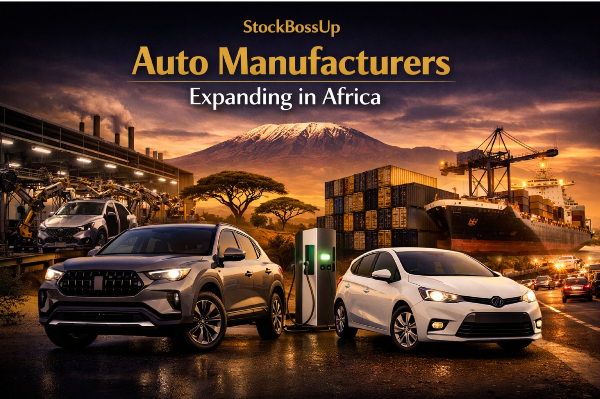
Auto Manufacturers Expanding in Africa: The Next Big Growth Frontier for the Global Auto Industry
At first glance, Africa may look like a small part of the global auto market. Vehicle ownership rates are lower than in North America, Europe, or China. Infrastructure is still developing in many regions.
But that view hides a growing shift.
Auto manufacturers are quietly expanding across Africa, betting on long-term population growth, urbanization, and rising middle-class demand. Yet the path is not simple. Companies face infrastructure gaps, import barriers, and fragmented markets that make expansion difficult.
This creates a hidden tension for automakers and investors. Africa looks like a high-growth opportunity, but it also carries some of the highest execution risks in the global automotive industry.
So why are major automakers expanding into Africa, and what makes this market so different from every other region?
The answer becomes clearer when you look at demand patterns, regional manufacturing strategies, and long-term demographic trends.
Why Are Auto Manufacturers Targeting Africa Now?
Africa is one of the fastest-growing population regions in the world. That alone is not enough to create an auto market. But combined with urban growth and rising incomes, it becomes a long-term opportunity.
Global automakers expanding into Africa include:
- Toyota Motor Corporation
- Volkswagen Group
- Stellantis
- Hyundai Motor Company
- Nissan Motor Corporation
- Suzuki Motor Corporation
These companies are entering or expanding through:
- Local assembly plants
- Import distribution networks
- Used vehicle channels
- Commercial fleet sales
One key driver is that vehicle ownership per capita is still significantly lower than global averages, leaving room for long-term growth.
A lesser-known reality is that used vehicles make up a large share of Africa’s car market, often far exceeding new car sales in many countries.
Why Is Africa a Difficult Market for Global Automakers?
Africa is not a single market. It is a collection of very different economies with different rules, road systems, and income levels.
Challenges include:
- Limited road infrastructure in many regions
- High import tariffs in certain countries
- Currency volatility
- Limited financing options for buyers
- Uneven fuel and EV infrastructure
These factors make it difficult for automakers to apply a one-size-fits-all strategy.
| Challenge |
Impact on Auto Expansion |
| Infrastructure gaps |
Limits vehicle usability |
| Import tariffs |
Increases car prices |
| Currency fluctuations |
Affects profitability |
| Financing limits |
Reduces buyer access |
Because of these challenges, many automakers focus on simplified vehicle models and cost-efficient designs rather than premium offerings.
Why Do Used Cars Dominate the African Auto Market?
In many African countries, used cars dominate the market more than new vehicles.
This happens because:
- New vehicles are often expensive relative to income
- Import taxes on new cars are high
- Used vehicles are more affordable upfront
- Financing options are limited
Toyota Motor Corporation has a strong presence in the used vehicle market due to its reputation for durability and long-term reliability.
One interesting market detail is that some vehicles imported into African countries are often re-exported from other regions after only a few years of use, creating a secondary global supply chain.
How Are Automakers Building Local Manufacturing in Africa?
Instead of relying only on imports, some automakers are building or expanding local assembly operations.
Examples include:
- Toyota Motor Corporation assembly in South Africa
- Volkswagen Group manufacturing operations in South Africa
- Stellantis partnerships in North and West Africa
- Hyundai Motor Company assembly and distribution networks
Local manufacturing helps reduce costs by:
- Lowering import tariffs
- Reducing shipping expenses
- Creating local employment incentives
- Improving supply chain efficiency
| Strategy |
Benefit |
Risk |
| Local assembly |
Lower tariffs |
Supply chain limits |
| Import distribution |
Faster entry |
Higher costs |
| Partnerships |
Local expertise |
Lower control |
| Full manufacturing |
Long-term efficiency |
High capital cost |
A key insight is that many automakers start with assembly plants before moving toward deeper manufacturing investments.
Why Are Affordable Vehicles the Focus in Africa?
Price sensitivity is one of the most important factors in African auto markets.
Automakers often prioritize:
- Small cars
- Fuel-efficient engines
- Low maintenance costs
- Durable suspensions for rough roads
Suzuki Motor Corporation and Hyundai Motor Company have gained traction in many emerging African markets due to affordable vehicle offerings.
A lesser-known detail is that vehicles designed for emerging markets often have simplified electronics compared to their global counterparts to reduce maintenance complexity.
How Is Infrastructure Shaping Auto Expansion in Africa?
Infrastructure plays a major role in determining which vehicles succeed.
Key infrastructure challenges include:
- Limited highway systems in rural areas
- Inconsistent fuel quality in some regions
- Uneven EV charging availability
- Limited repair networks outside cities
This affects vehicle design and product strategy.
| Infrastructure Factor |
Market Impact |
| Poor road quality |
Demand for durable suspension systems |
| Limited charging networks |
Slow EV adoption |
| Sparse repair centers |
Demand for reliable vehicles |
| Fuel availability differences |
Preference for fuel-efficient engines |
Because of this, internal combustion and hybrid vehicles still dominate most African markets.
Why Are EVs Slower to Expand in Africa?
Electric vehicles are growing globally, but Africa is still in early adoption stages.
Key barriers include:
- Limited charging infrastructure
- High upfront EV costs
- Grid reliability issues in some regions
- Import cost challenges
Companies like Nissan Motor Corporation and Hyundai Motor Company are testing early EV entry strategies, but widespread adoption remains limited.
However, commercial fleet electrification may expand first in urban centers where infrastructure is more controlled.
How Do Trade Policies Affect Auto Expansion in Africa?
Trade policies vary widely between African countries, making regional strategy important.
Factors include:
- Import tariffs on finished vehicles
- Local content requirements
- Regional trade agreements
- Customs processing delays
Stellantis and Volkswagen Group have adapted by forming partnerships or establishing regional assembly hubs to reduce trade friction.
One important detail is that regional trade agreements in Africa are gradually improving cross-border vehicle movement, which may support future expansion.
Why Do Commercial Vehicles Matter So Much in Africa?
Commercial vehicles are a major driver of auto demand in Africa.
This includes:
- Delivery trucks
- Small commercial vans
- Public transport vehicles
- Agricultural transport vehicles
Toyota Motor Corporation has a strong presence in commercial and utility vehicles due to durability and serviceability.
These vehicles often matter more than passenger cars in early-stage markets because they support economic activity directly.
How Are Financing Systems Changing Auto Demand?
Vehicle financing is still developing in many African markets.
Challenges include:
- Limited access to auto loans
- High interest rates
- Weak credit infrastructure
- Informal income systems
As financial systems improve, vehicle demand is expected to increase significantly.
| Financing Factor |
Market Effect |
| Limited credit access |
Lower vehicle ownership |
| High interest rates |
Delayed purchases |
| Weak credit systems |
Cash-based transactions |
| Growing banking systems |
Future demand expansion |
A key insight is that even small improvements in credit availability can significantly increase vehicle sales in emerging markets.
Why Are African Markets Important for Long-Term Growth?
Africa represents one of the last major regions with low vehicle penetration and strong population growth potential.
Automakers see long-term opportunities in:
- Urban expansion
- Rising middle-class income
- Infrastructure development
- Commercial transportation growth
This makes Africa a strategic long-term play rather than a short-term profit region.
Final Answer: Why Auto Manufacturers Are Expanding in Africa
Auto manufacturers are expanding in Africa because the region offers long-term growth potential driven by population growth, urbanization, and rising mobility demand.
Companies like Toyota Motor Corporation, Volkswagen Group, Stellantis, Hyundai Motor Company, and Nissan Motor Corporation are positioning early through imports, partnerships, and local assembly.
The surprising reality is that Africa is not just a future car market—it is already a major used vehicle market that is evolving into a structured new vehicle market over time.
The real opportunity is not immediate profits. It is long-term market formation.
Africa represents one of the last major regions where the auto industry can grow from the ground up.

















🔑 Key Takeaways: Auto Manufacturers Expanding in Africa
🌍 Africa is a long-term growth opportunity for global auto manufacturers
Automakers like Toyota Motor Corporation, Volkswagen Group, Hyundai Motor Company, and Stellantis are expanding into Africa due to rising population growth, urbanization, and increasing middle-class demand. While current vehicle penetration is low, long-term growth potential is significant across emerging urban markets.
🚗 Used vehicles dominate African auto markets due to affordability and import dynamics
Many African markets rely heavily on used vehicles because new cars are often expensive due to tariffs, financing limits, and income levels. This creates a strong secondary vehicle ecosystem and influences how automakers design entry strategies for the region.
🏭 Local manufacturing and assembly are key strategies for reducing costs and barriers
Global automakers expand in Africa through local assembly plants, partnerships, and regional distribution networks. This helps reduce import costs, avoid tariffs, and improve market access while adapting vehicles to local infrastructure conditions.
⚡ Infrastructure and financing challenges slow EV adoption but support gradual market development
Limited charging infrastructure, financing constraints, and uneven road systems slow electric vehicle adoption in Africa. As a result, internal combustion and hybrid vehicles currently dominate, while EV growth is expected to emerge gradually in urban centers.
Auto Manufacturers Expanding in Africa: The Next Big Growth Frontier for the Global Auto Industry
At first glance, Africa may look like a small part of the global auto market. Vehicle ownership rates are lower than in North America, Europe, or China. Infrastructure is still developing in many regions.
But that view hides a growing shift.
Auto manufacturers are quietly expanding across Africa, betting on long-term population growth, urbanization, and rising middle-class demand. Yet the path is not simple. Companies face infrastructure gaps, import barriers, and fragmented markets that make expansion difficult.
This creates a hidden tension for automakers and investors. Africa looks like a high-growth opportunity, but it also carries some of the highest execution risks in the global automotive industry.
So why are major automakers expanding into Africa, and what makes this market so different from every other region?
The answer becomes clearer when you look at demand patterns, regional manufacturing strategies, and long-term demographic trends.
Why Are Auto Manufacturers Targeting Africa Now?
Africa is one of the fastest-growing population regions in the world. That alone is not enough to create an auto market. But combined with urban growth and rising incomes, it becomes a long-term opportunity.
Global automakers expanding into Africa include:
These companies are entering or expanding through:
One key driver is that vehicle ownership per capita is still significantly lower than global averages, leaving room for long-term growth.
A lesser-known reality is that used vehicles make up a large share of Africa’s car market, often far exceeding new car sales in many countries.
Why Is Africa a Difficult Market for Global Automakers?
Africa is not a single market. It is a collection of very different economies with different rules, road systems, and income levels.
Challenges include:
These factors make it difficult for automakers to apply a one-size-fits-all strategy.
Because of these challenges, many automakers focus on simplified vehicle models and cost-efficient designs rather than premium offerings.
Why Do Used Cars Dominate the African Auto Market?
In many African countries, used cars dominate the market more than new vehicles.
This happens because:
Toyota Motor Corporation has a strong presence in the used vehicle market due to its reputation for durability and long-term reliability.
One interesting market detail is that some vehicles imported into African countries are often re-exported from other regions after only a few years of use, creating a secondary global supply chain.
How Are Automakers Building Local Manufacturing in Africa?
Instead of relying only on imports, some automakers are building or expanding local assembly operations.
Examples include:
Local manufacturing helps reduce costs by:
A key insight is that many automakers start with assembly plants before moving toward deeper manufacturing investments.
Why Are Affordable Vehicles the Focus in Africa?
Price sensitivity is one of the most important factors in African auto markets.
Automakers often prioritize:
Suzuki Motor Corporation and Hyundai Motor Company have gained traction in many emerging African markets due to affordable vehicle offerings.
A lesser-known detail is that vehicles designed for emerging markets often have simplified electronics compared to their global counterparts to reduce maintenance complexity.
How Is Infrastructure Shaping Auto Expansion in Africa?
Infrastructure plays a major role in determining which vehicles succeed.
Key infrastructure challenges include:
This affects vehicle design and product strategy.
Because of this, internal combustion and hybrid vehicles still dominate most African markets.
Why Are EVs Slower to Expand in Africa?
Electric vehicles are growing globally, but Africa is still in early adoption stages.
Key barriers include:
Companies like Nissan Motor Corporation and Hyundai Motor Company are testing early EV entry strategies, but widespread adoption remains limited.
However, commercial fleet electrification may expand first in urban centers where infrastructure is more controlled.
How Do Trade Policies Affect Auto Expansion in Africa?
Trade policies vary widely between African countries, making regional strategy important.
Factors include:
Stellantis and Volkswagen Group have adapted by forming partnerships or establishing regional assembly hubs to reduce trade friction.
One important detail is that regional trade agreements in Africa are gradually improving cross-border vehicle movement, which may support future expansion.
Why Do Commercial Vehicles Matter So Much in Africa?
Commercial vehicles are a major driver of auto demand in Africa.
This includes:
Toyota Motor Corporation has a strong presence in commercial and utility vehicles due to durability and serviceability.
These vehicles often matter more than passenger cars in early-stage markets because they support economic activity directly.
How Are Financing Systems Changing Auto Demand?
Vehicle financing is still developing in many African markets.
Challenges include:
As financial systems improve, vehicle demand is expected to increase significantly.
A key insight is that even small improvements in credit availability can significantly increase vehicle sales in emerging markets.
Why Are African Markets Important for Long-Term Growth?
Africa represents one of the last major regions with low vehicle penetration and strong population growth potential.
Automakers see long-term opportunities in:
This makes Africa a strategic long-term play rather than a short-term profit region.
Final Answer: Why Auto Manufacturers Are Expanding in Africa
Auto manufacturers are expanding in Africa because the region offers long-term growth potential driven by population growth, urbanization, and rising mobility demand.
Companies like Toyota Motor Corporation, Volkswagen Group, Stellantis, Hyundai Motor Company, and Nissan Motor Corporation are positioning early through imports, partnerships, and local assembly.
The surprising reality is that Africa is not just a future car market—it is already a major used vehicle market that is evolving into a structured new vehicle market over time.
The real opportunity is not immediate profits. It is long-term market formation.
Africa represents one of the last major regions where the auto industry can grow from the ground up.