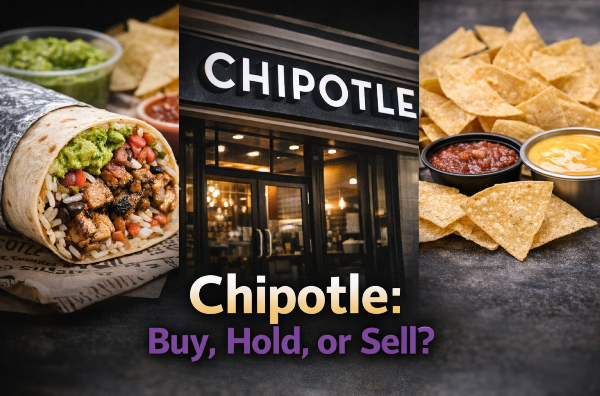
Chipotle has become one of the most recognizable fast‑casual restaurants in America. Its brand is strong, its stores are busy, and its growth story has been impressive for years. But popularity alone doesn’t make a stock a good investment. What matters is whether the numbers justify the price investors are being asked to pay today. And right now, that price is sitting near $39 per share, which is not exactly cheap for a restaurant chain.
To figure out whether buying at this level makes sense, we need to break down the company’s current performance and then look ahead. Chipotle’s most recent year delivered $11.3 billion in revenue and $1.5 billion in net income. That works out to a profit margin of 13.5%, which is high for the fast‑casual space. It’s not the absolute maximum the company could achieve, but it’s still a strong number that shows how efficient the business has become.
Even with that strength, the valuation is steep. At today’s price, Chipotle trades at a P/E ratio of 34 based on last year’s earnings. That tells us the market expects a lot from the company going forward. High expectations aren’t necessarily bad, but they do raise the bar for future performance. If the company doesn’t deliver, the stock can fall quickly.
Current Financial Snapshot
| Metric |
Value |
| Revenue (Last Year) |
$11.3B |
| Net Income |
$1.5B |
| Profit Margin |
13.5% |
| Share Price |
$39 |
| P/E Ratio |
34 |
The Bear Case: Slower Growth and Lower Expectations
Let’s start with a conservative scenario. In a bear case, Chipotle still grows, but at a more modest pace. A 7% revenue growth rate is reasonable for a company of this size, especially if economic conditions tighten or expansion slows. This scenario also assumes the profit margin stays around 13%, not improving much from where it is today.
Chipotle has been buying back shares, and even in a slower environment, it’s fair to assume that continues—just at a reduced pace. The real challenge in a bear case is valuation. If the company underperforms relative to market expectations, investors won’t be willing to pay a premium P/E ratio anymore. A more realistic multiple might be 17, which is still above the average restaurant stock but far below today’s lofty valuation.
Under these assumptions, the stock would be worth around $29 in five years. Buying at today’s price would lead to an annualized return of –5.66%, meaning investors would lose money over time. That’s the risk of buying a high‑expectation stock: even decent performance can disappoint the market.
Bear Case Summary
| Assumption |
Value |
| Revenue Growth |
7% |
| Profit Margin |
13% |
| Share Buybacks |
Slower |
| Future P/E |
17 |
| Estimated Future Price |
$29 |
| Annualized Return |
–5.66% |
The Bull Case: Strong Growth and Expanding Margins
Now let’s flip the script. In a bull case, Chipotle continues to fire on all cylinders. Revenue grows at a low double‑digit rate, margins expand to 17%, and share buybacks accelerate to around 5%. These are optimistic assumptions, but not impossible for a company with Chipotle’s brand strength and pricing power.
If the company hits these numbers, the market would likely reward it with a higher valuation. A P/E ratio of 21 fits a scenario where growth is strong and profitability improves. Under these conditions, the stock could reach $67 in five years. Buying at today’s price would produce an annualized return of 11.5%, which is a solid long‑term result.
This scenario assumes Chipotle continues opening new stores, raising prices when needed, and maintaining its operational efficiency. It also assumes the brand remains as strong as it is today. If all of that holds true, the upside is meaningful.
Bull Case Summary
| Assumption |
Value |
| Revenue Growth |
Low double‑digit |
| Profit Margin |
17% |
| Share Buybacks |
5% |
| Future P/E |
21 |
| Estimated Future Price |
$67 |
| Annualized Return |
11.5% |
The Middle Ground: Averaging the Two Outcomes
Most of the time, reality lands somewhere between the best and worst scenarios. If we average the bear and bull cases, we get a projected stock price of around $48 in five years. That translates to an annualized return of 4.35% from today’s price.
A 4% return isn’t terrible, but it’s not particularly exciting either—especially when the stock market historically returns around 7% to 10% per year. For a company trading at a premium valuation, a mid‑single‑digit return doesn’t offer much margin of safety.
This is where the challenge lies. Chipotle is a great business, but even great businesses can be bad investments if the price is too high. When a stock trades at a P/E above 30, the company needs to deliver near‑perfect results to justify the valuation. Anything less, and the stock can stagnate or decline.
Combined Case Summary
| Scenario |
Estimated Price |
Annualized Return |
| Bear Case |
$29 |
–5.66% |
| Bull Case |
$67 |
11.5% |
| Combined Estimate |
$48 |
4.35% |
Final Thoughts: Great Company, Tough Price
Chipotle is undeniably a strong business. Its margins are high, its brand is powerful, and its growth story is still alive. But the stock market doesn’t just care about quality—it cares about price. And at a P/E ratio above 30, the stock is priced for excellence.
If the company hits its bull‑case numbers, investors could see solid returns. But if growth slows even slightly, the downside becomes very real. That imbalance makes the stock difficult to justify at today’s price. There’s nothing wrong with waiting for a better entry point, especially when the valuation leaves so little room for error.
Chipotle may continue to impress customers, but investors need to be careful not to overpay for a great story. Sometimes the best move is simply to watch and wait.
Verdict: Buy, Hold, or Sell?
Based on the numbers and scenarios above, this stock is a sell at today’s price.
https://youtu.be/J6atO03jjyE?si=7QElSf1rEOhPpLAb











Chipotle has become one of the most recognizable fast‑casual restaurants in America. Its brand is strong, its stores are busy, and its growth story has been impressive for years. But popularity alone doesn’t make a stock a good investment. What matters is whether the numbers justify the price investors are being asked to pay today. And right now, that price is sitting near $39 per share, which is not exactly cheap for a restaurant chain.
To figure out whether buying at this level makes sense, we need to break down the company’s current performance and then look ahead. Chipotle’s most recent year delivered $11.3 billion in revenue and $1.5 billion in net income. That works out to a profit margin of 13.5%, which is high for the fast‑casual space. It’s not the absolute maximum the company could achieve, but it’s still a strong number that shows how efficient the business has become.
Even with that strength, the valuation is steep. At today’s price, Chipotle trades at a P/E ratio of 34 based on last year’s earnings. That tells us the market expects a lot from the company going forward. High expectations aren’t necessarily bad, but they do raise the bar for future performance. If the company doesn’t deliver, the stock can fall quickly.
Current Financial Snapshot
The Bear Case: Slower Growth and Lower Expectations
Let’s start with a conservative scenario. In a bear case, Chipotle still grows, but at a more modest pace. A 7% revenue growth rate is reasonable for a company of this size, especially if economic conditions tighten or expansion slows. This scenario also assumes the profit margin stays around 13%, not improving much from where it is today.
Chipotle has been buying back shares, and even in a slower environment, it’s fair to assume that continues—just at a reduced pace. The real challenge in a bear case is valuation. If the company underperforms relative to market expectations, investors won’t be willing to pay a premium P/E ratio anymore. A more realistic multiple might be 17, which is still above the average restaurant stock but far below today’s lofty valuation.
Under these assumptions, the stock would be worth around $29 in five years. Buying at today’s price would lead to an annualized return of –5.66%, meaning investors would lose money over time. That’s the risk of buying a high‑expectation stock: even decent performance can disappoint the market.
Bear Case Summary
The Bull Case: Strong Growth and Expanding Margins
Now let’s flip the script. In a bull case, Chipotle continues to fire on all cylinders. Revenue grows at a low double‑digit rate, margins expand to 17%, and share buybacks accelerate to around 5%. These are optimistic assumptions, but not impossible for a company with Chipotle’s brand strength and pricing power.
If the company hits these numbers, the market would likely reward it with a higher valuation. A P/E ratio of 21 fits a scenario where growth is strong and profitability improves. Under these conditions, the stock could reach $67 in five years. Buying at today’s price would produce an annualized return of 11.5%, which is a solid long‑term result.
This scenario assumes Chipotle continues opening new stores, raising prices when needed, and maintaining its operational efficiency. It also assumes the brand remains as strong as it is today. If all of that holds true, the upside is meaningful.
Bull Case Summary
The Middle Ground: Averaging the Two Outcomes
Most of the time, reality lands somewhere between the best and worst scenarios. If we average the bear and bull cases, we get a projected stock price of around $48 in five years. That translates to an annualized return of 4.35% from today’s price.
A 4% return isn’t terrible, but it’s not particularly exciting either—especially when the stock market historically returns around 7% to 10% per year. For a company trading at a premium valuation, a mid‑single‑digit return doesn’t offer much margin of safety.
This is where the challenge lies. Chipotle is a great business, but even great businesses can be bad investments if the price is too high. When a stock trades at a P/E above 30, the company needs to deliver near‑perfect results to justify the valuation. Anything less, and the stock can stagnate or decline.
Combined Case Summary
Final Thoughts: Great Company, Tough Price
Chipotle is undeniably a strong business. Its margins are high, its brand is powerful, and its growth story is still alive. But the stock market doesn’t just care about quality—it cares about price. And at a P/E ratio above 30, the stock is priced for excellence.
If the company hits its bull‑case numbers, investors could see solid returns. But if growth slows even slightly, the downside becomes very real. That imbalance makes the stock difficult to justify at today’s price. There’s nothing wrong with waiting for a better entry point, especially when the valuation leaves so little room for error.
Chipotle may continue to impress customers, but investors need to be careful not to overpay for a great story. Sometimes the best move is simply to watch and wait.
Verdict: Buy, Hold, or Sell?
Based on the numbers and scenarios above, this stock is a sell at today’s price.
https://youtu.be/J6atO03jjyE?si=7QElSf1rEOhPpLAb