🏭 Key Takeaways
🤖 Smart factories use AI, robotics, and real-time data to transform car production
Modern auto manufacturing is shifting from manual assembly lines to fully connected digital systems. Smart factories rely on artificial intelligence, robotics, and IoT sensors to monitor and adjust production in real time. This leads to faster output, fewer errors, and more efficient automotive manufacturing processes.
⚙️ Traditional auto factories struggle with flexibility and rising production complexity
Older manufacturing systems were built for mass production of identical vehicles. Today’s demand for customization, electric vehicles, and rapid design changes creates inefficiencies in these traditional setups. Smart factories solve this by enabling flexible, adaptive production lines that can change quickly without major downtime.
📊 Data and digital twins are becoming the core of automotive production systems
Data-driven decision-making is now more important than physical machinery in many factories. Digital twins allow manufacturers to simulate entire production lines before making real-world changes. This reduces risk, improves planning accuracy, and increases efficiency across global automotive operations.
🚀 Leading automakers are investing heavily in fully connected manufacturing ecosystems
Companies like Tesla, BMW, Toyota, and Mercedes-Benz are rapidly adopting smart factory technologies. These systems connect machines, supply chains, and production data into one network. The result is higher efficiency, reduced waste, and faster adaptation to market changes in the automotive industry.
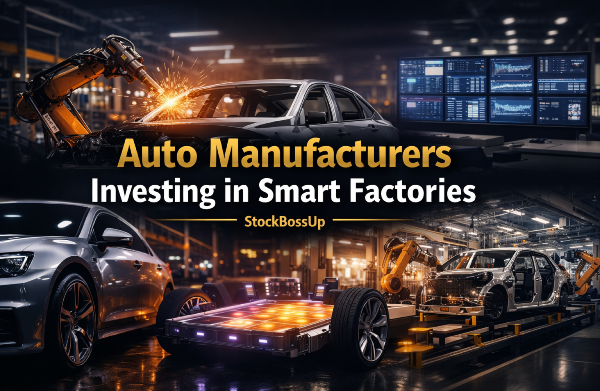
Auto Manufacturers Investing in Smart Factories
Why are modern car factories changing so quickly?
Car factories used to run on fixed schedules, predictable assembly lines, and large amounts of manual labor. That model is now under pressure. Vehicles are becoming more complex, especially with electric drivetrains, software systems, and custom features.
At the same time, global demand shifts faster than ever. Consumers expect more customization, shorter delivery times, and fewer defects. Traditional factories struggle to keep up with that level of change.
This creates a hidden challenge in the auto industry. The old way of building cars is too slow for the modern market, but upgrading entire factories is expensive and risky.
The solution many manufacturers are turning to is not just better machines. It is smarter systems that connect everything together in real time.
What exactly is a smart factory in auto manufacturing?
A smart factory uses digital systems, sensors, robotics, and artificial intelligence to control production with minimal human input. Instead of separate machines working independently, every part of the factory is connected.
Data flows continuously between machines. This allows production lines to adjust automatically when demand changes or when a defect is detected.
Robots now work alongside software that predicts problems before they happen. This reduces downtime and improves efficiency.
In some advanced plants, production lines can be reconfigured digitally before any physical changes are made on the floor.
Why are traditional factories struggling with modern demands?
Older factories were built for consistency, not flexibility. They were designed to produce large volumes of the same model for long periods.
Today’s auto market is different. Customers want more variations, including color options, software features, and battery configurations.
This shift creates complexity that older systems cannot handle efficiently. Every change in design or demand creates delays in traditional production systems.
Smart factories solve this by allowing rapid adjustments without shutting down entire production lines.
One major shift is how factories now rely on real-time data instead of fixed production schedules.
How do smart factories actually work in real life?
Smart factories combine robotics, AI, and data systems into one connected network. Sensors placed throughout the factory collect information about speed, temperature, and performance.
This data is analyzed instantly. If something is wrong, the system can adjust without waiting for human intervention.
Robots perform repetitive tasks like welding, painting, and assembly. Meanwhile, AI systems monitor quality and efficiency.
Some facilities even simulate production digitally before changes are made physically. This reduces downtime and improves planning accuracy.
Which automakers are leading the smart factory shift?
Major global manufacturers are investing heavily in smart factory technology.
Tesla is known for highly automated production systems. Its factories use real-time simulation tools that allow production lines to adjust quickly as new models are introduced.
Toyota focuses on combining automation with lean manufacturing principles. Their smart factories emphasize efficiency and waste reduction.
BMW and Mercedes-Benz use advanced digital systems to coordinate production and logistics across multiple plants.
Ford and General Motors are modernizing older facilities with AI-driven systems and robotics upgrades.
Volkswagen is investing heavily in digital production networks across Europe.
| Manufacturer |
Smart Factory Focus |
Key Technology |
Strength |
| Tesla |
Full automation + AI control |
Real-time simulation |
Fast reconfiguration |
| Toyota |
Lean smart manufacturing |
Predictive systems |
Efficiency optimization |
| BMW |
Connected production lines |
Digital logistics AI |
Multi-plant coordination |
| Mercedes-Benz |
Smart quality control |
AI inspection systems |
Precision manufacturing |
| Volkswagen |
Industrial digitization |
Cloud-based factories |
Large-scale integration |
Why robotics alone is not enough anymore
Robots are a key part of smart factories, but they are only one piece of the system. Without smart coordination, robots still operate in limited ways.
The real innovation comes from connecting robots to data systems that guide their actions in real time.
This allows production lines to adapt dynamically. For example, if demand for a specific model increases suddenly, robots can shift tasks without stopping the entire line.
One unexpected detail is that some factories now use AI systems that adjust robot movement paths every few seconds to reduce wear and improve speed.
This level of coordination was not possible in older automation systems.
How AI is changing automotive production lines
Artificial intelligence plays a central role in smart factories. It helps predict equipment failures, manage supply chains, and improve quality control.
AI systems can detect small defects that are invisible to the human eye. This reduces waste and improves product consistency.
Manufacturers also use AI to optimize production schedules. Instead of fixed timelines, factories now adjust output based on real-time demand.
Some advanced systems can even predict supply shortages before they happen and automatically adjust production priorities.
This reduces delays and keeps factories running more efficiently.
What role do digital twins play in manufacturing?
A digital twin is a virtual model of a real factory. It mirrors every machine, process, and workflow in real time.
Manufacturers use digital twins to test changes before applying them in the real world. This reduces risk and improves efficiency.
If a factory wants to change a production line, it can simulate the entire process digitally first.
This approach saves time and prevents costly mistakes.
In some advanced plants, digital twins are updated every second, creating a live virtual copy of the entire production system.
| Smart Factory Technology |
Purpose |
Benefit |
Industry Use |
| Robotics automation |
Physical assembly |
Speed + precision |
All major automakers |
| AI quality control |
Defect detection |
Reduced waste |
Premium manufacturers |
| Digital twins |
Virtual simulation |
Risk reduction |
Advanced EV factories |
| IoT sensors |
Real-time monitoring |
Instant feedback |
Connected production lines |
| Cloud systems |
Data integration |
Global coordination |
Multi-plant networks |
Why data is becoming more important than machinery
In smart factories, data is often more valuable than physical equipment. Machines are important, but data determines how efficiently they operate.
Every sensor, robot, and system generates information. This data is used to improve performance continuously.
Factories now rely on analytics to make decisions instead of fixed human schedules.
This shift changes the role of manufacturing engineers. They now focus more on data interpretation than manual oversight.
One interesting development is that some factories can now self-adjust production speed based on real-time traffic and shipping data.
What problems still slow down smart factory adoption?
Despite progress, smart factories face challenges. One major issue is cost. Upgrading entire factories requires large investments in technology and infrastructure.
Another challenge is integration. Older machines are not always compatible with modern digital systems.
Cybersecurity is also a growing concern. Connected factories create new risks if systems are not properly protected.
Training workers to manage advanced systems is another hurdle. Employees need new skills to operate AI-driven environments.
These challenges mean adoption is gradual rather than immediate.
Why some factories feel almost fully automated already
In the most advanced facilities, human involvement is minimal. Machines handle most tasks, while humans oversee systems and handle exceptions.
Some production lines can run for extended periods with very little manual intervention.
This level of automation allows factories to operate continuously and with high precision.
A notable example is how Tesla’s production systems can reconfigure workflows digitally before physical changes are made, reducing downtime significantly during model transitions.
Another development in BMW’s manufacturing network involves AI systems that automatically assign vehicles to optimal production sequences, improving overall efficiency without human scheduling.
These systems show how far automation has progressed in modern automotive manufacturing.
What happens when smart factories become fully connected?
The future of smart factories lies in full connectivity. Every machine, system, and supply chain element will communicate in real time.
This will allow factories to respond instantly to changes in demand, supply shortages, or production issues.
Manufacturing will become more flexible, efficient, and responsive than ever before.
The goal is not just automation, but intelligent coordination across entire global production networks.
In the end, smart factories are not replacing manufacturing—they are reshaping how it works at every level, from design to delivery.




🏭 Key Takeaways
🤖 Smart factories use AI, robotics, and real-time data to transform car production
Modern auto manufacturing is shifting from manual assembly lines to fully connected digital systems. Smart factories rely on artificial intelligence, robotics, and IoT sensors to monitor and adjust production in real time. This leads to faster output, fewer errors, and more efficient automotive manufacturing processes.
⚙️ Traditional auto factories struggle with flexibility and rising production complexity
Older manufacturing systems were built for mass production of identical vehicles. Today’s demand for customization, electric vehicles, and rapid design changes creates inefficiencies in these traditional setups. Smart factories solve this by enabling flexible, adaptive production lines that can change quickly without major downtime.
📊 Data and digital twins are becoming the core of automotive production systems
Data-driven decision-making is now more important than physical machinery in many factories. Digital twins allow manufacturers to simulate entire production lines before making real-world changes. This reduces risk, improves planning accuracy, and increases efficiency across global automotive operations.
🚀 Leading automakers are investing heavily in fully connected manufacturing ecosystems
Companies like Tesla, BMW, Toyota, and Mercedes-Benz are rapidly adopting smart factory technologies. These systems connect machines, supply chains, and production data into one network. The result is higher efficiency, reduced waste, and faster adaptation to market changes in the automotive industry.
Auto Manufacturers Investing in Smart Factories
Why are modern car factories changing so quickly?
Car factories used to run on fixed schedules, predictable assembly lines, and large amounts of manual labor. That model is now under pressure. Vehicles are becoming more complex, especially with electric drivetrains, software systems, and custom features.
At the same time, global demand shifts faster than ever. Consumers expect more customization, shorter delivery times, and fewer defects. Traditional factories struggle to keep up with that level of change.
This creates a hidden challenge in the auto industry. The old way of building cars is too slow for the modern market, but upgrading entire factories is expensive and risky.
The solution many manufacturers are turning to is not just better machines. It is smarter systems that connect everything together in real time.
What exactly is a smart factory in auto manufacturing?
A smart factory uses digital systems, sensors, robotics, and artificial intelligence to control production with minimal human input. Instead of separate machines working independently, every part of the factory is connected.
Data flows continuously between machines. This allows production lines to adjust automatically when demand changes or when a defect is detected.
Robots now work alongside software that predicts problems before they happen. This reduces downtime and improves efficiency.
In some advanced plants, production lines can be reconfigured digitally before any physical changes are made on the floor.
Why are traditional factories struggling with modern demands?
Older factories were built for consistency, not flexibility. They were designed to produce large volumes of the same model for long periods.
Today’s auto market is different. Customers want more variations, including color options, software features, and battery configurations.
This shift creates complexity that older systems cannot handle efficiently. Every change in design or demand creates delays in traditional production systems.
Smart factories solve this by allowing rapid adjustments without shutting down entire production lines.
One major shift is how factories now rely on real-time data instead of fixed production schedules.
How do smart factories actually work in real life?
Smart factories combine robotics, AI, and data systems into one connected network. Sensors placed throughout the factory collect information about speed, temperature, and performance.
This data is analyzed instantly. If something is wrong, the system can adjust without waiting for human intervention.
Robots perform repetitive tasks like welding, painting, and assembly. Meanwhile, AI systems monitor quality and efficiency.
Some facilities even simulate production digitally before changes are made physically. This reduces downtime and improves planning accuracy.
Which automakers are leading the smart factory shift?
Major global manufacturers are investing heavily in smart factory technology.
Tesla is known for highly automated production systems. Its factories use real-time simulation tools that allow production lines to adjust quickly as new models are introduced.
Toyota focuses on combining automation with lean manufacturing principles. Their smart factories emphasize efficiency and waste reduction.
BMW and Mercedes-Benz use advanced digital systems to coordinate production and logistics across multiple plants.
Ford and General Motors are modernizing older facilities with AI-driven systems and robotics upgrades.
Volkswagen is investing heavily in digital production networks across Europe.
Why robotics alone is not enough anymore
Robots are a key part of smart factories, but they are only one piece of the system. Without smart coordination, robots still operate in limited ways.
The real innovation comes from connecting robots to data systems that guide their actions in real time.
This allows production lines to adapt dynamically. For example, if demand for a specific model increases suddenly, robots can shift tasks without stopping the entire line.
One unexpected detail is that some factories now use AI systems that adjust robot movement paths every few seconds to reduce wear and improve speed.
This level of coordination was not possible in older automation systems.
How AI is changing automotive production lines
Artificial intelligence plays a central role in smart factories. It helps predict equipment failures, manage supply chains, and improve quality control.
AI systems can detect small defects that are invisible to the human eye. This reduces waste and improves product consistency.
Manufacturers also use AI to optimize production schedules. Instead of fixed timelines, factories now adjust output based on real-time demand.
Some advanced systems can even predict supply shortages before they happen and automatically adjust production priorities.
This reduces delays and keeps factories running more efficiently.
What role do digital twins play in manufacturing?
A digital twin is a virtual model of a real factory. It mirrors every machine, process, and workflow in real time.
Manufacturers use digital twins to test changes before applying them in the real world. This reduces risk and improves efficiency.
If a factory wants to change a production line, it can simulate the entire process digitally first.
This approach saves time and prevents costly mistakes.
In some advanced plants, digital twins are updated every second, creating a live virtual copy of the entire production system.
Why data is becoming more important than machinery
In smart factories, data is often more valuable than physical equipment. Machines are important, but data determines how efficiently they operate.
Every sensor, robot, and system generates information. This data is used to improve performance continuously.
Factories now rely on analytics to make decisions instead of fixed human schedules.
This shift changes the role of manufacturing engineers. They now focus more on data interpretation than manual oversight.
One interesting development is that some factories can now self-adjust production speed based on real-time traffic and shipping data.
What problems still slow down smart factory adoption?
Despite progress, smart factories face challenges. One major issue is cost. Upgrading entire factories requires large investments in technology and infrastructure.
Another challenge is integration. Older machines are not always compatible with modern digital systems.
Cybersecurity is also a growing concern. Connected factories create new risks if systems are not properly protected.
Training workers to manage advanced systems is another hurdle. Employees need new skills to operate AI-driven environments.
These challenges mean adoption is gradual rather than immediate.
Why some factories feel almost fully automated already
In the most advanced facilities, human involvement is minimal. Machines handle most tasks, while humans oversee systems and handle exceptions.
Some production lines can run for extended periods with very little manual intervention.
This level of automation allows factories to operate continuously and with high precision.
A notable example is how Tesla’s production systems can reconfigure workflows digitally before physical changes are made, reducing downtime significantly during model transitions.
Another development in BMW’s manufacturing network involves AI systems that automatically assign vehicles to optimal production sequences, improving overall efficiency without human scheduling.
These systems show how far automation has progressed in modern automotive manufacturing.
What happens when smart factories become fully connected?
The future of smart factories lies in full connectivity. Every machine, system, and supply chain element will communicate in real time.
This will allow factories to respond instantly to changes in demand, supply shortages, or production issues.
Manufacturing will become more flexible, efficient, and responsive than ever before.
The goal is not just automation, but intelligent coordination across entire global production networks.
In the end, smart factories are not replacing manufacturing—they are reshaping how it works at every level, from design to delivery.