| Company |
Symbol |
Headquarters |
Core Operations |
Integration Level |
Notes |
| Boise Cascade |
BCC |
Boise, Idaho |
Engineered wood, lumber, nationwide distribution |
Full |
Owns U.S. mills and distribution centers; no foreign operations. |
| Louisiana-Pacific Corporation |
LPX |
Nashville, Tennessee |
OSB, siding, engineered wood |
High |
All production and sales focused on U.S. and Canada; vertically integrated across domestic plants. |
| PotlatchDeltic Corporation |
PCH |
Spokane, Washington |
Timberland, lumber, real estate |
Full |
Owns and manages U.S. timberlands, mills, and housing developments. |
| Interfor U.S. Holdings |
Subsidiary of IFP |
Peachtree City, Georgia |
Sawmills, lumber manufacturing |
High |
Operates only U.S. mills; parent company is Canadian but U.S. operations are fully domestic. |
🪵 Key Takeaways: U.S. Lumber Industry Insights
🌲 Domestic Production Drives Stability
The U.S. remains one of the world’s largest lumber producers thanks to fast‑growing southern pine and efficient regional mills. Domestic supply shortens transport chains and cushions price shocks, keeping the market resilient even during global disruptions.
🏗️ Vertical Integration Protects Margins
Owning forests, mills, and distribution networks lets companies control costs and quality. Integrated firms like Weyerhaeuser and Boise Cascade can shift production toward higher‑margin engineered wood when prices fall, ensuring steady profitability.
💡 Technology and Sustainability Shape Growth
AI‑driven sawmills, drone mapping, and genetic forestry boost efficiency while reducing waste. Sustainable replanting and carbon‑credit programs turn environmental responsibility into long‑term financial advantage, aligning profit with preservation.
⚙️ Labor Shortage Threatens Future Supply
A shrinking skilled workforce is the industry’s hidden challenge. Even with automation, mills and forests need trained operators. Solving this gap will determine whether U.S. lumber production can meet rising housing demand in decades ahead.
Why U.S. Lumber Companies Matter More Than Most People Realize
U.S. lumber companies shape housing costs, supply chains, and long‑term investment trends.
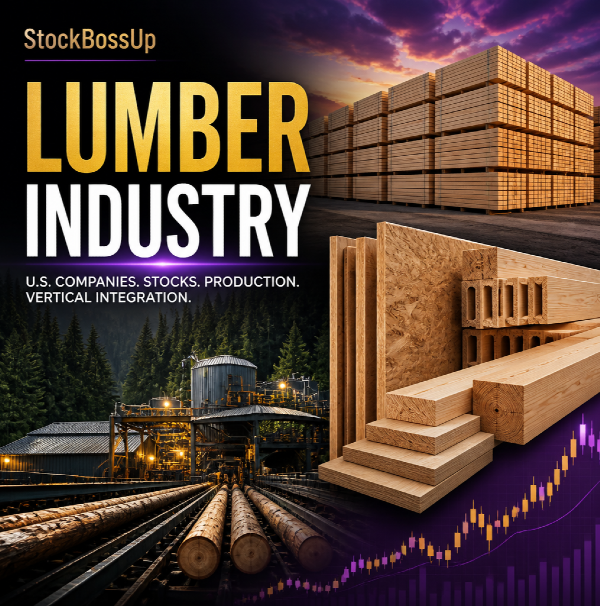
The lumber sector sits at the center of American construction. It supports homebuilding, remodeling, furniture, packaging, and even renewable energy. Many of the largest firms operate as publicly traded lumber companies or publicly traded timber companies, giving investors a direct way to participate in the industry’s growth.
These companies manage forests, run sawmills, produce engineered wood, and ship finished products across the country. Their performance affects everything from mortgage affordability to the cost of a backyard deck. Some firms even own millions of acres of timberland, making them major landholders in the United States.
But despite their size and influence, most people misunderstand how domestic production works, how vertical integration protects profits, and how lumber stocks behave during economic cycles. Even fewer understand the deeper structural issue that threatens long‑term supply stability.
Why Do U.S. Lumber Stocks Behave Differently Than Other Cyclical Stocks?
Lumber stocks move with housing demand, but they also follow their own rhythm because of timber growth cycles and land values.
U.S. lumber stocks are tied to the housing market, but they don’t move in perfect sync with homebuilders. Housing starts rise and fall quickly. Trees do not. Timber grows on long biological cycles, often 25 to 40 years. This creates a natural buffer that stabilizes long‑term supply.
Many investors are surprised to learn that timberland often appreciates even when lumber prices fall. That’s because land value, not just wood value, drives long‑term returns. Some companies also generate income from carbon credits, conservation leases, and renewable energy projects.
Another unique factor is that lumber companies often benefit from inflation. When the cost of goods rises, the value of standing timber usually rises too. This makes lumber stocks attractive during periods of high inflation or supply chain stress.
Below is a snapshot of major U.S. lumber and timber companies and their core business focus.
Major U.S. Lumber and Timber Companies
| Company |
Ticker |
Primary Focus |
| Weyerhaeuser |
WY |
Timberland, lumber, engineered wood |
| West Fraser |
WFG |
Lumber, OSB, pulp |
| Boise Cascade |
BCC |
Engineered wood, distribution |
| Louisiana-Pacific |
LPX |
Siding, OSB, engineered wood |
| PotlatchDeltic |
PCH |
Timberland, lumber, real estate |
Why Domestic Lumber Production Still Dominates the U.S. Market
The U.S. remains one of the world’s largest lumber producers because domestic forests grow fast and supply chains are shorter.
The United States has vast forests, especially in the South and Pacific Northwest. These regions grow pine and fir at high speeds, making them ideal for large‑scale production. Domestic mills also sit close to major construction markets, reducing transportation costs.
Even though Canada exports large volumes of softwood lumber to the U.S., domestic production still covers most American demand. Southern yellow pine, in particular, has become a backbone of U.S. construction because it grows quickly and works well for framing.
One little‑known fact: The U.S. South now produces more timber annually than the entire country did at the start of the 20th century. This growth is due to improved forestry practices, better genetics, and sustainable harvesting cycles.
Domestic production also helps stabilize prices. When global supply chains tighten, U.S. mills can ramp up output faster than foreign suppliers. This flexibility became clear during the pandemic, when domestic producers helped fill gaps caused by international shipping delays.
Why Vertical Integration Gives Lumber Companies a Competitive Edge
Vertical integration allows lumber companies to control costs, reduce risk, and protect margins during volatile markets.
Vertical integration means a company owns multiple stages of the supply chain. In the lumber industry, this often includes:
- Timberland ownership
- Logging operations
- Sawmills
- Engineered wood plants
- Distribution networks
Companies that control their own timberland have a major advantage. They don’t need to buy logs on the open market, where prices can swing wildly. Instead, they harvest from their own forests at predictable costs.
Vertical integration also improves quality control. A company that owns its forests and mills can ensure consistent wood density, moisture levels, and grading standards. Builders value this consistency, especially for large projects.
Another benefit is resilience. When lumber prices fall, integrated companies can shift production toward higher‑margin products like engineered wood or specialty panels. This flexibility helps them stay profitable even during downturns.
Vertical Integration Levels Among Major U.S. Lumber Companies
| Company |
Timberland Ownership |
Manufacturing |
Distribution |
| Weyerhaeuser |
High |
High |
Medium |
| Boise Cascade |
Low |
High |
High |
| Louisiana-Pacific |
Medium |
High |
Medium |
| PotlatchDeltic |
High |
Medium |
Low |
| West Fraser |
Medium |
High |
Medium |
Why Most People Misunderstand Lumber Supply and Demand Cycles
Lumber cycles are driven by housing, but also by long biological and environmental factors that most investors overlook.
Housing starts are the most visible driver of lumber demand. When more homes are built, lumber consumption rises. But supply is shaped by slower forces:
- Tree growth cycles
- Weather patterns
- Wildfire seasons
- Mill capacity
- Labor availability
One unique fact: A single mature pine tree can hold more than 200 gallons of water during peak growth. This means droughts can slow timber growth for years, affecting future supply.
Mill capacity also plays a major role. Even if forests are full of timber, mills can only process so much. When mills close—often due to low prices or labor shortages—supply tightens for years.
This mismatch between fast‑moving demand and slow‑moving supply creates the sharp price swings that lumber is known for.
Why U.S. Lumber Companies Are Investing Heavily in Technology
Technology is reshaping the lumber industry by improving efficiency, reducing waste, and increasing output.
Modern mills use advanced scanners, robotics, and AI‑driven optimization systems. These tools measure logs in real time and cut them in ways that maximize usable lumber. This reduces waste and increases profitability.
Forestry operations are also becoming more precise. Drones map forests. Satellites track growth rates. Data models predict harvest cycles. These tools help companies plan decades into the future.
Some firms are even experimenting with genetically improved seedlings that grow faster and resist disease. This could reshape the industry over the next 20 years.
Technology also improves sustainability. Better tracking systems ensure forests are harvested responsibly and replanted quickly. Many U.S. companies now operate under strict certification programs that verify sustainable practices.
Technology Adoption in the U.S. Lumber Industry
| Technology |
Impact |
Adoption Level |
| AI log scanning |
Higher yield |
High |
| Robotics |
Faster processing |
Medium |
| Drone mapping |
Better forest planning |
High |
| Satellite monitoring |
Long‑term forecasting |
Medium |
| Engineered wood innovation |
Higher margins |
High |
Why Sustainability Is Becoming a Core Part of Lumber Company Strategy
Sustainable forestry is not just good for the environment—it’s essential for long‑term profitability.
U.S. lumber companies rely on healthy forests. Without sustainable practices, they would run out of harvestable timber. That’s why most major firms follow strict guidelines for:
- Replanting
- Wildlife protection
- Water conservation
- Soil management
- Fire prevention
Many companies plant more trees than they harvest each year. Some even manage forests that absorb more carbon than they emit, creating new revenue opportunities through carbon markets.
Sustainability also improves brand reputation. Builders and consumers increasingly prefer materials with verified environmental benefits. This trend supports demand for engineered wood products, which often have lower carbon footprints than steel or concrete.
Why the U.S. Lumber Industry Still Faces a Hidden Long‑Term Problem
The biggest challenge facing U.S. lumber companies is not demand, pricing, or competition—it’s the shrinking number of skilled workers entering the industry.
The U.S. lumber sector is experiencing a generational labor gap. Many experienced loggers, mill operators, and forestry managers are nearing retirement. Younger workers are not entering the field at the same rate. This shortage affects:
- Mill productivity
- Logging capacity
- Maintenance schedules
- Safety standards
- Expansion plans
Even with automation, mills still need skilled technicians. Forests still need trained managers. Logging still requires experienced operators.
Without a new wave of workers, domestic production could struggle to keep up with long‑term demand—even though the forests themselves are healthy and abundant.
This labor gap is the quiet force shaping the future of U.S. lumber. It is the missing piece that explains why supply remains tight even when timber inventories are high.
What This Means for Investors and the Future of U.S. Lumber
U.S. lumber companies remain strong, but long‑term performance will depend on solving the labor shortage and expanding vertical integration.
The industry has stable forests, strong demand, and advanced technology. Vertical integration protects margins. Domestic production remains competitive. But the labor gap threatens future capacity.
Investors watching lumber stocks, timber stocks, or lumber company stocks should pay close attention to workforce trends. Companies that invest in training, automation, and retention will be better positioned for long‑term growth.
The U.S. lumber sector will continue to influence housing, construction, and land values for decades. But its future strength depends on whether it can attract the next generation of workers to keep America’s forests productive and its mills running at full capacity.
📚 Read More
Here is a collection of authoritative resources to deepen your understanding of the lumber and timber investment landscape. Each article is selected for clarity, credibility, and long term educational value.
Professional Perspectives
Research Summaries & Analysis
Practical How Tos & Step By Step Guides
Long Form Guides & Comprehensive Resources



















🪵 Key Takeaways: U.S. Lumber Industry Insights
🌲 Domestic Production Drives Stability
The U.S. remains one of the world’s largest lumber producers thanks to fast‑growing southern pine and efficient regional mills. Domestic supply shortens transport chains and cushions price shocks, keeping the market resilient even during global disruptions.🏗️ Vertical Integration Protects Margins
Owning forests, mills, and distribution networks lets companies control costs and quality. Integrated firms like Weyerhaeuser and Boise Cascade can shift production toward higher‑margin engineered wood when prices fall, ensuring steady profitability.💡 Technology and Sustainability Shape Growth
AI‑driven sawmills, drone mapping, and genetic forestry boost efficiency while reducing waste. Sustainable replanting and carbon‑credit programs turn environmental responsibility into long‑term financial advantage, aligning profit with preservation.⚙️ Labor Shortage Threatens Future Supply
A shrinking skilled workforce is the industry’s hidden challenge. Even with automation, mills and forests need trained operators. Solving this gap will determine whether U.S. lumber production can meet rising housing demand in decades ahead.Why U.S. Lumber Companies Matter More Than Most People Realize
U.S. lumber companies shape housing costs, supply chains, and long‑term investment trends.
The lumber sector sits at the center of American construction. It supports homebuilding, remodeling, furniture, packaging, and even renewable energy. Many of the largest firms operate as publicly traded lumber companies or publicly traded timber companies, giving investors a direct way to participate in the industry’s growth.
These companies manage forests, run sawmills, produce engineered wood, and ship finished products across the country. Their performance affects everything from mortgage affordability to the cost of a backyard deck. Some firms even own millions of acres of timberland, making them major landholders in the United States.
But despite their size and influence, most people misunderstand how domestic production works, how vertical integration protects profits, and how lumber stocks behave during economic cycles. Even fewer understand the deeper structural issue that threatens long‑term supply stability.
Why Do U.S. Lumber Stocks Behave Differently Than Other Cyclical Stocks?
Lumber stocks move with housing demand, but they also follow their own rhythm because of timber growth cycles and land values.
U.S. lumber stocks are tied to the housing market, but they don’t move in perfect sync with homebuilders. Housing starts rise and fall quickly. Trees do not. Timber grows on long biological cycles, often 25 to 40 years. This creates a natural buffer that stabilizes long‑term supply.
Many investors are surprised to learn that timberland often appreciates even when lumber prices fall. That’s because land value, not just wood value, drives long‑term returns. Some companies also generate income from carbon credits, conservation leases, and renewable energy projects.
Another unique factor is that lumber companies often benefit from inflation. When the cost of goods rises, the value of standing timber usually rises too. This makes lumber stocks attractive during periods of high inflation or supply chain stress.
Below is a snapshot of major U.S. lumber and timber companies and their core business focus.
Major U.S. Lumber and Timber Companies
Why Domestic Lumber Production Still Dominates the U.S. Market
The U.S. remains one of the world’s largest lumber producers because domestic forests grow fast and supply chains are shorter.
The United States has vast forests, especially in the South and Pacific Northwest. These regions grow pine and fir at high speeds, making them ideal for large‑scale production. Domestic mills also sit close to major construction markets, reducing transportation costs.
Even though Canada exports large volumes of softwood lumber to the U.S., domestic production still covers most American demand. Southern yellow pine, in particular, has become a backbone of U.S. construction because it grows quickly and works well for framing.
One little‑known fact: The U.S. South now produces more timber annually than the entire country did at the start of the 20th century. This growth is due to improved forestry practices, better genetics, and sustainable harvesting cycles.
Domestic production also helps stabilize prices. When global supply chains tighten, U.S. mills can ramp up output faster than foreign suppliers. This flexibility became clear during the pandemic, when domestic producers helped fill gaps caused by international shipping delays.
Why Vertical Integration Gives Lumber Companies a Competitive Edge
Vertical integration allows lumber companies to control costs, reduce risk, and protect margins during volatile markets.
Vertical integration means a company owns multiple stages of the supply chain. In the lumber industry, this often includes:
Companies that control their own timberland have a major advantage. They don’t need to buy logs on the open market, where prices can swing wildly. Instead, they harvest from their own forests at predictable costs.
Vertical integration also improves quality control. A company that owns its forests and mills can ensure consistent wood density, moisture levels, and grading standards. Builders value this consistency, especially for large projects.
Another benefit is resilience. When lumber prices fall, integrated companies can shift production toward higher‑margin products like engineered wood or specialty panels. This flexibility helps them stay profitable even during downturns.
Vertical Integration Levels Among Major U.S. Lumber Companies
Why Most People Misunderstand Lumber Supply and Demand Cycles
Lumber cycles are driven by housing, but also by long biological and environmental factors that most investors overlook.
Housing starts are the most visible driver of lumber demand. When more homes are built, lumber consumption rises. But supply is shaped by slower forces:
One unique fact: A single mature pine tree can hold more than 200 gallons of water during peak growth. This means droughts can slow timber growth for years, affecting future supply.
Mill capacity also plays a major role. Even if forests are full of timber, mills can only process so much. When mills close—often due to low prices or labor shortages—supply tightens for years.
This mismatch between fast‑moving demand and slow‑moving supply creates the sharp price swings that lumber is known for.
Why U.S. Lumber Companies Are Investing Heavily in Technology
Technology is reshaping the lumber industry by improving efficiency, reducing waste, and increasing output.
Modern mills use advanced scanners, robotics, and AI‑driven optimization systems. These tools measure logs in real time and cut them in ways that maximize usable lumber. This reduces waste and increases profitability.
Forestry operations are also becoming more precise. Drones map forests. Satellites track growth rates. Data models predict harvest cycles. These tools help companies plan decades into the future.
Some firms are even experimenting with genetically improved seedlings that grow faster and resist disease. This could reshape the industry over the next 20 years.
Technology also improves sustainability. Better tracking systems ensure forests are harvested responsibly and replanted quickly. Many U.S. companies now operate under strict certification programs that verify sustainable practices.
Technology Adoption in the U.S. Lumber Industry
Why Sustainability Is Becoming a Core Part of Lumber Company Strategy
Sustainable forestry is not just good for the environment—it’s essential for long‑term profitability.
U.S. lumber companies rely on healthy forests. Without sustainable practices, they would run out of harvestable timber. That’s why most major firms follow strict guidelines for:
Many companies plant more trees than they harvest each year. Some even manage forests that absorb more carbon than they emit, creating new revenue opportunities through carbon markets.
Sustainability also improves brand reputation. Builders and consumers increasingly prefer materials with verified environmental benefits. This trend supports demand for engineered wood products, which often have lower carbon footprints than steel or concrete.
Why the U.S. Lumber Industry Still Faces a Hidden Long‑Term Problem
The biggest challenge facing U.S. lumber companies is not demand, pricing, or competition—it’s the shrinking number of skilled workers entering the industry.
The U.S. lumber sector is experiencing a generational labor gap. Many experienced loggers, mill operators, and forestry managers are nearing retirement. Younger workers are not entering the field at the same rate. This shortage affects:
Even with automation, mills still need skilled technicians. Forests still need trained managers. Logging still requires experienced operators.
Without a new wave of workers, domestic production could struggle to keep up with long‑term demand—even though the forests themselves are healthy and abundant.
This labor gap is the quiet force shaping the future of U.S. lumber. It is the missing piece that explains why supply remains tight even when timber inventories are high.
What This Means for Investors and the Future of U.S. Lumber
U.S. lumber companies remain strong, but long‑term performance will depend on solving the labor shortage and expanding vertical integration.
The industry has stable forests, strong demand, and advanced technology. Vertical integration protects margins. Domestic production remains competitive. But the labor gap threatens future capacity.
Investors watching lumber stocks, timber stocks, or lumber company stocks should pay close attention to workforce trends. Companies that invest in training, automation, and retention will be better positioned for long‑term growth.
The U.S. lumber sector will continue to influence housing, construction, and land values for decades. But its future strength depends on whether it can attract the next generation of workers to keep America’s forests productive and its mills running at full capacity.
📚 Read More
Here is a collection of authoritative resources to deepen your understanding of the lumber and timber investment landscape. Each article is selected for clarity, credibility, and long term educational value.
Professional Perspectives
Research Summaries & Analysis
Practical How Tos & Step By Step Guides
Long Form Guides & Comprehensive Resources