🔑 Key Takeaways: Private-Label Parts and Aftermarket Stock Performance
📊 Private-label auto parts significantly boost aftermarket profit margins
Private-label parts typically deliver higher gross margins than national brands because they remove intermediary branding and marketing costs. This allows aftermarket retailers to capture more profit per sale while maintaining competitive pricing for customers.
🏭 Control over supply chains and manufacturing improves financial performance
Retailers that develop strong private-label programs gain more control over sourcing, pricing, and inventory. Many private-label parts are produced in the same factories as branded products, but better supply coordination helps improve efficiency and stock stability.
📦 Inventory efficiency and turnover improve with private-label expansion
Private-label products help reduce SKU complexity, improve warehouse efficiency, and increase inventory turnover. This leads to better cash flow and more stable operations, which can strengthen overall aftermarket stock performance.
📉 Private-label strength increases resilience during inflation and downturns
During inflation or economic slowdowns, private-label demand tends to grow as consumers seek lower-cost alternatives. This shift helps stabilize revenue and margins, making companies with strong private-label portfolios more resilient in volatile markets.
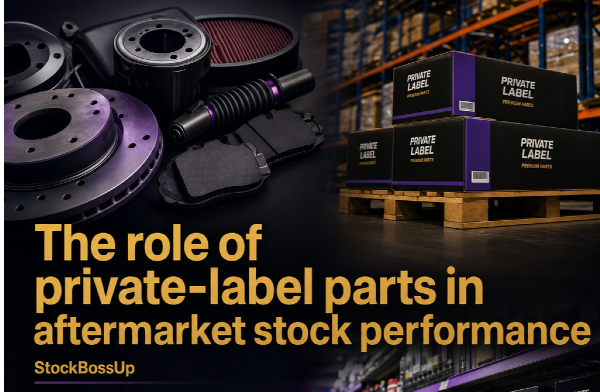
The Role of Private-Label Parts in Aftermarket Stock Performance
At first glance, aftermarket auto parts look simple. A driver needs brakes, a battery, or a filter, and they choose from familiar national brands or cheaper store options.
But behind the shelf, private-label parts play a much bigger role. They quietly shape profit margins, inventory efficiency, and even stock market performance for major aftermarket companies.
The challenge is not whether private-label parts matter. It is why they can significantly improve financial performance in some companies while having a weaker effect in others.
The answer is not obvious at first. It depends on pricing power, supply control, and how deeply private-label products are embedded into a company’s distribution system.
Why Are Private-Label Parts Becoming So Important in the Aftermarket?
Private-label parts are products sold under a retailer’s own brand instead of a manufacturer’s brand. They include common items like brake pads, filters, batteries, and wiper blades.
These products are usually cheaper for customers but more profitable for retailers.
Retailers gain more control over pricing and supply when they own the brand. They are no longer dependent on external branding strategies or manufacturer pricing rules.
A lesser-known detail is that many private-label auto parts are produced in the same factories as national brands. The difference often comes down to packaging, branding, and pricing strategy rather than core manufacturing.
How Do Private-Label Parts Improve Profit Margins?
Private-label products typically generate higher gross margins than branded parts.
This is because retailers eliminate several layers of cost tied to national brand marketing and distribution.
Instead of sharing profit with manufacturers and brand owners, retailers capture more of the final sale value.
Even a small increase in private-label penetration can significantly improve overall profitability.
| Product Type |
Typical Margin Level |
Pricing Control |
Supply Dependency |
| National brand parts |
Low to medium |
Low |
High |
| Private-label parts |
High |
High |
Medium |
| OEM dealer parts |
Medium |
Low |
High |
| Performance parts |
Medium to high |
Medium |
Medium |
A key detail is that private-label brake components often carry meaningfully higher margins than equivalent branded versions, especially in high-volume maintenance categories.
Why Do Customers Trust Private-Label Auto Parts?
Trust is a major barrier in automotive purchasing. Consumers want reliability and safety, especially for critical components.
Private-label brands overcome this by offering warranties and positioning themselves as equivalent alternatives to national brands.
Over time, customers become more comfortable with these products, especially when performance differences are minimal.
In many cases, return rates for private-label parts are comparable to branded products once brand trust is established.
| Factor |
National Brands |
Private-Label Brands |
| Consumer trust |
High |
Growing |
| Price advantage |
Low |
High |
| Warranty support |
Standard |
Often equal or stronger |
| Brand recognition |
Strong |
Moderate to growing |
A subtle reality is that many customers do not realize they are buying private-label parts because packaging often emphasizes retailer branding over manufacturer identity.
How Do Private-Label Parts Improve Inventory Performance?
Inventory management is one of the most important drivers of profitability in aftermarket retail.
Private-label products give retailers more control over supply and demand planning.
They can order in bulk, adjust production schedules, and reduce dependence on unpredictable supplier timelines.
This leads to faster inventory turnover and fewer stockouts.
| Inventory Metric |
Branded Parts |
Private-Label Parts |
| Turnover speed |
Moderate |
High |
| Stock availability |
Variable |
More stable |
| Pricing flexibility |
Low |
High |
| Supply control |
Shared |
Direct |
Private-label expansion also reduces SKU complexity, making warehouse management more efficient and lowering operational costs.
Why Do Private-Label Parts Strengthen Stock Market Performance?
Public aftermarket companies are often judged by gross margin growth, inventory efficiency, and cash flow stability.
Private-label growth improves all three.
Higher margins improve earnings. Better inventory control improves cash flow. Reduced supplier dependence improves long-term stability.
These improvements often translate into stronger investor confidence.
| Financial Metric |
Impact of Private-Label Growth |
| Gross margin |
Increases |
| Cash flow stability |
Improves |
| Inventory turnover |
Strengthens |
| Earnings predictability |
Improves |
A notable effect is that consistent private-label expansion is often interpreted by investors as improved pricing power and operational discipline.
How Do Companies Differ in Private-Label Strategy?
Not all aftermarket companies approach private-label products the same way.
Some build full ecosystems around their private brands. Others use them selectively in high-volume categories.
Larger retailers tend to invest more aggressively in private-label expansion due to scale advantages.
| Strategy Type |
Description |
Private-Label Penetration |
Risk Level |
| Full ecosystem |
Broad category coverage |
High |
Medium |
| Selective rollout |
Focused categories |
Medium |
Low |
| Limited use |
Supplemental strategy |
Low |
High |
Companies with deeper private-label integration often show more stable earnings during slower economic cycles.
Why Do Private-Label Parts Improve Competitive Position?
Private-label products reduce dependence on external suppliers.
This gives retailers more negotiating power and pricing flexibility.
It also creates product differentiation that competitors cannot easily replicate.
Over time, private-label brands can become a structural advantage rather than just a cost-saving tool.
A surprising pattern in aftermarket retail is that private-label wiper blades and cabin air filters have, in some regions, overtaken national brands in sales volume due to aggressive pricing and strong in-store placement strategies.
How Do Supply Chains Support Private-Label Growth?
Private-label expansion depends on contract manufacturing and flexible supply chains.
Retailers work with multiple manufacturers to produce similar products under different branding agreements.
This allows rapid scaling without owning production facilities.
| Supply Chain Component |
Role in Private-Label System |
| Contract manufacturers |
Production base |
| Logistics networks |
Distribution efficiency |
| Quality control systems |
Brand protection |
| Forecasting tools |
Demand alignment |
The main advantage is control. Retailers can adjust pricing, packaging, and sourcing without renegotiating national brand agreements.
Why Do Private-Label Products Perform Better in Downturns?
During economic slowdowns, consumers become more price-sensitive.
Private-label products benefit because they offer lower prices without significant quality loss.
Retailers often increase private-label promotion during downturns to maintain margins and volume.
| Economic Condition |
Private-Label Demand |
Branded Demand |
| Strong economy |
Steady growth |
Stable |
| Inflation period |
Increased adoption |
Pressure |
| Recession |
Strong growth |
Decline |
| Recovery phase |
Balanced mix |
Recovery |
This makes private-label products a stabilizing force for earnings during volatile periods.
How Do Private-Label Parts Affect Long-Term Stock Performance?
Over time, private-label expansion changes how the market values aftermarket companies.
Higher margins, stronger cash flow, and better inventory control often lead to more stable earnings.
This stability can support stronger valuation multiples in the long run.
Private-label strength is often viewed as a sign of pricing control and operational maturity.
Final Insight: Why Private-Label Parts Quietly Drive Market Performance
Private-label parts are more than low-cost alternatives. They are a structural advantage inside the aftermarket system.
They improve margins, reduce supplier dependence, and increase control over pricing and inventory.
They also strengthen resilience during economic cycles by stabilizing demand and profitability.
In the end, private-label growth does not just change what consumers buy. It changes how aftermarket companies perform financially and how they are valued in the stock market.














🔑 Key Takeaways: Private-Label Parts and Aftermarket Stock Performance
📊 Private-label auto parts significantly boost aftermarket profit margins
Private-label parts typically deliver higher gross margins than national brands because they remove intermediary branding and marketing costs. This allows aftermarket retailers to capture more profit per sale while maintaining competitive pricing for customers.
🏭 Control over supply chains and manufacturing improves financial performance
Retailers that develop strong private-label programs gain more control over sourcing, pricing, and inventory. Many private-label parts are produced in the same factories as branded products, but better supply coordination helps improve efficiency and stock stability.
📦 Inventory efficiency and turnover improve with private-label expansion
Private-label products help reduce SKU complexity, improve warehouse efficiency, and increase inventory turnover. This leads to better cash flow and more stable operations, which can strengthen overall aftermarket stock performance.
📉 Private-label strength increases resilience during inflation and downturns
During inflation or economic slowdowns, private-label demand tends to grow as consumers seek lower-cost alternatives. This shift helps stabilize revenue and margins, making companies with strong private-label portfolios more resilient in volatile markets.
The Role of Private-Label Parts in Aftermarket Stock Performance
At first glance, aftermarket auto parts look simple. A driver needs brakes, a battery, or a filter, and they choose from familiar national brands or cheaper store options.
But behind the shelf, private-label parts play a much bigger role. They quietly shape profit margins, inventory efficiency, and even stock market performance for major aftermarket companies.
The challenge is not whether private-label parts matter. It is why they can significantly improve financial performance in some companies while having a weaker effect in others.
The answer is not obvious at first. It depends on pricing power, supply control, and how deeply private-label products are embedded into a company’s distribution system.
Why Are Private-Label Parts Becoming So Important in the Aftermarket?
Private-label parts are products sold under a retailer’s own brand instead of a manufacturer’s brand. They include common items like brake pads, filters, batteries, and wiper blades.
These products are usually cheaper for customers but more profitable for retailers.
Retailers gain more control over pricing and supply when they own the brand. They are no longer dependent on external branding strategies or manufacturer pricing rules.
A lesser-known detail is that many private-label auto parts are produced in the same factories as national brands. The difference often comes down to packaging, branding, and pricing strategy rather than core manufacturing.
How Do Private-Label Parts Improve Profit Margins?
Private-label products typically generate higher gross margins than branded parts.
This is because retailers eliminate several layers of cost tied to national brand marketing and distribution.
Instead of sharing profit with manufacturers and brand owners, retailers capture more of the final sale value.
Even a small increase in private-label penetration can significantly improve overall profitability.
A key detail is that private-label brake components often carry meaningfully higher margins than equivalent branded versions, especially in high-volume maintenance categories.
Why Do Customers Trust Private-Label Auto Parts?
Trust is a major barrier in automotive purchasing. Consumers want reliability and safety, especially for critical components.
Private-label brands overcome this by offering warranties and positioning themselves as equivalent alternatives to national brands.
Over time, customers become more comfortable with these products, especially when performance differences are minimal.
In many cases, return rates for private-label parts are comparable to branded products once brand trust is established.
A subtle reality is that many customers do not realize they are buying private-label parts because packaging often emphasizes retailer branding over manufacturer identity.
How Do Private-Label Parts Improve Inventory Performance?
Inventory management is one of the most important drivers of profitability in aftermarket retail.
Private-label products give retailers more control over supply and demand planning.
They can order in bulk, adjust production schedules, and reduce dependence on unpredictable supplier timelines.
This leads to faster inventory turnover and fewer stockouts.
Private-label expansion also reduces SKU complexity, making warehouse management more efficient and lowering operational costs.
Why Do Private-Label Parts Strengthen Stock Market Performance?
Public aftermarket companies are often judged by gross margin growth, inventory efficiency, and cash flow stability.
Private-label growth improves all three.
Higher margins improve earnings. Better inventory control improves cash flow. Reduced supplier dependence improves long-term stability.
These improvements often translate into stronger investor confidence.
A notable effect is that consistent private-label expansion is often interpreted by investors as improved pricing power and operational discipline.
How Do Companies Differ in Private-Label Strategy?
Not all aftermarket companies approach private-label products the same way.
Some build full ecosystems around their private brands. Others use them selectively in high-volume categories.
Larger retailers tend to invest more aggressively in private-label expansion due to scale advantages.
Companies with deeper private-label integration often show more stable earnings during slower economic cycles.
Why Do Private-Label Parts Improve Competitive Position?
Private-label products reduce dependence on external suppliers.
This gives retailers more negotiating power and pricing flexibility.
It also creates product differentiation that competitors cannot easily replicate.
Over time, private-label brands can become a structural advantage rather than just a cost-saving tool.
A surprising pattern in aftermarket retail is that private-label wiper blades and cabin air filters have, in some regions, overtaken national brands in sales volume due to aggressive pricing and strong in-store placement strategies.
How Do Supply Chains Support Private-Label Growth?
Private-label expansion depends on contract manufacturing and flexible supply chains.
Retailers work with multiple manufacturers to produce similar products under different branding agreements.
This allows rapid scaling without owning production facilities.
The main advantage is control. Retailers can adjust pricing, packaging, and sourcing without renegotiating national brand agreements.
Why Do Private-Label Products Perform Better in Downturns?
During economic slowdowns, consumers become more price-sensitive.
Private-label products benefit because they offer lower prices without significant quality loss.
Retailers often increase private-label promotion during downturns to maintain margins and volume.
This makes private-label products a stabilizing force for earnings during volatile periods.
How Do Private-Label Parts Affect Long-Term Stock Performance?
Over time, private-label expansion changes how the market values aftermarket companies.
Higher margins, stronger cash flow, and better inventory control often lead to more stable earnings.
This stability can support stronger valuation multiples in the long run.
Private-label strength is often viewed as a sign of pricing control and operational maturity.
Final Insight: Why Private-Label Parts Quietly Drive Market Performance
Private-label parts are more than low-cost alternatives. They are a structural advantage inside the aftermarket system.
They improve margins, reduce supplier dependence, and increase control over pricing and inventory.
They also strengthen resilience during economic cycles by stabilizing demand and profitability.
In the end, private-label growth does not just change what consumers buy. It changes how aftermarket companies perform financially and how they are valued in the stock market.