Last updated on June 23rd 2026 by Noah Brody
🔑 Key Takeaways
🌎 Internet retail has become one of the largest and fastest-evolving sectors in the global economy
Online commerce continues to gain market share from traditional retail as consumers increasingly shop through websites, mobile apps, and digital marketplaces. The industry's growth is driven by convenience, logistics innovation, and expanding internet access worldwide.
📦 Logistics networks and fulfillment infrastructure create powerful competitive advantages
The leading internet retailers are not simply online storefronts. Companies such as Amazon, Alibaba, MercadoLibre, and JD.com have invested billions into warehouses, transportation systems, and delivery networks that are difficult for competitors to replicate.
📱 Mobile commerce, AI, and digital payments are reshaping the industry's future
New technologies are making online shopping faster, more personalized, and more efficient. Retailers that successfully leverage artificial intelligence, mobile platforms, and integrated payment ecosystems are positioned to capture future growth.
📈 Investors should focus on scale, profitability, and market leadership
The strongest internet retail companies combine large customer bases, strong logistics capabilities, healthy cash flow, and expanding ecosystems. These characteristics often create durable competitive advantages and long-term growth opportunities.
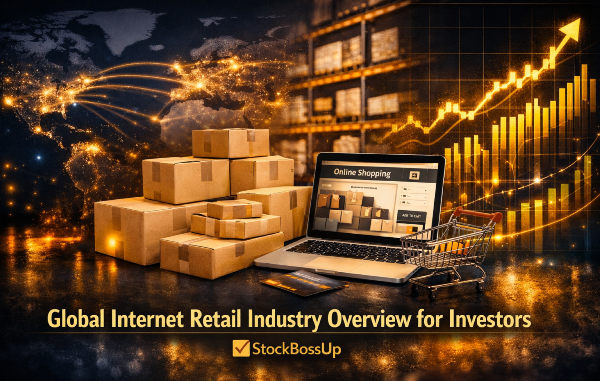
Global Internet Retail Industry Overview for Investors
The Shopping Mall That Never Closes
The global internet retail industry has transformed how people buy almost everything. From groceries and electronics to furniture and pharmaceuticals, consumers increasingly turn to digital platforms instead of physical stores.
For investors, internet retail represents far more than online shopping. It is a massive ecosystem that combines technology, logistics, payments, advertising, cloud computing, and consumer behavior into one rapidly evolving market.
The industry's growth has been remarkable. What began as a niche segment of retail has become a dominant force across major economies. Millions of consumers now expect products to be available instantly, delivered quickly, and purchased with only a few taps on a smartphone.
Perhaps the most remarkable aspect of internet retail is how quickly consumer habits can change. A shopper who once drove twenty minutes to a store may now expect same-day delivery without ever leaving home.
This shift continues to create opportunities for companies that can deliver convenience, speed, and value.
Why Internet Retail Continues to Grow
The biggest reason internet retail keeps expanding is simple: convenience.
Consumers can compare products, read reviews, check prices, and complete purchases within minutes. Physical stores often cannot match that level of efficiency.
Technology has also lowered barriers to entry for retailers. Small businesses can reach global audiences through marketplaces and direct-to-consumer websites without building large physical store networks.
Another factor is changing demographics. Younger consumers have grown up shopping online and often view digital purchasing as the default option rather than an alternative.
As internet access expands globally, new markets continue to enter the digital economy.
| Growth Driver |
Impact on Industry |
| Smartphone adoption |
Very High |
| Faster internet speeds |
High |
| Digital payments |
High |
| Logistics improvements |
Very High |
| Global connectivity |
High |
One interesting detail is that many consumers now begin product searches directly on Amazon rather than using traditional search engines. For many shoppers, the marketplace itself has become the first stop in the buying journey.
The Global Leaders Shaping the Industry
A relatively small number of companies control much of the global internet retail landscape.
Amazon remains the dominant force in North America and several international markets. The company combines e-commerce, logistics, cloud computing, advertising, and subscription services into a powerful ecosystem.
Alibaba remains one of the largest players in China and Asia. Through platforms such as Taobao and Tmall, the company serves hundreds of millions of consumers and merchants.
MercadoLibre has established itself as the leading e-commerce platform in Latin America. Its combination of marketplace services, logistics, and fintech products creates a strong competitive position.
JD.com continues to stand out because of its highly developed logistics network and direct retail model.
Meanwhile, companies such as Shopify, Coupang, Sea Limited, and PDD Holdings continue expanding their influence in various regions.
| Company |
Primary Market |
Key Strength |
| Amazon |
North America |
Logistics and scale |
| Alibaba |
China |
Marketplace ecosystem |
| MercadoLibre |
Latin America |
Commerce and fintech |
| JD.com |
China |
Fulfillment network |
| Shopify |
Global |
Merchant enablement |
| Coupang |
South Korea |
Fast delivery |
The largest internet retailers are increasingly becoming technology companies that happen to sell products rather than retailers that happen to use technology.
Why Logistics Has Become a Competitive Weapon
Fast delivery is no longer a luxury. It has become an expectation.
The companies that win in internet retail are often those with the strongest logistics capabilities.
Building warehouses is expensive. Building nationwide fulfillment networks is even harder. Maintaining transportation fleets, inventory systems, and delivery partnerships requires enormous investment.
This creates significant barriers to entry.
Amazon's fulfillment infrastructure is one of the most valuable assets in the entire retail sector. MercadoLibre has spent years building logistics capabilities across Latin America. JD.com operates one of the most sophisticated delivery networks in China.
Investors often focus on revenue growth, but logistics infrastructure can be just as important.
| Logistics Advantage |
Business Impact |
| Faster delivery |
Higher customer retention |
| Better inventory management |
Improved margins |
| Regional warehouses |
Reduced shipping costs |
| Delivery optimization |
Increased efficiency |
| Automated fulfillment |
Higher scalability |
A customer may forget where they bought a product, but they rarely forget a delivery that arrived earlier than expected.
Mobile Commerce Is Changing Everything
The smartphone has become the primary storefront for much of the world.
Mobile commerce now accounts for a large share of global online retail transactions. Consumers browse, compare, purchase, and track orders directly from mobile devices.
This trend is especially important in emerging markets where many consumers skipped desktop computers entirely and moved straight to smartphones.
Retailers have responded by investing heavily in mobile apps, digital wallets, and personalized shopping experiences.
The result is a shopping experience that feels increasingly seamless.
A fascinating development is that some consumers spend more time browsing products through social media platforms than through traditional online stores. The line between entertainment and shopping continues to blur.
The Growing Role of Digital Payments
Digital payments are a critical piece of the internet retail ecosystem.
Consumers expect transactions to be fast, secure, and convenient. Retailers that simplify payment processes often experience higher conversion rates.
This has created opportunities for integrated payment platforms.
Mercado Pago has become a major growth driver for MercadoLibre. Alipay remains deeply connected to Alibaba's ecosystem. Numerous internet retailers are building payment solutions directly into their platforms.
| Payment Feature |
Benefit |
| One-click checkout |
Faster purchases |
| Digital wallets |
Improved convenience |
| Buy-now-pay-later options |
Increased spending |
| Fraud protection |
Higher trust |
| Mobile payments |
Better user experience |
Payment systems are becoming strategic assets rather than simple transaction tools.
Artificial Intelligence Is Becoming a Retail Engine
Artificial intelligence is rapidly changing internet retail operations.
Retailers use AI to recommend products, forecast demand, optimize pricing, manage inventory, and improve customer service.
The technology helps companies operate more efficiently while creating more personalized shopping experiences.
For investors, AI may become one of the most important competitive differentiators over the next decade.
Companies that effectively leverage data can better understand customer behavior and respond more quickly to changing trends.
This creates advantages that can compound over time.
As AI systems improve, retailers may increasingly predict what consumers want before consumers actively search for it.
International Expansion Remains a Major Opportunity
Despite impressive growth, internet retail still has significant room to expand globally.
Many emerging markets remain underpenetrated compared to developed economies.
Rising incomes, increasing smartphone adoption, and improving internet infrastructure continue to create opportunities for e-commerce growth.
Companies with strong international strategies may benefit from years of future expansion.
| Region |
Growth Potential |
| Latin America |
High |
| Southeast Asia |
Very High |
| India |
Very High |
| Africa |
High |
| Middle East |
Moderate to High |
Investors should pay close attention to companies building strong positions in regions where online retail adoption is still developing.
Risks Investors Should Watch
Internet retail is not without challenges.
Competition remains intense. Customer acquisition costs can rise quickly. Logistics expenses can pressure margins.
Regulatory scrutiny is also increasing. Governments around the world are examining large technology and e-commerce companies more closely.
Economic slowdowns can reduce consumer spending, while supply chain disruptions can affect inventory availability.
At the same time, cybersecurity threats remain an ongoing concern.
| Risk Factor |
Potential Impact |
| Increased competition |
Margin pressure |
| Regulatory changes |
Operational challenges |
| Economic downturns |
Lower consumer demand |
| Supply chain disruptions |
Inventory shortages |
| Cybersecurity threats |
Reputation and financial risk |
The strongest companies are often those that can navigate these challenges while continuing to invest for future growth.
What Investors Should Focus On
Not all internet retail stocks are created equal.
Some companies prioritize growth at all costs. Others focus on profitability and cash generation. The most attractive opportunities often balance both objectives.
Investors should examine market share, logistics infrastructure, customer retention, profitability trends, and ecosystem strength.
A large user base alone is not enough. Sustainable competitive advantages matter.
Companies that successfully combine commerce, payments, logistics, advertising, and technology services often build stronger long-term business models.
The internet retail industry remains one of the most dynamic sectors in the global economy. Consumer behavior continues to evolve, technology continues to improve, and new markets continue to come online.
For long-term investors, understanding the industry's structure is the first step toward identifying the companies most likely to benefit from the next chapter of digital commerce. The winners may not simply be the biggest retailers. They may be the businesses that build the strongest ecosystems around how people shop, pay, and interact online.
🚀 Expand Your Edge: Elite Internet Retail & E-Commerce Intelligence
Ready to capitalize on the future of digital commerce? Our Internet Retail Investor Intelligence Hub is designed to help investors analyze the companies, technologies, and trends reshaping global shopping. From foundational industry research and stock selection to AI, logistics, valuation, and international growth, explore the curated silos below to uncover your next investment opportunity.
🌐 Industry Fundamentals & Market Leaders
📊 Financial Strength & Shareholder Returns
🤖 Technology, AI & Digital Transformation
🚚 Logistics, Fulfillment & Supply Chain Intelligence
🌍 Global Expansion & Market Opportunities
⚠️ Risk Management & Economic Trends
🔍 Competitive Analysis & Advanced Research













Last updated on June 23rd 2026 by Noah Brody
🔑 Key Takeaways
🌎 Internet retail has become one of the largest and fastest-evolving sectors in the global economy
Online commerce continues to gain market share from traditional retail as consumers increasingly shop through websites, mobile apps, and digital marketplaces. The industry's growth is driven by convenience, logistics innovation, and expanding internet access worldwide.
📦 Logistics networks and fulfillment infrastructure create powerful competitive advantages
The leading internet retailers are not simply online storefronts. Companies such as Amazon, Alibaba, MercadoLibre, and JD.com have invested billions into warehouses, transportation systems, and delivery networks that are difficult for competitors to replicate.
📱 Mobile commerce, AI, and digital payments are reshaping the industry's future
New technologies are making online shopping faster, more personalized, and more efficient. Retailers that successfully leverage artificial intelligence, mobile platforms, and integrated payment ecosystems are positioned to capture future growth.
📈 Investors should focus on scale, profitability, and market leadership
The strongest internet retail companies combine large customer bases, strong logistics capabilities, healthy cash flow, and expanding ecosystems. These characteristics often create durable competitive advantages and long-term growth opportunities.
Global Internet Retail Industry Overview for Investors
The Shopping Mall That Never Closes
The global internet retail industry has transformed how people buy almost everything. From groceries and electronics to furniture and pharmaceuticals, consumers increasingly turn to digital platforms instead of physical stores.
For investors, internet retail represents far more than online shopping. It is a massive ecosystem that combines technology, logistics, payments, advertising, cloud computing, and consumer behavior into one rapidly evolving market.
The industry's growth has been remarkable. What began as a niche segment of retail has become a dominant force across major economies. Millions of consumers now expect products to be available instantly, delivered quickly, and purchased with only a few taps on a smartphone.
Perhaps the most remarkable aspect of internet retail is how quickly consumer habits can change. A shopper who once drove twenty minutes to a store may now expect same-day delivery without ever leaving home.
This shift continues to create opportunities for companies that can deliver convenience, speed, and value.
Why Internet Retail Continues to Grow
The biggest reason internet retail keeps expanding is simple: convenience.
Consumers can compare products, read reviews, check prices, and complete purchases within minutes. Physical stores often cannot match that level of efficiency.
Technology has also lowered barriers to entry for retailers. Small businesses can reach global audiences through marketplaces and direct-to-consumer websites without building large physical store networks.
Another factor is changing demographics. Younger consumers have grown up shopping online and often view digital purchasing as the default option rather than an alternative.
As internet access expands globally, new markets continue to enter the digital economy.
One interesting detail is that many consumers now begin product searches directly on Amazon rather than using traditional search engines. For many shoppers, the marketplace itself has become the first stop in the buying journey.
The Global Leaders Shaping the Industry
A relatively small number of companies control much of the global internet retail landscape.
Amazon remains the dominant force in North America and several international markets. The company combines e-commerce, logistics, cloud computing, advertising, and subscription services into a powerful ecosystem.
Alibaba remains one of the largest players in China and Asia. Through platforms such as Taobao and Tmall, the company serves hundreds of millions of consumers and merchants.
MercadoLibre has established itself as the leading e-commerce platform in Latin America. Its combination of marketplace services, logistics, and fintech products creates a strong competitive position.
JD.com continues to stand out because of its highly developed logistics network and direct retail model.
Meanwhile, companies such as Shopify, Coupang, Sea Limited, and PDD Holdings continue expanding their influence in various regions.
The largest internet retailers are increasingly becoming technology companies that happen to sell products rather than retailers that happen to use technology.
Why Logistics Has Become a Competitive Weapon
Fast delivery is no longer a luxury. It has become an expectation.
The companies that win in internet retail are often those with the strongest logistics capabilities.
Building warehouses is expensive. Building nationwide fulfillment networks is even harder. Maintaining transportation fleets, inventory systems, and delivery partnerships requires enormous investment.
This creates significant barriers to entry.
Amazon's fulfillment infrastructure is one of the most valuable assets in the entire retail sector. MercadoLibre has spent years building logistics capabilities across Latin America. JD.com operates one of the most sophisticated delivery networks in China.
Investors often focus on revenue growth, but logistics infrastructure can be just as important.
A customer may forget where they bought a product, but they rarely forget a delivery that arrived earlier than expected.
Mobile Commerce Is Changing Everything
The smartphone has become the primary storefront for much of the world.
Mobile commerce now accounts for a large share of global online retail transactions. Consumers browse, compare, purchase, and track orders directly from mobile devices.
This trend is especially important in emerging markets where many consumers skipped desktop computers entirely and moved straight to smartphones.
Retailers have responded by investing heavily in mobile apps, digital wallets, and personalized shopping experiences.
The result is a shopping experience that feels increasingly seamless.
A fascinating development is that some consumers spend more time browsing products through social media platforms than through traditional online stores. The line between entertainment and shopping continues to blur.
The Growing Role of Digital Payments
Digital payments are a critical piece of the internet retail ecosystem.
Consumers expect transactions to be fast, secure, and convenient. Retailers that simplify payment processes often experience higher conversion rates.
This has created opportunities for integrated payment platforms.
Mercado Pago has become a major growth driver for MercadoLibre. Alipay remains deeply connected to Alibaba's ecosystem. Numerous internet retailers are building payment solutions directly into their platforms.
Payment systems are becoming strategic assets rather than simple transaction tools.
Artificial Intelligence Is Becoming a Retail Engine
Artificial intelligence is rapidly changing internet retail operations.
Retailers use AI to recommend products, forecast demand, optimize pricing, manage inventory, and improve customer service.
The technology helps companies operate more efficiently while creating more personalized shopping experiences.
For investors, AI may become one of the most important competitive differentiators over the next decade.
Companies that effectively leverage data can better understand customer behavior and respond more quickly to changing trends.
This creates advantages that can compound over time.
As AI systems improve, retailers may increasingly predict what consumers want before consumers actively search for it.
International Expansion Remains a Major Opportunity
Despite impressive growth, internet retail still has significant room to expand globally.
Many emerging markets remain underpenetrated compared to developed economies.
Rising incomes, increasing smartphone adoption, and improving internet infrastructure continue to create opportunities for e-commerce growth.
Companies with strong international strategies may benefit from years of future expansion.
Investors should pay close attention to companies building strong positions in regions where online retail adoption is still developing.
Risks Investors Should Watch
Internet retail is not without challenges.
Competition remains intense. Customer acquisition costs can rise quickly. Logistics expenses can pressure margins.
Regulatory scrutiny is also increasing. Governments around the world are examining large technology and e-commerce companies more closely.
Economic slowdowns can reduce consumer spending, while supply chain disruptions can affect inventory availability.
At the same time, cybersecurity threats remain an ongoing concern.
The strongest companies are often those that can navigate these challenges while continuing to invest for future growth.
What Investors Should Focus On
Not all internet retail stocks are created equal.
Some companies prioritize growth at all costs. Others focus on profitability and cash generation. The most attractive opportunities often balance both objectives.
Investors should examine market share, logistics infrastructure, customer retention, profitability trends, and ecosystem strength.
A large user base alone is not enough. Sustainable competitive advantages matter.
Companies that successfully combine commerce, payments, logistics, advertising, and technology services often build stronger long-term business models.
The internet retail industry remains one of the most dynamic sectors in the global economy. Consumer behavior continues to evolve, technology continues to improve, and new markets continue to come online.
For long-term investors, understanding the industry's structure is the first step toward identifying the companies most likely to benefit from the next chapter of digital commerce. The winners may not simply be the biggest retailers. They may be the businesses that build the strongest ecosystems around how people shop, pay, and interact online.
🚀 Expand Your Edge: Elite Internet Retail & E-Commerce Intelligence
Ready to capitalize on the future of digital commerce? Our Internet Retail Investor Intelligence Hub is designed to help investors analyze the companies, technologies, and trends reshaping global shopping. From foundational industry research and stock selection to AI, logistics, valuation, and international growth, explore the curated silos below to uncover your next investment opportunity.
🌐 Industry Fundamentals & Market Leaders
📊 Financial Strength & Shareholder Returns
🤖 Technology, AI & Digital Transformation
🚚 Logistics, Fulfillment & Supply Chain Intelligence
🌍 Global Expansion & Market Opportunities
⚠️ Risk Management & Economic Trends
🔍 Competitive Analysis & Advanced Research