Last updated on June 23rd 2026 by Noah Brody
🔑 Key Takeaways
💰 The most profitable internet retail companies generate revenue from far more than online shopping
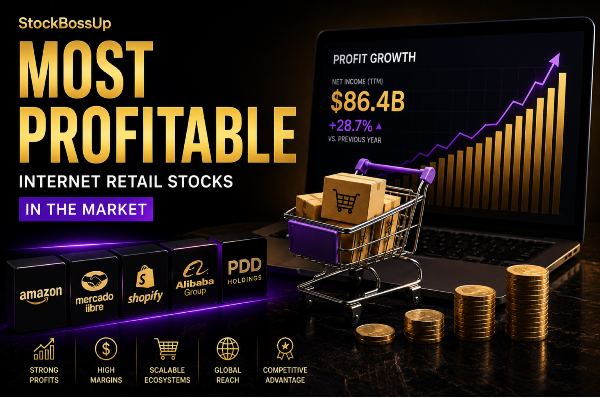
Industry leaders such as Amazon, Alibaba, MercadoLibre, PDD Holdings, and JD.com have expanded into advertising, payments, logistics, cloud computing, and marketplace services. These higher-margin businesses often contribute significantly to overall profitability.
📦 Marketplace models typically produce stronger margins than inventory-heavy retail models
Companies that connect buyers and sellers without owning large amounts of inventory can often scale faster and generate higher profit margins than traditional retail businesses.
🚀 Profitability often follows ecosystem strength rather than sales volume alone
The most profitable internet retailers build ecosystems that encourage repeat purchases, customer loyalty, merchant participation, and recurring revenue streams.
🏰 Durable competitive advantages help protect profits over the long term
Strong logistics networks, trusted brands, network effects, and digital platforms allow leading e-commerce companies to maintain pricing power and defend market share.
Most Profitable Internet Retail Stocks in the Market
When Revenue Meets Real Earnings
Growing revenue is exciting.
Generating profits is what ultimately matters.
The internet retail sector has produced some of the largest and fastest-growing companies in the world. Yet many investors eventually discover that massive sales figures do not always translate into equally impressive profits.
That is because online retail can be a challenging business. Shipping costs, fulfillment expenses, customer acquisition spending, and technology investments can eat into margins.
The companies that consistently generate strong profits have usually built advantages that extend far beyond simply selling products online.
They have created ecosystems.
These ecosystems often include advertising platforms, payment networks, subscriptions, logistics services, cloud computing, and merchant tools. Together, these businesses can transform a retailer into a profit-generating machine.
Amazon: The Profit Engine Hidden Inside E-Commerce
Amazon is often viewed as the king of online retail.
Yet its profitability story goes much deeper than product sales.
The company's marketplace allows third-party sellers to reach millions of customers. Those sellers pay fees that often carry stronger margins than direct retail operations.
Advertising has become another major contributor.
Brands increasingly pay for premium placement within Amazon's ecosystem because shoppers arrive with strong purchase intent.
Meanwhile, Amazon Web Services provides an entirely different profit engine.
Although AWS is not a retail business, it contributes significantly to Amazon's overall earnings power.
This combination of commerce, advertising, subscriptions, and cloud computing creates one of the most diversified profit structures in the industry.
| Amazon Profit Driver |
Contribution to Profitability |
| Marketplace Fees |
High-margin revenue |
| Advertising Services |
Strong margins |
| Prime Memberships |
Recurring income |
| AWS Cloud Business |
Significant earnings contributor |
| Logistics Services |
Ecosystem support |
Many investors focus on what Amazon sells. The more important question may be how many different ways Amazon earns money from a single customer relationship.
Alibaba's Marketplace Model Supports Strong Margins
Alibaba built one of the world's largest e-commerce ecosystems using a marketplace-focused approach.
Unlike many traditional retailers, Alibaba often acts as the platform connecting buyers and sellers rather than directly owning large amounts of inventory.
This structure can create attractive economics.
Marketplace operators typically avoid many inventory risks while benefiting from transaction volume growth.
Alibaba has also expanded into cloud services, logistics partnerships, digital commerce infrastructure, and business services.
These complementary businesses help diversify revenue while supporting overall profitability.
The company's scale remains one of its greatest advantages.
Millions of merchants and consumers interact across Alibaba's platforms every day, creating powerful network effects that support long-term earnings potential.
MercadoLibre Continues Building a Profitable Ecosystem
MercadoLibre has become one of the most successful digital commerce companies in Latin America.
Its profitability story revolves around ecosystem expansion.
The company operates online marketplaces, payment systems, logistics networks, advertising services, and financial products.
Each business supports the others.
A consumer may start by making an online purchase. Later, that same customer could use Mercado Pago for payments, receive financing, or interact with additional services offered through the platform.
This interconnected model creates multiple profit opportunities from a single user relationship.
| MercadoLibre Business Segment |
Strategic Value |
| Marketplace Operations |
Core transaction growth |
| Mercado Pago |
Financial ecosystem expansion |
| Advertising Services |
Higher-margin revenue |
| Logistics Network |
Customer retention |
| Credit Products |
Additional monetization |
As digital commerce adoption continues growing throughout Latin America, MercadoLibre remains positioned to benefit from both retail and financial technology trends.
PDD Holdings Shows How Scale Can Drive Profitability
PDD Holdings has become one of the most closely watched companies in global e-commerce.
Its rapid growth attracted investor attention, but profitability has become an equally important part of the story.
The company's marketplace model allows it to scale efficiently.
Rather than managing massive inventories across every product category, PDD Holdings connects buyers and sellers through its platforms.
This approach can create operating leverage as transaction volume increases.
International expansion has also opened new opportunities.
As more users join the ecosystem, the company gains additional opportunities to monetize advertising, merchant services, and marketplace activity.
One fascinating aspect of digital marketplaces is that profitability can improve significantly even when the company never physically touches most of the products being sold.
JD.com Takes a Different Path
JD.com represents a different approach to e-commerce profitability.
Unlike many marketplace-focused competitors, JD.com built extensive logistics and fulfillment capabilities.
This strategy requires significant investment.
Warehouses, delivery systems, automation technologies, and transportation infrastructure are not cheap.
However, they can create meaningful competitive advantages.
Customers often value fast delivery, reliable service, and strong quality control.
JD.com's logistics capabilities help support those goals while differentiating the company from competitors.
The result is a business model that prioritizes operational excellence and customer experience.
While margins may differ from pure marketplace operators, the strategy has helped JD.com build a trusted position in Chinese e-commerce.
Why Marketplace Models Often Produce Stronger Margins
One reason many profitable internet retail companies operate marketplaces is simple economics.
Traditional retailers purchase inventory and then resell it.
Marketplace operators connect buyers and sellers.
That distinction can have a major impact on profitability.
| Business Model |
Margin Characteristics |
| Traditional Retail |
Lower margins |
| Marketplace Platform |
Higher margins |
| Advertising Services |
Very high margins |
| Payment Processing |
Moderate to high margins |
| Software Platforms |
High margins |
Marketplace businesses often generate revenue through fees, commissions, advertising, and value-added services.
These revenue streams can scale efficiently as transaction volume grows.
That does not mean marketplaces are always superior.
However, they frequently provide attractive profit opportunities when executed successfully.
Advertising Has Become a Hidden Gold Mine
Many investors still think of internet retailers primarily as shopping platforms.
Increasingly, they are advertising businesses as well.
When consumers search for products, companies gain valuable information about purchase intent.
Brands are willing to pay for visibility in those moments.
Amazon has built one of the world's largest advertising businesses.
Alibaba and MercadoLibre have expanded advertising offerings as well.
Advertising revenue is especially attractive because it often carries much higher margins than retail operations.
A retailer may earn only a small percentage on a product sale, but advertising attached to that transaction can be far more profitable.
This trend continues reshaping the economics of digital commerce.
Logistics Can Improve Profitability Over Time
Building logistics infrastructure requires substantial investment.
Initially, those investments may pressure earnings.
Over time, efficient logistics networks can become competitive advantages.
Companies with strong fulfillment systems may reduce shipping costs, improve delivery speed, increase customer satisfaction, and strengthen retention.
These benefits can compound.
A lesser-known reality is that improvements measured in minutes within warehouse operations can translate into millions of dollars in annual efficiency gains for large e-commerce companies.
Operational excellence often becomes a hidden source of profitability.
What Investors Should Watch Beyond Earnings
Profitability matters.
The quality of profitability matters even more.
Investors should evaluate whether profits are sustainable.
Strong competitive advantages often provide clues.
Network effects, brand loyalty, logistics infrastructure, recurring revenue, and ecosystem strength can all help protect earnings.
| Profitability Indicator |
Why It Matters |
| Operating Margin Trends |
Efficiency improvements |
| Free Cash Flow |
Financial flexibility |
| Customer Retention |
Revenue stability |
| Network Effects |
Competitive protection |
| Revenue Diversification |
Lower business risk |
Companies that combine strong profits with durable competitive advantages often attract long-term investor interest.
The Businesses Turning Clicks Into Cash
The most profitable internet retail stocks have evolved beyond online shopping.
Amazon built a powerful mix of commerce, advertising, subscriptions, and cloud computing. Alibaba leverages marketplace economics and ecosystem scale. MercadoLibre combines e-commerce with financial technology. PDD Holdings benefits from efficient platform economics. JD.com differentiates itself through logistics excellence.
Each company followed a different path.
Yet they share an important characteristic.
They found ways to monetize customer relationships beyond simple product transactions.
For investors, that distinction can be critical.
Anyone can build an online store.
The companies that consistently generate strong profits build entire ecosystems around that store.
That is often where the real value is created.
🚀 Expand Your Edge: Elite Internet Retail & E-Commerce Intelligence
Ready to capitalize on the future of digital commerce? Our Internet Retail Investor Intelligence Hub is designed to help investors analyze the companies, technologies, and trends reshaping global shopping. From foundational industry research and stock selection to AI, logistics, valuation, and international growth, explore the curated silos below to uncover your next investment opportunity.
🌐 Industry Fundamentals & Market Leaders
📊 Financial Strength & Shareholder Returns
🤖 Technology, AI & Digital Transformation
🚚 Logistics, Fulfillment & Supply Chain Intelligence
🌍 Global Expansion & Market Opportunities
⚠️ Risk Management & Economic Trends
🔍 Competitive Analysis & Advanced Research


















Last updated on June 23rd 2026 by Noah Brody
🔑 Key Takeaways
💰 The most profitable internet retail companies generate revenue from far more than online shopping
Industry leaders such as Amazon, Alibaba, MercadoLibre, PDD Holdings, and JD.com have expanded into advertising, payments, logistics, cloud computing, and marketplace services. These higher-margin businesses often contribute significantly to overall profitability.
📦 Marketplace models typically produce stronger margins than inventory-heavy retail models
Companies that connect buyers and sellers without owning large amounts of inventory can often scale faster and generate higher profit margins than traditional retail businesses.
🚀 Profitability often follows ecosystem strength rather than sales volume alone
The most profitable internet retailers build ecosystems that encourage repeat purchases, customer loyalty, merchant participation, and recurring revenue streams.
🏰 Durable competitive advantages help protect profits over the long term
Strong logistics networks, trusted brands, network effects, and digital platforms allow leading e-commerce companies to maintain pricing power and defend market share.
Most Profitable Internet Retail Stocks in the Market
When Revenue Meets Real Earnings
Growing revenue is exciting.
Generating profits is what ultimately matters.
The internet retail sector has produced some of the largest and fastest-growing companies in the world. Yet many investors eventually discover that massive sales figures do not always translate into equally impressive profits.
That is because online retail can be a challenging business. Shipping costs, fulfillment expenses, customer acquisition spending, and technology investments can eat into margins.
The companies that consistently generate strong profits have usually built advantages that extend far beyond simply selling products online.
They have created ecosystems.
These ecosystems often include advertising platforms, payment networks, subscriptions, logistics services, cloud computing, and merchant tools. Together, these businesses can transform a retailer into a profit-generating machine.
Amazon: The Profit Engine Hidden Inside E-Commerce
Amazon is often viewed as the king of online retail.
Yet its profitability story goes much deeper than product sales.
The company's marketplace allows third-party sellers to reach millions of customers. Those sellers pay fees that often carry stronger margins than direct retail operations.
Advertising has become another major contributor.
Brands increasingly pay for premium placement within Amazon's ecosystem because shoppers arrive with strong purchase intent.
Meanwhile, Amazon Web Services provides an entirely different profit engine.
Although AWS is not a retail business, it contributes significantly to Amazon's overall earnings power.
This combination of commerce, advertising, subscriptions, and cloud computing creates one of the most diversified profit structures in the industry.
Many investors focus on what Amazon sells. The more important question may be how many different ways Amazon earns money from a single customer relationship.
Alibaba's Marketplace Model Supports Strong Margins
Alibaba built one of the world's largest e-commerce ecosystems using a marketplace-focused approach.
Unlike many traditional retailers, Alibaba often acts as the platform connecting buyers and sellers rather than directly owning large amounts of inventory.
This structure can create attractive economics.
Marketplace operators typically avoid many inventory risks while benefiting from transaction volume growth.
Alibaba has also expanded into cloud services, logistics partnerships, digital commerce infrastructure, and business services.
These complementary businesses help diversify revenue while supporting overall profitability.
The company's scale remains one of its greatest advantages.
Millions of merchants and consumers interact across Alibaba's platforms every day, creating powerful network effects that support long-term earnings potential.
MercadoLibre Continues Building a Profitable Ecosystem
MercadoLibre has become one of the most successful digital commerce companies in Latin America.
Its profitability story revolves around ecosystem expansion.
The company operates online marketplaces, payment systems, logistics networks, advertising services, and financial products.
Each business supports the others.
A consumer may start by making an online purchase. Later, that same customer could use Mercado Pago for payments, receive financing, or interact with additional services offered through the platform.
This interconnected model creates multiple profit opportunities from a single user relationship.
As digital commerce adoption continues growing throughout Latin America, MercadoLibre remains positioned to benefit from both retail and financial technology trends.
PDD Holdings Shows How Scale Can Drive Profitability
PDD Holdings has become one of the most closely watched companies in global e-commerce.
Its rapid growth attracted investor attention, but profitability has become an equally important part of the story.
The company's marketplace model allows it to scale efficiently.
Rather than managing massive inventories across every product category, PDD Holdings connects buyers and sellers through its platforms.
This approach can create operating leverage as transaction volume increases.
International expansion has also opened new opportunities.
As more users join the ecosystem, the company gains additional opportunities to monetize advertising, merchant services, and marketplace activity.
One fascinating aspect of digital marketplaces is that profitability can improve significantly even when the company never physically touches most of the products being sold.
JD.com Takes a Different Path
JD.com represents a different approach to e-commerce profitability.
Unlike many marketplace-focused competitors, JD.com built extensive logistics and fulfillment capabilities.
This strategy requires significant investment.
Warehouses, delivery systems, automation technologies, and transportation infrastructure are not cheap.
However, they can create meaningful competitive advantages.
Customers often value fast delivery, reliable service, and strong quality control.
JD.com's logistics capabilities help support those goals while differentiating the company from competitors.
The result is a business model that prioritizes operational excellence and customer experience.
While margins may differ from pure marketplace operators, the strategy has helped JD.com build a trusted position in Chinese e-commerce.
Why Marketplace Models Often Produce Stronger Margins
One reason many profitable internet retail companies operate marketplaces is simple economics.
Traditional retailers purchase inventory and then resell it.
Marketplace operators connect buyers and sellers.
That distinction can have a major impact on profitability.
Marketplace businesses often generate revenue through fees, commissions, advertising, and value-added services.
These revenue streams can scale efficiently as transaction volume grows.
That does not mean marketplaces are always superior.
However, they frequently provide attractive profit opportunities when executed successfully.
Advertising Has Become a Hidden Gold Mine
Many investors still think of internet retailers primarily as shopping platforms.
Increasingly, they are advertising businesses as well.
When consumers search for products, companies gain valuable information about purchase intent.
Brands are willing to pay for visibility in those moments.
Amazon has built one of the world's largest advertising businesses.
Alibaba and MercadoLibre have expanded advertising offerings as well.
Advertising revenue is especially attractive because it often carries much higher margins than retail operations.
A retailer may earn only a small percentage on a product sale, but advertising attached to that transaction can be far more profitable.
This trend continues reshaping the economics of digital commerce.
Logistics Can Improve Profitability Over Time
Building logistics infrastructure requires substantial investment.
Initially, those investments may pressure earnings.
Over time, efficient logistics networks can become competitive advantages.
Companies with strong fulfillment systems may reduce shipping costs, improve delivery speed, increase customer satisfaction, and strengthen retention.
These benefits can compound.
A lesser-known reality is that improvements measured in minutes within warehouse operations can translate into millions of dollars in annual efficiency gains for large e-commerce companies.
Operational excellence often becomes a hidden source of profitability.
What Investors Should Watch Beyond Earnings
Profitability matters.
The quality of profitability matters even more.
Investors should evaluate whether profits are sustainable.
Strong competitive advantages often provide clues.
Network effects, brand loyalty, logistics infrastructure, recurring revenue, and ecosystem strength can all help protect earnings.
Companies that combine strong profits with durable competitive advantages often attract long-term investor interest.
The Businesses Turning Clicks Into Cash
The most profitable internet retail stocks have evolved beyond online shopping.
Amazon built a powerful mix of commerce, advertising, subscriptions, and cloud computing. Alibaba leverages marketplace economics and ecosystem scale. MercadoLibre combines e-commerce with financial technology. PDD Holdings benefits from efficient platform economics. JD.com differentiates itself through logistics excellence.
Each company followed a different path.
Yet they share an important characteristic.
They found ways to monetize customer relationships beyond simple product transactions.
For investors, that distinction can be critical.
Anyone can build an online store.
The companies that consistently generate strong profits build entire ecosystems around that store.
That is often where the real value is created.
🚀 Expand Your Edge: Elite Internet Retail & E-Commerce Intelligence
Ready to capitalize on the future of digital commerce? Our Internet Retail Investor Intelligence Hub is designed to help investors analyze the companies, technologies, and trends reshaping global shopping. From foundational industry research and stock selection to AI, logistics, valuation, and international growth, explore the curated silos below to uncover your next investment opportunity.
🌐 Industry Fundamentals & Market Leaders
📊 Financial Strength & Shareholder Returns
🤖 Technology, AI & Digital Transformation
🚚 Logistics, Fulfillment & Supply Chain Intelligence
🌍 Global Expansion & Market Opportunities
⚠️ Risk Management & Economic Trends
🔍 Competitive Analysis & Advanced Research