🔑 Key Takeaways
🔋 Lithium-ion batteries dominate today’s EV market, but solid-state is the long-term target
Lithium-ion suppliers like CATL, LG Energy Solution, Panasonic Energy, and BYD currently power nearly all electric vehicles on the road. Solid-state battery suppliers are still in development or early commercialization stages, but they aim to deliver higher energy density, faster charging, and improved safety in future EV platforms.
🏭 Lithium-ion supply chains are mature, while solid-state supply chains are still forming
Lithium-ion production benefits from established manufacturing scale, global mining networks, and proven OEM integration. Solid-state battery suppliers such as QuantumScape, Solid Power, Toyota, and Samsung SDI are still building scalable production systems, which limits near-term volume but increases long-term upside potential.
⚡ Solid-state technology focuses on safety and energy density improvements over lithium-ion
Solid-state batteries replace liquid electrolytes with solid materials, reducing fire risk and improving energy density. Lithium-ion batteries continue to improve through incremental chemistry upgrades, but they face physical limits that solid-state designs aim to overcome.
🚗 Automakers are investing in both technologies to manage transition risk
Companies like Toyota, Volkswagen, BMW, Ford, and Hyundai are investing in lithium-ion supply chains while funding solid-state development programs. This dual strategy helps automakers secure current production needs while preparing for next-generation battery platforms.
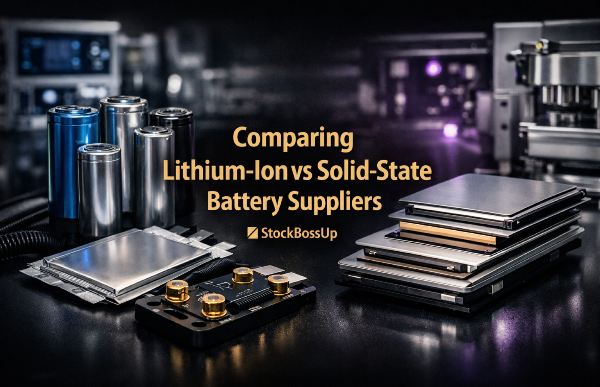
Comparing Lithium-Ion vs Solid-State Battery Suppliers
The battery industry is divided between two major technologies: lithium-ion systems that dominate today’s electric vehicles, and solid-state batteries that represent the next phase of innovation. Both technologies are supported by different groups of suppliers, with very different levels of maturity, scale, and commercial readiness.
Lithium-ion suppliers currently control the vast majority of EV production. Solid-state suppliers are still in the development and pilot phase, but they are attracting significant investment from automakers and technology firms.
Understanding the difference between these supplier ecosystems is key to seeing where the EV industry is today and where it is likely to move over the next decade.
Why Lithium-Ion Suppliers Dominate Today’s EV Market
Lithium-ion batteries are the foundation of the modern electric vehicle industry. They are widely used because they offer a strong balance of cost, energy density, and manufacturing scalability.
Major suppliers such as CATL, LG Energy Solution, Panasonic Energy, and BYD operate large-scale production facilities that supply most global automakers. These companies have spent years building integrated supply chains that include mining, refining, cell production, and assembly.
Lithium-ion technology also benefits from continuous incremental improvements, including better cathode chemistries and improved thermal management systems.
| Supplier |
Region |
Strength |
Market Role |
| CATL |
China |
Scale + cost efficiency |
Global EV leader |
| LG Energy Solution |
South Korea |
OEM partnerships |
High-growth supplier |
| Panasonic Energy |
Japan |
Reliability |
Long-term EV partner |
| BYD |
China |
Vertical integration |
EV + battery producer |
A key advantage of lithium-ion suppliers is that their production systems are already optimized for mass manufacturing, allowing them to support millions of EVs annually.
Why Solid-State Battery Suppliers Are Still Emerging
Solid-state batteries are still in early commercialization. Unlike lithium-ion batteries, they use solid electrolytes instead of liquid ones, which changes both performance and manufacturing requirements.
Companies like QuantumScape, Solid Power, Toyota, and Samsung SDI are leading development efforts in this space. However, most solid-state production remains in pilot or prototype stages.
Scaling solid-state manufacturing is difficult because it requires new materials, new production techniques, and new quality control systems that differ from lithium-ion manufacturing.
| Company |
Technology Stage |
Focus Area |
Commercial Status |
| QuantumScape |
Development |
Solid electrolyte cells |
Pre-scale |
| Solid Power |
Pilot production |
EV cell testing |
Early stage |
| Toyota |
R&D + prototypes |
Hybrid solid-state systems |
Testing phase |
| Samsung SDI |
Advanced R&D |
Hybrid transition tech |
Near-term development |
Solid-state suppliers are focused less on volume today and more on solving long-term technical barriers.
Lithium-Ion vs Solid-State Performance Differences
Lithium-ion and solid-state batteries differ significantly in structure and performance goals. Lithium-ion systems are optimized for proven reliability, while solid-state systems aim for next-generation improvements.
Solid-state batteries are expected to offer higher energy density, faster charging times, and improved safety. Lithium-ion batteries continue to improve but face physical limits in how much energy they can store efficiently.
| Feature |
Lithium-Ion |
Solid-State |
| Energy density |
High |
Higher potential |
| Charging speed |
Moderate |
Faster potential |
| Safety |
Good |
Improved |
| Manufacturing maturity |
High |
Low |
| Cost efficiency |
Strong |
Not yet optimized |
A key insight is that even small gains in energy density for solid-state batteries could significantly extend EV range without increasing battery size.
Why Supply Chains Are Very Different
Lithium-ion supply chains are highly developed and globally distributed. They rely on established mining operations for lithium, nickel, cobalt, and graphite, followed by large-scale refining and manufacturing.
Solid-state supply chains are still being built. They require new materials and production processes that are not yet standardized at scale.
This difference creates a major gap in cost structure and availability.
| Supply Chain Stage |
Lithium-Ion |
Solid-State |
| Raw materials |
Established |
Emerging |
| Manufacturing scale |
Global |
Limited |
| OEM integration |
Mature |
Early-stage |
| Cost structure |
Optimized |
High cost |
Lithium-ion benefits from decades of optimization, while solid-state is still in its early industrial phase.
Why Automakers Are Investing in Both Technologies
Automakers are not choosing between lithium-ion and solid-state exclusively. Instead, they are investing in both to reduce risk and ensure long-term flexibility.
Toyota is one of the most active investors in solid-state research while continuing to use lithium-ion systems in current vehicles. Volkswagen, BMW, Ford, and Hyundai are also supporting dual-track battery strategies.
This approach allows automakers to maintain production stability while preparing for future technological shifts.
| Automaker |
Lithium-Ion Strategy |
Solid-State Strategy |
| Toyota |
Large-scale hybrid + EV use |
Aggressive R&D |
| Volkswagen |
EV expansion |
Pilot investments |
| BMW |
EV platform scaling |
Strategic partnerships |
| Ford |
EV production growth |
Early development |
A key detail is that most automakers expect lithium-ion to remain dominant for several years even after solid-state technology becomes commercially available.
Why Investment Cycles Differ Between the Two
Lithium-ion battery suppliers tend to follow commodity-driven investment cycles. Their profitability is influenced by raw material prices and production scale efficiency.
Solid-state suppliers follow innovation-driven cycles. Their value is tied more to research breakthroughs and commercialization milestones than current revenue.
| Investment Factor |
Lithium-Ion |
Solid-State |
| Revenue base |
Established |
Minimal |
| Growth driver |
EV demand |
Technology breakthroughs |
| Risk profile |
Medium |
High |
| Time to scale |
Immediate |
Long-term |
This creates very different investment profiles for companies in each category.
Final Insight
Lithium-ion and solid-state batteries represent two different stages of the same industry evolution. Lithium-ion suppliers dominate today because they have scale, infrastructure, and OEM integration. Solid-state suppliers represent the next phase, but they still face significant technical and manufacturing challenges.
Companies like CATL, LG Energy Solution, Panasonic Energy, and BYD define the current market. Companies like QuantumScape, Solid Power, Toyota, and Samsung SDI represent the future direction of battery innovation.
The transition between these two technologies will not happen suddenly. Instead, it will unfold gradually as solid-state systems move from labs to pilot lines to full production.






🔑 Key Takeaways
🔋 Lithium-ion batteries dominate today’s EV market, but solid-state is the long-term target
Lithium-ion suppliers like CATL, LG Energy Solution, Panasonic Energy, and BYD currently power nearly all electric vehicles on the road. Solid-state battery suppliers are still in development or early commercialization stages, but they aim to deliver higher energy density, faster charging, and improved safety in future EV platforms.
🏭 Lithium-ion supply chains are mature, while solid-state supply chains are still forming
Lithium-ion production benefits from established manufacturing scale, global mining networks, and proven OEM integration. Solid-state battery suppliers such as QuantumScape, Solid Power, Toyota, and Samsung SDI are still building scalable production systems, which limits near-term volume but increases long-term upside potential.
⚡ Solid-state technology focuses on safety and energy density improvements over lithium-ion
Solid-state batteries replace liquid electrolytes with solid materials, reducing fire risk and improving energy density. Lithium-ion batteries continue to improve through incremental chemistry upgrades, but they face physical limits that solid-state designs aim to overcome.
🚗 Automakers are investing in both technologies to manage transition risk
Companies like Toyota, Volkswagen, BMW, Ford, and Hyundai are investing in lithium-ion supply chains while funding solid-state development programs. This dual strategy helps automakers secure current production needs while preparing for next-generation battery platforms.
Comparing Lithium-Ion vs Solid-State Battery Suppliers
The battery industry is divided between two major technologies: lithium-ion systems that dominate today’s electric vehicles, and solid-state batteries that represent the next phase of innovation. Both technologies are supported by different groups of suppliers, with very different levels of maturity, scale, and commercial readiness.
Lithium-ion suppliers currently control the vast majority of EV production. Solid-state suppliers are still in the development and pilot phase, but they are attracting significant investment from automakers and technology firms.
Understanding the difference between these supplier ecosystems is key to seeing where the EV industry is today and where it is likely to move over the next decade.
Why Lithium-Ion Suppliers Dominate Today’s EV Market
Lithium-ion batteries are the foundation of the modern electric vehicle industry. They are widely used because they offer a strong balance of cost, energy density, and manufacturing scalability.
Major suppliers such as CATL, LG Energy Solution, Panasonic Energy, and BYD operate large-scale production facilities that supply most global automakers. These companies have spent years building integrated supply chains that include mining, refining, cell production, and assembly.
Lithium-ion technology also benefits from continuous incremental improvements, including better cathode chemistries and improved thermal management systems.
A key advantage of lithium-ion suppliers is that their production systems are already optimized for mass manufacturing, allowing them to support millions of EVs annually.
Why Solid-State Battery Suppliers Are Still Emerging
Solid-state batteries are still in early commercialization. Unlike lithium-ion batteries, they use solid electrolytes instead of liquid ones, which changes both performance and manufacturing requirements.
Companies like QuantumScape, Solid Power, Toyota, and Samsung SDI are leading development efforts in this space. However, most solid-state production remains in pilot or prototype stages.
Scaling solid-state manufacturing is difficult because it requires new materials, new production techniques, and new quality control systems that differ from lithium-ion manufacturing.
Solid-state suppliers are focused less on volume today and more on solving long-term technical barriers.
Lithium-Ion vs Solid-State Performance Differences
Lithium-ion and solid-state batteries differ significantly in structure and performance goals. Lithium-ion systems are optimized for proven reliability, while solid-state systems aim for next-generation improvements.
Solid-state batteries are expected to offer higher energy density, faster charging times, and improved safety. Lithium-ion batteries continue to improve but face physical limits in how much energy they can store efficiently.
A key insight is that even small gains in energy density for solid-state batteries could significantly extend EV range without increasing battery size.
Why Supply Chains Are Very Different
Lithium-ion supply chains are highly developed and globally distributed. They rely on established mining operations for lithium, nickel, cobalt, and graphite, followed by large-scale refining and manufacturing.
Solid-state supply chains are still being built. They require new materials and production processes that are not yet standardized at scale.
This difference creates a major gap in cost structure and availability.
Lithium-ion benefits from decades of optimization, while solid-state is still in its early industrial phase.
Why Automakers Are Investing in Both Technologies
Automakers are not choosing between lithium-ion and solid-state exclusively. Instead, they are investing in both to reduce risk and ensure long-term flexibility.
Toyota is one of the most active investors in solid-state research while continuing to use lithium-ion systems in current vehicles. Volkswagen, BMW, Ford, and Hyundai are also supporting dual-track battery strategies.
This approach allows automakers to maintain production stability while preparing for future technological shifts.
A key detail is that most automakers expect lithium-ion to remain dominant for several years even after solid-state technology becomes commercially available.
Why Investment Cycles Differ Between the Two
Lithium-ion battery suppliers tend to follow commodity-driven investment cycles. Their profitability is influenced by raw material prices and production scale efficiency.
Solid-state suppliers follow innovation-driven cycles. Their value is tied more to research breakthroughs and commercialization milestones than current revenue.
This creates very different investment profiles for companies in each category.
Final Insight
Lithium-ion and solid-state batteries represent two different stages of the same industry evolution. Lithium-ion suppliers dominate today because they have scale, infrastructure, and OEM integration. Solid-state suppliers represent the next phase, but they still face significant technical and manufacturing challenges.
Companies like CATL, LG Energy Solution, Panasonic Energy, and BYD define the current market. Companies like QuantumScape, Solid Power, Toyota, and Samsung SDI represent the future direction of battery innovation.
The transition between these two technologies will not happen suddenly. Instead, it will unfold gradually as solid-state systems move from labs to pilot lines to full production.