Two Distinct Demand Drivers
The furnishings, fixtures, and appliances industry serves two fundamentally different customer segments: the residential market and the commercial market. Understanding the characteristics, cycles, and investment implications of each segment is essential for investors seeking to accurately model sector demand and identify companies best positioned for different economic environments.
The Residential Market
The residential market is driven by single-family and multi-family housing starts, existing home sales, and consumer renovation activity. It is highly correlated with mortgage rates, consumer confidence, and housing market conditions. Residential demand tends to be more cyclical, with sharp boom-bust patterns tied to the housing cycle. Companies serving the residential market include most major furniture retailers, appliance manufacturers, and residential fixture suppliers.
The Commercial Market
Office and Corporate Environments
Commercial office furnishings represent a significant subsegment, driven by corporate capital expenditure budgets, office construction, and workplace reconfiguration trends. The rise of hybrid work models post-pandemic has fundamentally disrupted traditional office furniture demand, accelerating the decline of traditional workstation configurations and driving demand for collaboration-oriented furniture and flexible workspace solutions. Companies like MillerKnoll (formerly Herman Miller), Steelcase, and Haworth are the leading players in this segment.
Hospitality and Healthcare Sectors
The hospitality sector (hotels, restaurants, resorts) and the healthcare sector (hospitals, clinics, senior living facilities) represent major commercial markets for specialized furnishings and fixtures. These sectors have distinct procurement cycles, durability requirements, and design specifications that differ substantially from residential and standard commercial markets. Companies with dedicated hospitality and healthcare product lines command premium pricing and enjoy more stable, contract-based revenue streams.
Cyclical Differences and Investment Implications
Commercial markets tend to lag residential markets in cyclical turns. During economic expansions, commercial construction and renovation accelerate as businesses invest in workspace improvements. During recessions, commercial capex is cut quickly, often before residential markets deteriorate. Companies with balanced residential and commercial exposure tend to exhibit smoother earnings profiles. Investors should track commercial construction permit data, corporate capital spending surveys, and hotel construction pipelines as leading indicators for commercial demand.
Conclusion
Understanding the distinction between residential and commercial demand markets is fundamental to sector analysis. Investors who can accurately assess each company's residential versus commercial exposure, and who track the leading indicators for each segment, will be better positioned to anticipate earnings trends and identify the most attractive entry points throughout the economic cycle.
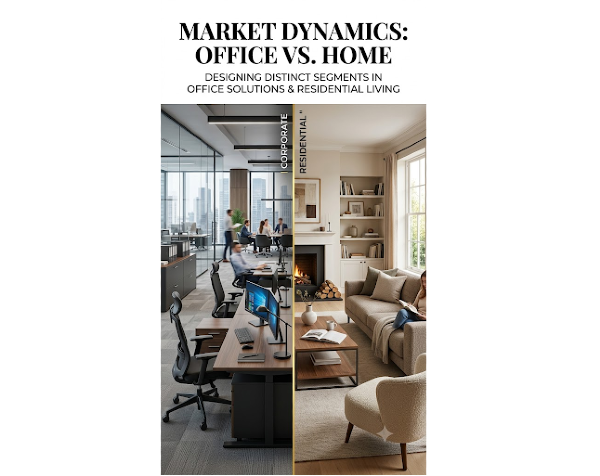





















Two Distinct Demand Drivers
The furnishings, fixtures, and appliances industry serves two fundamentally different customer segments: the residential market and the commercial market. Understanding the characteristics, cycles, and investment implications of each segment is essential for investors seeking to accurately model sector demand and identify companies best positioned for different economic environments.
The Residential Market
The residential market is driven by single-family and multi-family housing starts, existing home sales, and consumer renovation activity. It is highly correlated with mortgage rates, consumer confidence, and housing market conditions. Residential demand tends to be more cyclical, with sharp boom-bust patterns tied to the housing cycle. Companies serving the residential market include most major furniture retailers, appliance manufacturers, and residential fixture suppliers.
The Commercial Market
Office and Corporate Environments
Commercial office furnishings represent a significant subsegment, driven by corporate capital expenditure budgets, office construction, and workplace reconfiguration trends. The rise of hybrid work models post-pandemic has fundamentally disrupted traditional office furniture demand, accelerating the decline of traditional workstation configurations and driving demand for collaboration-oriented furniture and flexible workspace solutions. Companies like MillerKnoll (formerly Herman Miller), Steelcase, and Haworth are the leading players in this segment.
Hospitality and Healthcare Sectors
The hospitality sector (hotels, restaurants, resorts) and the healthcare sector (hospitals, clinics, senior living facilities) represent major commercial markets for specialized furnishings and fixtures. These sectors have distinct procurement cycles, durability requirements, and design specifications that differ substantially from residential and standard commercial markets. Companies with dedicated hospitality and healthcare product lines command premium pricing and enjoy more stable, contract-based revenue streams.
Cyclical Differences and Investment Implications
Commercial markets tend to lag residential markets in cyclical turns. During economic expansions, commercial construction and renovation accelerate as businesses invest in workspace improvements. During recessions, commercial capex is cut quickly, often before residential markets deteriorate. Companies with balanced residential and commercial exposure tend to exhibit smoother earnings profiles. Investors should track commercial construction permit data, corporate capital spending surveys, and hotel construction pipelines as leading indicators for commercial demand.
Conclusion
Understanding the distinction between residential and commercial demand markets is fundamental to sector analysis. Investors who can accurately assess each company's residential versus commercial exposure, and who track the leading indicators for each segment, will be better positioned to anticipate earnings trends and identify the most attractive entry points throughout the economic cycle.