Last updated on July 28th 2026 by Noah Brody
🔑 Key Takeaways
🛍️ Specialty retailers win by becoming experts, while traditional retailers win by becoming convenient.
Specialty retailers often build loyal customer bases by focusing deeply on specific product categories such as auto parts, beauty, or home improvement. Traditional retailers compete by offering broad product selection and one-stop shopping experiences.
💰 Specialty retail stocks can enjoy higher margins and stronger pricing power.
Customers frequently pay for expertise, product selection, and convenience in niche categories, allowing many specialty retailers to maintain attractive profitability.
📦 Traditional retailers benefit from enormous scale and diversified revenue streams.
Large retailers can spread costs across billions of dollars in sales and offset weakness in one category with strength in another, creating resilience during economic uncertainty.
🏆 Neither model is universally better—the right investment depends on the trends and risks investors want to target.
Specialty retailers offer exposure to specific growth themes, while traditional retailers often provide stability and broad consumer spending exposure.
Specialty Retail Stocks vs Traditional Retail Stocks
A Boutique and a Superstore Walk Into a Mall...
Imagine two stores standing side by side.
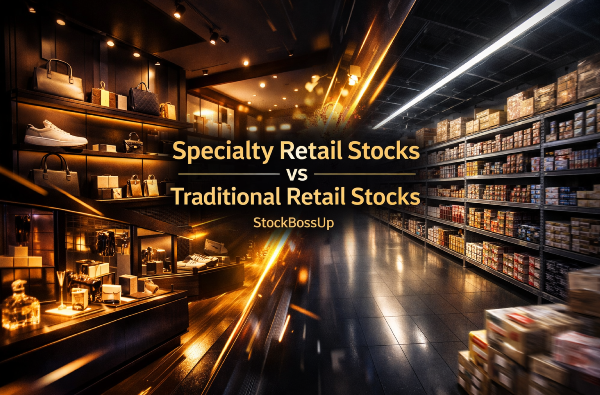
One is a giant superstore with groceries, clothing, electronics, furniture, and household goods all under one roof. The other is a specialty retailer dedicated entirely to sporting equipment and outdoor gear.
The superstore says, "I have everything."
The specialty retailer replies, "I know everything."
That simple difference explains much of the investment case behind these two retail models.
Traditional retailers try to satisfy as many consumer needs as possible. Specialty retailers focus on serving particular needs exceptionally well. Both approaches can produce enormous businesses and impressive stock returns, but they make money in different ways and respond differently to economic conditions.
For investors, understanding these distinctions can help answer an important question: Are you looking for a Swiss Army knife or a finely crafted chef's knife?
Both are useful. They simply excel at different jobs.
What Makes Traditional Retailers So Powerful?
Traditional retailers operate much like small cities.
Inside a single store, consumers can purchase food, clothing, cleaning supplies, electronics, and seasonal decorations. The goal is convenience. Customers can solve multiple shopping needs during a single trip.
Companies like Walmart (NYSE: WMT), Target (NYSE: TGT), and Costco Wholesale (NASDAQ: COST) have built their empires around this concept.
Their greatest advantage is scale.
Scale in retail is a bit like gravity. Once a company becomes large enough, it begins pulling in additional advantages. Massive purchasing power leads to lower costs. Lower costs allow for competitive pricing. Competitive pricing attracts more customers, which generates even greater scale.
The cycle can become remarkably powerful.
Traditional retailers also benefit from diversification. If apparel sales weaken, grocery sales may remain strong. If electronics demand slows, household essentials can help offset the pressure.
This diversification often creates resilience that investors appreciate during uncertain economic periods.
Why Do Specialty Retailers Often Inspire More Customer Loyalty?
Specialty retailers operate according to an entirely different philosophy.
Instead of trying to be everything to everyone, they aim to become indispensable to a particular customer.
Home Depot (NYSE: HD) focuses on home improvement. AutoZone (NYSE: AZO) specializes in automotive parts and maintenance products. Ulta Beauty (NASDAQ: ULTA) caters to beauty enthusiasts. Dick's Sporting Goods (NYSE: DKS) serves athletes and outdoor enthusiasts.
Their advantage comes from expertise.
Walking into a specialty retailer often feels like visiting a knowledgeable friend who happens to have thousands of products on the shelves. Customers seek advice, recommendations, and confidence that they are purchasing the right solution.
That trust can become a powerful competitive moat.
One surprising fact is that some specialty retailers enjoy customer loyalty rates that rival those of subscription businesses. When consumers find a retailer that consistently solves their problems, switching becomes surprisingly difficult.
| Feature |
Specialty Retail Stocks |
Traditional Retail Stocks |
| Product Selection |
Deep and focused |
Broad and diversified |
| Customer Experience |
Expertise-driven |
Convenience-driven |
| Pricing Power |
Often stronger |
Usually lower |
| Revenue Sources |
More concentrated |
More diversified |
| Customer Loyalty |
Often very high |
Moderate |
| Scale Advantages |
Category-specific |
Enormous and broad |
Which Type of Retailer Usually Earns Better Margins?
Margins in retail can be a bit like real estate.
Location matters.
In retail, that "location" is often where a company sits in the customer's mind.
A consumer purchasing lumber for a kitchen remodel may prioritize product availability and expert advice more than saving a few dollars. Someone buying specialty skincare products often values recommendations and trusted brands. A repair shop that needs a replacement part immediately may care far more about reliability than price.
Specialty retailers can sometimes command higher margins because they solve specific problems and provide expertise.
Traditional retailers frequently compete more aggressively on price.
That does not necessarily make them less profitable. Their enormous sales volumes can compensate for thinner margins.
Think of it this way.
Specialty retailers may earn more profit on each transaction.
Traditional retailers may make up for lower margins through sheer scale and frequency.
Both roads can lead to impressive shareholder returns.
How Do Economic Slowdowns Affect These Businesses?
Different types of retailers react differently when the economy hits turbulence.
Traditional retailers often have defensive characteristics because they sell essential products. People may postpone purchasing a new television, but they still need groceries, detergent, and toilet paper.
Specialty retail is more varied.
Some categories are remarkably resilient.
Auto parts retailers often benefit during economic slowdowns because consumers delay purchasing new vehicles and instead repair older ones. Off-price retailers may attract more value-conscious shoppers. Pet spending frequently remains steady because owners view many pet-related expenses as necessities.
Other specialty categories can be more sensitive to consumer confidence.
Luxury products, high-end sporting goods, and discretionary hobbies may experience softer demand.
Specialty retail is less like a single industry and more like a neighborhood filled with different businesses. Some stores remain busy during every season, while others depend heavily on favorable economic weather.
| Economic Environment |
Potential Retail Beneficiaries |
| Consumer Confidence |
Beauty, sporting goods, luxury |
| Economic Slowdown |
Auto parts, off-price retail |
| Inflation |
Discount retailers |
| Housing Recovery |
Home improvement retailers |
| Rising Pet Ownership |
Pet-focused retailers |
Has E-Commerce Changed the Rules of the Game?
Retail has become a relay race.
Consumers pass the baton from smartphones to websites and then to physical stores, expecting every handoff to feel seamless.
A customer might compare prices on a phone during lunch, place an order after dinner, and pick it up on the drive home from work. Another shopper may browse products in-store and later reorder through an app.
Retailers that make these transitions effortless are increasingly capturing market share.
Traditional retailers have leveraged their enormous distribution networks and store footprints to support online fulfillment. Specialty retailers, meanwhile, have used their category expertise to create personalized experiences and targeted recommendations.
The line between physical and digital shopping continues to blur.
One surprising fact is that many retail stores now function as miniature fulfillment centers, shipping products and processing online orders in addition to serving walk-in customers.
The modern store is part showroom, part warehouse, and part distribution hub.
Which Business Model Offers Better Long-Term Growth Potential?
The answer depends on what trends investors want to own.
Specialty retail stocks often provide targeted exposure to powerful themes.
An aging vehicle fleet benefits auto parts retailers.
Rising pet ownership supports pet-focused companies.
Housing shortages and aging homes can create long-term demand for home improvement retailers.
Traditional retailers, meanwhile, offer broad exposure to consumer spending.
They may benefit from population growth, rising wages, and expanding household formation without relying on any single category.
Investing in traditional retail can feel like purchasing an index of everyday consumer behavior.
Investing in specialty retail can feel like making a focused bet on a particular trend.
Neither approach is inherently superior.
Each simply offers a different path.
So Which Type of Retail Stock Is Better?
The answer resembles choosing between a toolbox and a specialized power tool.
The toolbox can solve many problems.
The power tool may solve one problem exceptionally well.
Traditional retailers often appeal to investors seeking stability, scale, and diversified exposure to consumer spending.
Specialty retailers frequently attract investors looking for focused opportunities, higher customer loyalty, and exposure to long-term secular trends.
Interestingly, some of the market's best-performing retail stocks over the past several decades have come from both camps. Companies like Costco have used scale and convenience to build extraordinary businesses, while companies like Home Depot and AutoZone have demonstrated the power of specialization and expertise.
The lesson for investors is refreshingly simple.
You do not necessarily have to choose one side.
A portfolio can benefit from both.
Traditional retailers provide broad exposure to the everyday rhythms of consumer spending, while specialty retailers offer opportunities to participate in powerful niche trends and passionate customer communities.
After all, every shopping district needs both the superstore and the specialist. And sometimes, the most successful investment portfolios do too.
🚀 Expand Your Edge: Elite Specialty Retail Stock Intelligence
Looking for the next standout retail investment? Our Specialty Retail Investor Intelligence Hub brings together comprehensive research covering industry fundamentals, market leaders, financial quality, valuation, digital transformation, consumer trends, and long-term growth opportunities. Whether you're identifying market-leading retailers or evaluating emerging investment themes, explore the curated resources below to strengthen your investment research.
🏬 Industry Fundamentals & Market Overview
📊 Financial Strength & Business Quality
💵 Dividends, Valuation & Investor Returns
🤖 Technology, AI & Omnichannel Retail
🌍 Consumer Trends & Growth Opportunities
⚠️ Risk Management & Economic Outlook



















Last updated on July 28th 2026 by Noah Brody
🔑 Key Takeaways
🛍️ Specialty retailers win by becoming experts, while traditional retailers win by becoming convenient.
Specialty retailers often build loyal customer bases by focusing deeply on specific product categories such as auto parts, beauty, or home improvement. Traditional retailers compete by offering broad product selection and one-stop shopping experiences.
💰 Specialty retail stocks can enjoy higher margins and stronger pricing power.
Customers frequently pay for expertise, product selection, and convenience in niche categories, allowing many specialty retailers to maintain attractive profitability.
📦 Traditional retailers benefit from enormous scale and diversified revenue streams.
Large retailers can spread costs across billions of dollars in sales and offset weakness in one category with strength in another, creating resilience during economic uncertainty.
🏆 Neither model is universally better—the right investment depends on the trends and risks investors want to target.
Specialty retailers offer exposure to specific growth themes, while traditional retailers often provide stability and broad consumer spending exposure.
Specialty Retail Stocks vs Traditional Retail Stocks
A Boutique and a Superstore Walk Into a Mall...
Imagine two stores standing side by side.
One is a giant superstore with groceries, clothing, electronics, furniture, and household goods all under one roof. The other is a specialty retailer dedicated entirely to sporting equipment and outdoor gear.
The superstore says, "I have everything."
The specialty retailer replies, "I know everything."
That simple difference explains much of the investment case behind these two retail models.
Traditional retailers try to satisfy as many consumer needs as possible. Specialty retailers focus on serving particular needs exceptionally well. Both approaches can produce enormous businesses and impressive stock returns, but they make money in different ways and respond differently to economic conditions.
For investors, understanding these distinctions can help answer an important question: Are you looking for a Swiss Army knife or a finely crafted chef's knife?
Both are useful. They simply excel at different jobs.
What Makes Traditional Retailers So Powerful?
Traditional retailers operate much like small cities.
Inside a single store, consumers can purchase food, clothing, cleaning supplies, electronics, and seasonal decorations. The goal is convenience. Customers can solve multiple shopping needs during a single trip.
Companies like Walmart (NYSE: WMT), Target (NYSE: TGT), and Costco Wholesale (NASDAQ: COST) have built their empires around this concept.
Their greatest advantage is scale.
Scale in retail is a bit like gravity. Once a company becomes large enough, it begins pulling in additional advantages. Massive purchasing power leads to lower costs. Lower costs allow for competitive pricing. Competitive pricing attracts more customers, which generates even greater scale.
The cycle can become remarkably powerful.
Traditional retailers also benefit from diversification. If apparel sales weaken, grocery sales may remain strong. If electronics demand slows, household essentials can help offset the pressure.
This diversification often creates resilience that investors appreciate during uncertain economic periods.
Why Do Specialty Retailers Often Inspire More Customer Loyalty?
Specialty retailers operate according to an entirely different philosophy.
Instead of trying to be everything to everyone, they aim to become indispensable to a particular customer.
Home Depot (NYSE: HD) focuses on home improvement. AutoZone (NYSE: AZO) specializes in automotive parts and maintenance products. Ulta Beauty (NASDAQ: ULTA) caters to beauty enthusiasts. Dick's Sporting Goods (NYSE: DKS) serves athletes and outdoor enthusiasts.
Their advantage comes from expertise.
Walking into a specialty retailer often feels like visiting a knowledgeable friend who happens to have thousands of products on the shelves. Customers seek advice, recommendations, and confidence that they are purchasing the right solution.
That trust can become a powerful competitive moat.
One surprising fact is that some specialty retailers enjoy customer loyalty rates that rival those of subscription businesses. When consumers find a retailer that consistently solves their problems, switching becomes surprisingly difficult.
Which Type of Retailer Usually Earns Better Margins?
Margins in retail can be a bit like real estate.
Location matters.
In retail, that "location" is often where a company sits in the customer's mind.
A consumer purchasing lumber for a kitchen remodel may prioritize product availability and expert advice more than saving a few dollars. Someone buying specialty skincare products often values recommendations and trusted brands. A repair shop that needs a replacement part immediately may care far more about reliability than price.
Specialty retailers can sometimes command higher margins because they solve specific problems and provide expertise.
Traditional retailers frequently compete more aggressively on price.
That does not necessarily make them less profitable. Their enormous sales volumes can compensate for thinner margins.
Think of it this way.
Specialty retailers may earn more profit on each transaction.
Traditional retailers may make up for lower margins through sheer scale and frequency.
Both roads can lead to impressive shareholder returns.
How Do Economic Slowdowns Affect These Businesses?
Different types of retailers react differently when the economy hits turbulence.
Traditional retailers often have defensive characteristics because they sell essential products. People may postpone purchasing a new television, but they still need groceries, detergent, and toilet paper.
Specialty retail is more varied.
Some categories are remarkably resilient.
Auto parts retailers often benefit during economic slowdowns because consumers delay purchasing new vehicles and instead repair older ones. Off-price retailers may attract more value-conscious shoppers. Pet spending frequently remains steady because owners view many pet-related expenses as necessities.
Other specialty categories can be more sensitive to consumer confidence.
Luxury products, high-end sporting goods, and discretionary hobbies may experience softer demand.
Specialty retail is less like a single industry and more like a neighborhood filled with different businesses. Some stores remain busy during every season, while others depend heavily on favorable economic weather.
Has E-Commerce Changed the Rules of the Game?
Retail has become a relay race.
Consumers pass the baton from smartphones to websites and then to physical stores, expecting every handoff to feel seamless.
A customer might compare prices on a phone during lunch, place an order after dinner, and pick it up on the drive home from work. Another shopper may browse products in-store and later reorder through an app.
Retailers that make these transitions effortless are increasingly capturing market share.
Traditional retailers have leveraged their enormous distribution networks and store footprints to support online fulfillment. Specialty retailers, meanwhile, have used their category expertise to create personalized experiences and targeted recommendations.
The line between physical and digital shopping continues to blur.
One surprising fact is that many retail stores now function as miniature fulfillment centers, shipping products and processing online orders in addition to serving walk-in customers.
The modern store is part showroom, part warehouse, and part distribution hub.
Which Business Model Offers Better Long-Term Growth Potential?
The answer depends on what trends investors want to own.
Specialty retail stocks often provide targeted exposure to powerful themes.
An aging vehicle fleet benefits auto parts retailers.
Rising pet ownership supports pet-focused companies.
Housing shortages and aging homes can create long-term demand for home improvement retailers.
Traditional retailers, meanwhile, offer broad exposure to consumer spending.
They may benefit from population growth, rising wages, and expanding household formation without relying on any single category.
Investing in traditional retail can feel like purchasing an index of everyday consumer behavior.
Investing in specialty retail can feel like making a focused bet on a particular trend.
Neither approach is inherently superior.
Each simply offers a different path.
So Which Type of Retail Stock Is Better?
The answer resembles choosing between a toolbox and a specialized power tool.
The toolbox can solve many problems.
The power tool may solve one problem exceptionally well.
Traditional retailers often appeal to investors seeking stability, scale, and diversified exposure to consumer spending.
Specialty retailers frequently attract investors looking for focused opportunities, higher customer loyalty, and exposure to long-term secular trends.
Interestingly, some of the market's best-performing retail stocks over the past several decades have come from both camps. Companies like Costco have used scale and convenience to build extraordinary businesses, while companies like Home Depot and AutoZone have demonstrated the power of specialization and expertise.
The lesson for investors is refreshingly simple.
You do not necessarily have to choose one side.
A portfolio can benefit from both.
Traditional retailers provide broad exposure to the everyday rhythms of consumer spending, while specialty retailers offer opportunities to participate in powerful niche trends and passionate customer communities.
After all, every shopping district needs both the superstore and the specialist. And sometimes, the most successful investment portfolios do too.
🚀 Expand Your Edge: Elite Specialty Retail Stock Intelligence
Looking for the next standout retail investment? Our Specialty Retail Investor Intelligence Hub brings together comprehensive research covering industry fundamentals, market leaders, financial quality, valuation, digital transformation, consumer trends, and long-term growth opportunities. Whether you're identifying market-leading retailers or evaluating emerging investment themes, explore the curated resources below to strengthen your investment research.
🏬 Industry Fundamentals & Market Overview
📊 Financial Strength & Business Quality
💵 Dividends, Valuation & Investor Returns
🤖 Technology, AI & Omnichannel Retail
🌍 Consumer Trends & Growth Opportunities
⚠️ Risk Management & Economic Outlook