Last updated on July 1st 2026 by Noah Brody
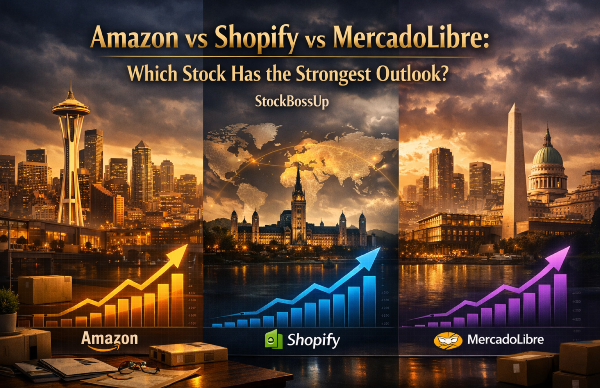
Amazon vs Shopify vs MercadoLibre: Which Stock Has the Strongest Outlook?
🔑 Key Takeaways
🛒 Amazon remains the king of scale and profitability in global e-commerce
Amazon combines online retail, cloud computing, advertising, and logistics into one of the world's largest business ecosystems. Its diversification gives it multiple growth engines and makes it less dependent on retail spending alone.
🏪 Shopify offers one of the purest ways to invest in global e-commerce entrepreneurship
Rather than competing directly with merchants, Shopify provides the tools that help businesses sell online. Its asset-light model and growing merchant ecosystem position it for long-term expansion.
🌎 MercadoLibre may have the biggest runway for international growth
Latin America's e-commerce and digital payments markets remain less mature than those in North America and Europe. MercadoLibre's logistics and fintech ecosystems could benefit from years of rising digital adoption.
📈 The strongest outlook depends on what investors value most
Amazon offers stability and diversification, Shopify provides exposure to e-commerce infrastructure, and MercadoLibre delivers high-growth emerging market potential. Each stock appeals to a different type of investor.
Amazon vs Shopify vs MercadoLibre: Which Stock Has the Strongest Outlook?
Three Different Roads Lead to E-Commerce Success
Imagine three businesses standing at the starting line of a race.
One arrives in a giant cargo jet.
One shows up with a toolbox.
The third rolls in on a motorcycle carrying a map of Latin America.
That is essentially the story of Amazon, Shopify, and MercadoLibre.
All three are major players in e-commerce. All three have produced impressive growth. Yet they operate with remarkably different business models.
Amazon built an empire of logistics, cloud computing, and retail dominance.
Shopify became the digital landlord for millions of merchants.
MercadoLibre created an entire commerce and financial ecosystem across Latin America.
For investors, choosing among these companies is not simply about picking an e-commerce stock.
It is about choosing which vision of the future seems most compelling.
Amazon: The Giant That Keeps Finding New Engines
Amazon is so large that it sometimes feels less like a retailer and more like an economic ecosystem.
The company operates one of the world's largest e-commerce platforms, a massive logistics network, a leading digital advertising business, and the dominant cloud infrastructure provider through Amazon Web Services.
That diversification matters.
When retail spending slows, cloud services and advertising can help offset weakness.
When economic conditions improve, multiple business segments can accelerate simultaneously.
Few companies have as many ways to grow.
The sheer size of Amazon can occasionally make investors wonder whether meaningful growth remains possible.
Yet the company has repeatedly proven capable of finding new markets and building entirely new businesses.
It has become a master of reinvention.
Shopify: The Merchant's Best Friend
If Amazon is the giant department store, Shopify is the company handing out keys to thousands of digital storefronts.
The business model is wonderfully simple.
Help entrepreneurs sell online.
Then help them sell more.
Shopify earns revenue through subscriptions, payment processing, merchant solutions, and additional services that support online businesses.
The company does not need to own warehouses full of inventory.
It does not need to manufacture products.
Instead, it benefits when its merchants succeed.
This asset-light model gives Shopify attractive economics and allows management to focus heavily on software and innovation.
The company has effectively become the operating system for independent commerce.
As long as people continue launching businesses online, Shopify has opportunities to grow.
MercadoLibre: The Emerging Market Champion
MercadoLibre sometimes feels like several companies hiding inside one stock.
It operates an e-commerce marketplace.
It runs logistics operations.
It provides digital payment services.
It offers financial products.
It even helps expand financial inclusion throughout Latin America.
The company built much of this infrastructure because it had to.
Many regions lacked mature payment systems and delivery networks.
Rather than wait for those systems to improve, MercadoLibre built many of them itself.
That effort required significant investment.
It also created powerful competitive advantages.
The company now sits at the center of several major long-term trends, including e-commerce adoption, digital payments, and fintech growth across Latin America.
Few companies have as much runway ahead of them.
| Company |
Primary Business Strength |
| Amazon |
Diversified ecosystem |
| Shopify |
Merchant software platform |
| MercadoLibre |
E-commerce and fintech integration |
All three businesses are connected to e-commerce, but they play very different games.
Which Company Has the Largest Addressable Market?
This question is a little like asking whether the ocean, the sky, or outer space is bigger.
Each company serves enormous markets.
Amazon participates in global retail, cloud computing, advertising, logistics, and subscription services.
Its opportunity set is almost difficult to quantify.
Shopify benefits from global entrepreneurship.
Every small business, creator, and enterprise seeking an online presence could become a potential customer.
MercadoLibre's opportunity comes from geography.
Latin America has hundreds of millions of consumers, rising smartphone adoption, growing internet penetration, and expanding digital payment usage.
Each company still has significant room to grow.
The difference lies in where that growth may come from.
Who Has the Strongest Competitive Moat?
Amazon may have one of the deepest moats in modern business.
Its logistics network alone would require enormous amounts of capital and time to replicate.
The company's scale creates advantages in purchasing, fulfillment, advertising, and customer acquisition.
Shopify's moat is more subtle.
It benefits from ecosystem effects.
Merchants build stores, integrate applications, and adopt payment solutions that make switching platforms more difficult over time.
MercadoLibre enjoys both scale and infrastructure advantages.
Its logistics and payment ecosystems have become increasingly difficult for competitors to challenge.
One interesting reality is that MercadoLibre's payment platform often introduces consumers to digital financial services before they become active e-commerce users, creating multiple points of customer engagement.
Competitive advantages come in many forms.
Each company has built a moat that reflects its unique strategy.
Which Stock Has the Best Growth Story?
If growth were a movie, these three companies would belong to different genres.
Amazon is the seasoned blockbuster.
Shopify is the entrepreneurial underdog.
MercadoLibre is the fast-paced adventure story.
Amazon still generates impressive growth despite its massive size.
However, large numbers become increasingly difficult to move.
Shopify has opportunities to benefit from the continued expansion of online entrepreneurship and omnichannel commerce.
MercadoLibre arguably has the largest long-term runway because many Latin American markets remain relatively underpenetrated.
The company could benefit from multiple growth drivers simultaneously.
For pure growth potential, MercadoLibre may have the highest ceiling.
For predictable execution, Amazon may offer greater stability.
Financial Strength Matters
Growth is exciting.
Cash flow pays the bills.
Amazon generates substantial cash flow and has the financial flexibility to invest heavily in future initiatives.
Its scale provides resilience.
Shopify maintains a relatively asset-light model that allows it to remain agile.
The company can often direct resources toward innovation rather than massive physical infrastructure.
MercadoLibre continues investing aggressively in logistics and financial services.
These investments may pressure margins occasionally, but they also help strengthen the company's competitive position.
| Metric |
Amazon |
Shopify |
MercadoLibre |
| Business Diversification |
Very High |
Moderate |
High |
| International Growth Potential |
High |
High |
Very High |
| Logistics Infrastructure |
Very High |
Low |
High |
| Fintech Exposure |
Moderate |
Low |
Very High |
| Financial Flexibility |
Very High |
High |
High |
Financial strength often determines which companies can continue investing through both good times and bad.
Which Company Faces the Biggest Risks?
Every investment comes with challenges.
Amazon faces the difficulty of maintaining high growth while operating at enormous scale. Regulatory scrutiny also remains a consideration.
Shopify must continue attracting merchants while navigating competitive pressures in commerce software and payment services.
MercadoLibre faces additional challenges tied to emerging market exposure, including currency fluctuations, economic volatility, and regulatory uncertainty.
Interestingly, each company's greatest strength also creates its biggest risk.
Amazon's size invites regulatory attention.
Shopify's merchant focus makes it sensitive to small business conditions.
MercadoLibre's emerging market exposure provides enormous growth opportunities but also increases volatility.
Investing is often an exercise in balancing opportunities and risks.
So Which Stock Has the Strongest Outlook?
Choosing between Amazon, Shopify, and MercadoLibre is a bit like choosing between a luxury train, a sports car, and an off-road vehicle.
All three can get you somewhere exciting.
They simply travel different roads.
Amazon offers diversification, cash flow, and one of the strongest competitive ecosystems ever assembled. It may appeal to investors seeking a blend of growth and stability.
Shopify provides exposure to the continuing rise of entrepreneurship and digital commerce infrastructure. It remains one of the purest plays on enabling e-commerce rather than directly participating in retail competition.
MercadoLibre arguably offers the longest runway. E-commerce, fintech adoption, and digital payments in Latin America still have significant room for expansion.
Another fascinating trend is that MercadoLibre's logistics network now handles volumes that would have seemed impossible for the region's e-commerce industry only a decade ago, highlighting how rapidly digital adoption can accelerate once infrastructure improves.
There is no universally correct answer.
The strongest outlook depends on the type of investor.
Those seeking stability may prefer Amazon.
Those attracted to software and entrepreneurship may gravitate toward Shopify.
Those willing to embrace higher growth potential and greater volatility may find MercadoLibre particularly compelling.
Three companies.
Three strategies.
Three very different journeys through the future of global e-commerce.
🚀 Expand Your Edge: Elite Internet Retail & E-Commerce Intelligence
Ready to capitalize on the future of digital commerce? Our Internet Retail Investor Intelligence Hub is designed to help investors analyze the companies, technologies, and trends reshaping global shopping. From foundational industry research and stock selection to AI, logistics, valuation, and international growth, explore the curated silos below to uncover your next investment opportunity.
🌐 Industry Fundamentals & Market Leaders
📊 Financial Strength & Shareholder Returns
🤖 Technology, AI & Digital Transformation
🚚 Logistics, Fulfillment & Supply Chain Intelligence
🌍 Global Expansion & Market Opportunities
⚠️ Risk Management & Economic Trends
🔍 Competitive Analysis & Advanced Research

















Last updated on July 1st 2026 by Noah Brody
Amazon vs Shopify vs MercadoLibre: Which Stock Has the Strongest Outlook?
🔑 Key Takeaways
🛒 Amazon remains the king of scale and profitability in global e-commerce
Amazon combines online retail, cloud computing, advertising, and logistics into one of the world's largest business ecosystems. Its diversification gives it multiple growth engines and makes it less dependent on retail spending alone.
🏪 Shopify offers one of the purest ways to invest in global e-commerce entrepreneurship
Rather than competing directly with merchants, Shopify provides the tools that help businesses sell online. Its asset-light model and growing merchant ecosystem position it for long-term expansion.
🌎 MercadoLibre may have the biggest runway for international growth
Latin America's e-commerce and digital payments markets remain less mature than those in North America and Europe. MercadoLibre's logistics and fintech ecosystems could benefit from years of rising digital adoption.
📈 The strongest outlook depends on what investors value most
Amazon offers stability and diversification, Shopify provides exposure to e-commerce infrastructure, and MercadoLibre delivers high-growth emerging market potential. Each stock appeals to a different type of investor.
Amazon vs Shopify vs MercadoLibre: Which Stock Has the Strongest Outlook?
Three Different Roads Lead to E-Commerce Success
Imagine three businesses standing at the starting line of a race.
One arrives in a giant cargo jet.
One shows up with a toolbox.
The third rolls in on a motorcycle carrying a map of Latin America.
That is essentially the story of Amazon, Shopify, and MercadoLibre.
All three are major players in e-commerce. All three have produced impressive growth. Yet they operate with remarkably different business models.
Amazon built an empire of logistics, cloud computing, and retail dominance.
Shopify became the digital landlord for millions of merchants.
MercadoLibre created an entire commerce and financial ecosystem across Latin America.
For investors, choosing among these companies is not simply about picking an e-commerce stock.
It is about choosing which vision of the future seems most compelling.
Amazon: The Giant That Keeps Finding New Engines
Amazon is so large that it sometimes feels less like a retailer and more like an economic ecosystem.
The company operates one of the world's largest e-commerce platforms, a massive logistics network, a leading digital advertising business, and the dominant cloud infrastructure provider through Amazon Web Services.
That diversification matters.
When retail spending slows, cloud services and advertising can help offset weakness.
When economic conditions improve, multiple business segments can accelerate simultaneously.
Few companies have as many ways to grow.
The sheer size of Amazon can occasionally make investors wonder whether meaningful growth remains possible.
Yet the company has repeatedly proven capable of finding new markets and building entirely new businesses.
It has become a master of reinvention.
Shopify: The Merchant's Best Friend
If Amazon is the giant department store, Shopify is the company handing out keys to thousands of digital storefronts.
The business model is wonderfully simple.
Help entrepreneurs sell online.
Then help them sell more.
Shopify earns revenue through subscriptions, payment processing, merchant solutions, and additional services that support online businesses.
The company does not need to own warehouses full of inventory.
It does not need to manufacture products.
Instead, it benefits when its merchants succeed.
This asset-light model gives Shopify attractive economics and allows management to focus heavily on software and innovation.
The company has effectively become the operating system for independent commerce.
As long as people continue launching businesses online, Shopify has opportunities to grow.
MercadoLibre: The Emerging Market Champion
MercadoLibre sometimes feels like several companies hiding inside one stock.
It operates an e-commerce marketplace.
It runs logistics operations.
It provides digital payment services.
It offers financial products.
It even helps expand financial inclusion throughout Latin America.
The company built much of this infrastructure because it had to.
Many regions lacked mature payment systems and delivery networks.
Rather than wait for those systems to improve, MercadoLibre built many of them itself.
That effort required significant investment.
It also created powerful competitive advantages.
The company now sits at the center of several major long-term trends, including e-commerce adoption, digital payments, and fintech growth across Latin America.
Few companies have as much runway ahead of them.
All three businesses are connected to e-commerce, but they play very different games.
Which Company Has the Largest Addressable Market?
This question is a little like asking whether the ocean, the sky, or outer space is bigger.
Each company serves enormous markets.
Amazon participates in global retail, cloud computing, advertising, logistics, and subscription services.
Its opportunity set is almost difficult to quantify.
Shopify benefits from global entrepreneurship.
Every small business, creator, and enterprise seeking an online presence could become a potential customer.
MercadoLibre's opportunity comes from geography.
Latin America has hundreds of millions of consumers, rising smartphone adoption, growing internet penetration, and expanding digital payment usage.
Each company still has significant room to grow.
The difference lies in where that growth may come from.
Who Has the Strongest Competitive Moat?
Amazon may have one of the deepest moats in modern business.
Its logistics network alone would require enormous amounts of capital and time to replicate.
The company's scale creates advantages in purchasing, fulfillment, advertising, and customer acquisition.
Shopify's moat is more subtle.
It benefits from ecosystem effects.
Merchants build stores, integrate applications, and adopt payment solutions that make switching platforms more difficult over time.
MercadoLibre enjoys both scale and infrastructure advantages.
Its logistics and payment ecosystems have become increasingly difficult for competitors to challenge.
One interesting reality is that MercadoLibre's payment platform often introduces consumers to digital financial services before they become active e-commerce users, creating multiple points of customer engagement.
Competitive advantages come in many forms.
Each company has built a moat that reflects its unique strategy.
Which Stock Has the Best Growth Story?
If growth were a movie, these three companies would belong to different genres.
Amazon is the seasoned blockbuster.
Shopify is the entrepreneurial underdog.
MercadoLibre is the fast-paced adventure story.
Amazon still generates impressive growth despite its massive size.
However, large numbers become increasingly difficult to move.
Shopify has opportunities to benefit from the continued expansion of online entrepreneurship and omnichannel commerce.
MercadoLibre arguably has the largest long-term runway because many Latin American markets remain relatively underpenetrated.
The company could benefit from multiple growth drivers simultaneously.
For pure growth potential, MercadoLibre may have the highest ceiling.
For predictable execution, Amazon may offer greater stability.
Financial Strength Matters
Growth is exciting.
Cash flow pays the bills.
Amazon generates substantial cash flow and has the financial flexibility to invest heavily in future initiatives.
Its scale provides resilience.
Shopify maintains a relatively asset-light model that allows it to remain agile.
The company can often direct resources toward innovation rather than massive physical infrastructure.
MercadoLibre continues investing aggressively in logistics and financial services.
These investments may pressure margins occasionally, but they also help strengthen the company's competitive position.
Financial strength often determines which companies can continue investing through both good times and bad.
Which Company Faces the Biggest Risks?
Every investment comes with challenges.
Amazon faces the difficulty of maintaining high growth while operating at enormous scale. Regulatory scrutiny also remains a consideration.
Shopify must continue attracting merchants while navigating competitive pressures in commerce software and payment services.
MercadoLibre faces additional challenges tied to emerging market exposure, including currency fluctuations, economic volatility, and regulatory uncertainty.
Interestingly, each company's greatest strength also creates its biggest risk.
Amazon's size invites regulatory attention.
Shopify's merchant focus makes it sensitive to small business conditions.
MercadoLibre's emerging market exposure provides enormous growth opportunities but also increases volatility.
Investing is often an exercise in balancing opportunities and risks.
So Which Stock Has the Strongest Outlook?
Choosing between Amazon, Shopify, and MercadoLibre is a bit like choosing between a luxury train, a sports car, and an off-road vehicle.
All three can get you somewhere exciting.
They simply travel different roads.
Amazon offers diversification, cash flow, and one of the strongest competitive ecosystems ever assembled. It may appeal to investors seeking a blend of growth and stability.
Shopify provides exposure to the continuing rise of entrepreneurship and digital commerce infrastructure. It remains one of the purest plays on enabling e-commerce rather than directly participating in retail competition.
MercadoLibre arguably offers the longest runway. E-commerce, fintech adoption, and digital payments in Latin America still have significant room for expansion.
Another fascinating trend is that MercadoLibre's logistics network now handles volumes that would have seemed impossible for the region's e-commerce industry only a decade ago, highlighting how rapidly digital adoption can accelerate once infrastructure improves.
There is no universally correct answer.
The strongest outlook depends on the type of investor.
Those seeking stability may prefer Amazon.
Those attracted to software and entrepreneurship may gravitate toward Shopify.
Those willing to embrace higher growth potential and greater volatility may find MercadoLibre particularly compelling.
Three companies.
Three strategies.
Three very different journeys through the future of global e-commerce.
🚀 Expand Your Edge: Elite Internet Retail & E-Commerce Intelligence
Ready to capitalize on the future of digital commerce? Our Internet Retail Investor Intelligence Hub is designed to help investors analyze the companies, technologies, and trends reshaping global shopping. From foundational industry research and stock selection to AI, logistics, valuation, and international growth, explore the curated silos below to uncover your next investment opportunity.
🌐 Industry Fundamentals & Market Leaders
📊 Financial Strength & Shareholder Returns
🤖 Technology, AI & Digital Transformation
🚚 Logistics, Fulfillment & Supply Chain Intelligence
🌍 Global Expansion & Market Opportunities
⚠️ Risk Management & Economic Trends
🔍 Competitive Analysis & Advanced Research