Last updated on July 28th 2026 by Noah Brody
Key Takeaways
📉 Rising interest rates compress specialty retail stock valuations by reducing future cash flow value
Higher discount rates lower the present value of future earnings, which directly impacts valuation multiples across the sector.
⚖️ High-quality retailers hold up better because stable cash flow offsets rate pressure
Companies with strong free cash flow and low debt maintain more stable valuations even in high-rate environments.
🏦 Leveraged and cyclical retailers are hit hardest when rates increase
Higher borrowing costs and weaker consumer demand amplify valuation declines in more sensitive specialty retail segments.
📊 Rate cuts tend to expand multiples, especially for growth-oriented retail stocks
Lower rates increase investor willingness to pay for future earnings growth and improve sector-wide valuation sentiment.
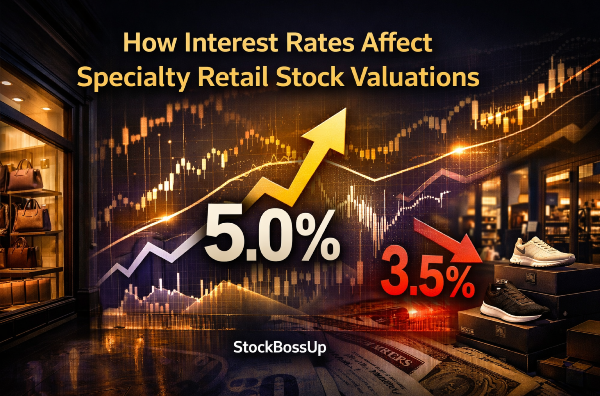
How Interest Rates Affect Specialty Retail Stock Valuations
Why interest rates matter so much for specialty retail valuations
Interest rates matter for specialty retail stock valuations because they influence both consumer behavior and how investors value future earnings. When rates move, they affect borrowing costs, spending decisions, and discount rates used in valuation models.
Specialty retail spans categories like auto parts, home improvement, beauty, electronics, and general merchandise. These businesses rely heavily on consumer spending, which is sensitive to financing costs such as credit cards, auto loans, and home equity lines.
At the same time, investors adjust valuation models based on interest rates. Higher rates reduce the present value of future cash flows, which compresses price-to-earnings multiples across the sector.
How higher interest rates compress retail valuations
When interest rates rise, specialty retail valuations typically come under pressure. This happens through a combination of slower consumer spending and higher discount rates applied to future earnings.
Consumers often reduce discretionary spending when borrowing becomes more expensive. This impacts categories like electronics and discretionary beauty products more than essential retail segments.
At the same time, investors require higher returns to hold equities. This increases the discount rate used in valuation models, which lowers the present value of future cash flows.
Companies like Best Buy tend to feel this pressure more strongly because demand is cyclical and tied to consumer confidence and financing conditions.
Even high-quality retailers like Home Depot can experience multiple compression during aggressive rate hiking cycles, even if their underlying business remains strong.
Why strong retailers resist valuation decline better
Not all specialty retail stocks react the same way to interest rate changes. High-quality companies with strong cash flow and low debt tend to hold up better.
Companies like AutoZone benefit from non-discretionary demand. Vehicle repairs are necessary regardless of economic conditions, which stabilizes revenue even during tight monetary policy periods.
Similarly, retailers with strong pricing power can offset inflation and maintain margins. This helps preserve earnings even as borrowing costs rise.
Balance sheet strength is another key factor. Companies with low leverage are less sensitive to rising interest expenses and can continue investing through rate cycles.
A subtle advantage is recurring demand. Categories with repeat purchases tend to be less affected by short-term changes in consumer financing conditions.
Which specialty retail segments are most sensitive to interest rates
Different specialty retail segments react differently to interest rate changes. Cyclical and discretionary categories are usually the most sensitive.
Electronics retail is highly sensitive because purchases are often financed or delayed based on credit conditions. Higher rates reduce affordability and delay upgrade cycles.
Home improvement is moderately sensitive. While repairs are essential, larger renovation projects are often postponed when borrowing costs rise.
Auto parts retail is the least sensitive because demand is necessity-driven. Vehicle maintenance cannot be easily delayed, which stabilizes earnings and valuations.
Beauty retail falls in the middle. While some products are discretionary, strong loyalty programs help reduce volatility compared to pure discretionary sectors.
| Segment |
Rate Sensitivity |
Demand Type |
Valuation Impact |
| Auto Parts |
Low |
Essential |
Stable multiples |
| Home Improvement |
Medium |
Mixed |
Moderate compression |
| Beauty Retail |
Medium |
Repeat purchase |
Mild volatility |
| Electronics |
High |
Discretionary |
Strong compression |
The role of discount rates in valuation models
Interest rates directly affect valuation through discount rates used in financial models. Higher rates reduce the present value of future earnings, which lowers price-to-earnings multiples.
In equity markets, this same principle applies in reverse when valuing future cash flows. Higher discount rates reduce current valuations even if earnings remain unchanged.
This is why growth-oriented specialty retailers often experience sharper valuation swings during rate hikes. Their value is more dependent on future earnings growth.
Conversely, stable cash flow businesses are less affected because a larger portion of their value comes from near-term earnings.
Why rate cuts often boost specialty retail valuations
When interest rates fall, specialty retail valuations tend to expand. Lower discount rates increase the present value of future cash flows, making equities more attractive relative to fixed income.
Consumers also benefit from lower borrowing costs. This can increase spending on discretionary categories such as electronics and home upgrades.
Companies like Home Depot often benefit from this environment because housing-related activity tends to increase when financing becomes cheaper.
Lower rates also reduce debt servicing costs for leveraged retailers, improving profitability and investor sentiment.
A less obvious effect is increased investor risk appetite. Lower rates tend to push capital toward equities, which increases valuation multiples across the retail sector.
Long-term outlook: why interest rates will keep shaping retail valuations
Interest rates will continue to play a major role in specialty retail valuations because they influence both consumers and investors simultaneously. This dual impact makes retail one of the most rate-sensitive sectors in equities.
Companies with strong balance sheets and recurring demand will likely maintain more stable valuations over time. These businesses are less exposed to financing cycles and more dependent on structural demand.
Technology adoption and omnichannel retailing may reduce some volatility by improving efficiency and cash flow stability. However, interest rates will still set the baseline valuation environment.
Overall, specialty retail valuations will continue to fluctuate with monetary policy, but the strongest companies will remain more resilient due to consistent cash generation and disciplined capital allocation.
🚀 Expand Your Edge: Elite Specialty Retail Stock Intelligence
Looking for the next standout retail investment? Our Specialty Retail Investor Intelligence Hub brings together comprehensive research covering industry fundamentals, market leaders, financial quality, valuation, digital transformation, consumer trends, and long-term growth opportunities. Whether you're identifying market-leading retailers or evaluating emerging investment themes, explore the curated resources below to strengthen your investment research.
🏬 Industry Fundamentals & Market Overview
📊 Financial Strength & Business Quality
💵 Dividends, Valuation & Investor Returns
🤖 Technology, AI & Omnichannel Retail
🌍 Consumer Trends & Growth Opportunities
⚠️ Risk Management & Economic Outlook




















Last updated on July 28th 2026 by Noah Brody
Key Takeaways
📉 Rising interest rates compress specialty retail stock valuations by reducing future cash flow value
Higher discount rates lower the present value of future earnings, which directly impacts valuation multiples across the sector.⚖️ High-quality retailers hold up better because stable cash flow offsets rate pressure
Companies with strong free cash flow and low debt maintain more stable valuations even in high-rate environments.🏦 Leveraged and cyclical retailers are hit hardest when rates increase
Higher borrowing costs and weaker consumer demand amplify valuation declines in more sensitive specialty retail segments.📊 Rate cuts tend to expand multiples, especially for growth-oriented retail stocks
Lower rates increase investor willingness to pay for future earnings growth and improve sector-wide valuation sentiment.How Interest Rates Affect Specialty Retail Stock Valuations
Why interest rates matter so much for specialty retail valuations
Interest rates matter for specialty retail stock valuations because they influence both consumer behavior and how investors value future earnings. When rates move, they affect borrowing costs, spending decisions, and discount rates used in valuation models.
Specialty retail spans categories like auto parts, home improvement, beauty, electronics, and general merchandise. These businesses rely heavily on consumer spending, which is sensitive to financing costs such as credit cards, auto loans, and home equity lines.
At the same time, investors adjust valuation models based on interest rates. Higher rates reduce the present value of future cash flows, which compresses price-to-earnings multiples across the sector.
How higher interest rates compress retail valuations
When interest rates rise, specialty retail valuations typically come under pressure. This happens through a combination of slower consumer spending and higher discount rates applied to future earnings.
Consumers often reduce discretionary spending when borrowing becomes more expensive. This impacts categories like electronics and discretionary beauty products more than essential retail segments.
At the same time, investors require higher returns to hold equities. This increases the discount rate used in valuation models, which lowers the present value of future cash flows.
Companies like Best Buy tend to feel this pressure more strongly because demand is cyclical and tied to consumer confidence and financing conditions.
Even high-quality retailers like Home Depot can experience multiple compression during aggressive rate hiking cycles, even if their underlying business remains strong.
Why strong retailers resist valuation decline better
Not all specialty retail stocks react the same way to interest rate changes. High-quality companies with strong cash flow and low debt tend to hold up better.
Companies like AutoZone benefit from non-discretionary demand. Vehicle repairs are necessary regardless of economic conditions, which stabilizes revenue even during tight monetary policy periods.
Similarly, retailers with strong pricing power can offset inflation and maintain margins. This helps preserve earnings even as borrowing costs rise.
Balance sheet strength is another key factor. Companies with low leverage are less sensitive to rising interest expenses and can continue investing through rate cycles.
A subtle advantage is recurring demand. Categories with repeat purchases tend to be less affected by short-term changes in consumer financing conditions.
Which specialty retail segments are most sensitive to interest rates
Different specialty retail segments react differently to interest rate changes. Cyclical and discretionary categories are usually the most sensitive.
Electronics retail is highly sensitive because purchases are often financed or delayed based on credit conditions. Higher rates reduce affordability and delay upgrade cycles.
Home improvement is moderately sensitive. While repairs are essential, larger renovation projects are often postponed when borrowing costs rise.
Auto parts retail is the least sensitive because demand is necessity-driven. Vehicle maintenance cannot be easily delayed, which stabilizes earnings and valuations.
Beauty retail falls in the middle. While some products are discretionary, strong loyalty programs help reduce volatility compared to pure discretionary sectors.
The role of discount rates in valuation models
Interest rates directly affect valuation through discount rates used in financial models. Higher rates reduce the present value of future earnings, which lowers price-to-earnings multiples.
In equity markets, this same principle applies in reverse when valuing future cash flows. Higher discount rates reduce current valuations even if earnings remain unchanged.
This is why growth-oriented specialty retailers often experience sharper valuation swings during rate hikes. Their value is more dependent on future earnings growth.
Conversely, stable cash flow businesses are less affected because a larger portion of their value comes from near-term earnings.
Why rate cuts often boost specialty retail valuations
When interest rates fall, specialty retail valuations tend to expand. Lower discount rates increase the present value of future cash flows, making equities more attractive relative to fixed income.
Consumers also benefit from lower borrowing costs. This can increase spending on discretionary categories such as electronics and home upgrades.
Companies like Home Depot often benefit from this environment because housing-related activity tends to increase when financing becomes cheaper.
Lower rates also reduce debt servicing costs for leveraged retailers, improving profitability and investor sentiment.
A less obvious effect is increased investor risk appetite. Lower rates tend to push capital toward equities, which increases valuation multiples across the retail sector.
Long-term outlook: why interest rates will keep shaping retail valuations
Interest rates will continue to play a major role in specialty retail valuations because they influence both consumers and investors simultaneously. This dual impact makes retail one of the most rate-sensitive sectors in equities.
Companies with strong balance sheets and recurring demand will likely maintain more stable valuations over time. These businesses are less exposed to financing cycles and more dependent on structural demand.
Technology adoption and omnichannel retailing may reduce some volatility by improving efficiency and cash flow stability. However, interest rates will still set the baseline valuation environment.
Overall, specialty retail valuations will continue to fluctuate with monetary policy, but the strongest companies will remain more resilient due to consistent cash generation and disciplined capital allocation.
🚀 Expand Your Edge: Elite Specialty Retail Stock Intelligence
Looking for the next standout retail investment? Our Specialty Retail Investor Intelligence Hub brings together comprehensive research covering industry fundamentals, market leaders, financial quality, valuation, digital transformation, consumer trends, and long-term growth opportunities. Whether you're identifying market-leading retailers or evaluating emerging investment themes, explore the curated resources below to strengthen your investment research.
🏬 Industry Fundamentals & Market Overview
📊 Financial Strength & Business Quality
💵 Dividends, Valuation & Investor Returns
🤖 Technology, AI & Omnichannel Retail
🌍 Consumer Trends & Growth Opportunities
⚠️ Risk Management & Economic Outlook