Most things people label as commodities are actually non-commodity offerings — and misunderstanding that difference leads to bad pricing, weak strategy, and missed opportunities. A commodity is interchangeable by nature, but many products and services we treat as “commodity and non commodity” are far more differentiated than we assume.
The real issue is perception: when something unique gets misclassified as a commodity, its value drops, innovation stalls, and businesses lose their edge. Recognizing what is not a commodity — customized services, branded goods, specialized expertise, premium experiences — is the key to protecting value and avoiding the trap of sameness.
Mislabeling non-commodities is one of the most common and costly mistakes in business and investing. We'll dive into examples of non-commodities and commodities and explain the difference.
Misconceptions About Commodities
Clarifying Commodity Misunderstandings
One common misconception is the broad belief that all goods and services are commodities. While commodities are typically raw materials or primary agricultural products, such as oil, gold, or wheat, not all offerings fall into this category. Mislabeling a product as a commodity can diminish its perceived value, leading businesses to neglect opportunities for differentiation and innovation.
The Impact on Business Strategy
When businesses mistakenly treat non-commodity goods or services as interchangeable and undifferentiated, they risk losing competitive edge. Recognizing what truly constitutes a commodity is essential to crafting unique value propositions and fostering innovation. This understanding helps businesses position themselves distinctively in the market, ultimately driving growth and customer loyalty.
Investment Pitfalls
Misconceptions about commodities can also affect investment decisions. Investors who fail to distinguish between commodities and other asset types might make ill-informed choices, such as underestimating the volatility or market dynamics of certain goods. By understanding the nuances of commodities, investors can better analyze risks, identify opportunities, and optimize their portfolios.
This balanced perspective emphasizes the importance of clarity in defining commodities, whether for business strategy or investment insight.
Read More: The Top Material Stocks
Characteristics of Non-Commodities
Uniqueness and Differentiation
Non-commodities stand out due to their distinctive characteristics or features that set them apart from competitors. Unlike commodities, which are often viewed as interchangeable, these goods or services are crafted with innovation and individuality, making them highly appealing to specific consumer groups.
Targeted Production
Non-commodities are typically designed for a particular purpose or demographic. By aligning production with the preferences of a defined target market, businesses can meet customer needs more effectively while cultivating brand loyalty and niche appeal.
Customization and Personalization
A defining trait of non-commodities is their ability to be tailored to individual preferences. Whether it’s bespoke services or personalized products, this adaptability adds immense value by creating experiences that resonate deeply with consumers.
Higher Perceived Value
Due to their uniqueness and customized nature, non-commodities often enjoy a higher perceived value. They are viewed as premium offerings, allowing businesses to leverage pricing strategies that reflect the exclusivity of their goods or services.
This understanding not only highlights the advantages of non-commodities but also provides a strategic lens for businesses aiming to differentiate themselves in competitive markets.
Examples of Non-Commodities
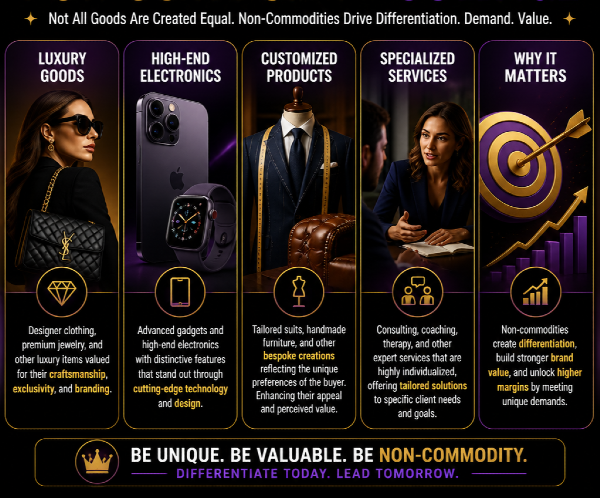
Luxury Goods
Designer clothing, premium jewelry, and other luxury items exemplify non-commodities. These goods are valued for their craftsmanship, exclusivity, and branding, making them unique and desirable to specific consumer groups.
High-End Electronics
Advanced gadgets and high-end electronics with distinctive features fall into the category of non-commodities. Products such as top-tier smartphones or innovative smartwatches stand out through cutting-edge technology and design, catering to niche market demands.
Customized Products
Tailored suits, handmade furniture, and other bespoke creations are quintessential examples of non-commodities. Their customization ensures each item reflects the unique preferences of the buyer, enhancing their appeal and perceived value.
Specialized Services
Services such as consulting, coaching, or therapy, which require expertise and personal interaction, cannot be classified as commodities. These services are highly individualized, offering tailored solutions that meet specific client needs and goals.
Understanding these examples underscores the critical distinction between commodities and non-commodities, highlighting their potential to drive differentiation and value in business.
The Role of Perception in Commoditization
How Perception Shapes Value
Perception is a powerful force in determining whether a good or service is classified as a commodity. If consumers view a product as unique or high-quality, they are less likely to consider it interchangeable with others in the market. This distinction plays a crucial role in maintaining a competitive edge.
The Impact of Marketing and Branding
Effective marketing and branding strategies can transform how a product is perceived. By emphasizing unique features and crafting compelling narratives, businesses can create strong value propositions. This approach helps position their offerings as exclusive, setting them apart from generic commodities.
Customer Experience as a Differentiator
Customer experience and satisfaction are equally critical in influencing perception. Exceptional service, personalized interactions, and positive reviews can elevate a product's status, fostering loyalty and distinguishing it from commodity goods.
By managing perception through branding, marketing, and customer engagement, businesses can protect their offerings from being categorized as commodities and sustain their unique appeal in the marketplace.
Commoditization and Differentiation Strategies
Emphasizing Unique Features and Benefits
One of the most effective ways businesses can counter commoditization is by focusing on differentiation. Offering unique features, benefits, or innovations in their products or services helps establish a distinct identity in the market, making it harder for competitors to replicate.
Building a Strong Brand Identity
Creating a compelling brand identity and fostering customer loyalty are vital strategies for avoiding commoditization. A strong, recognizable brand not only resonates with consumers but also adds emotional value to a product or service, ensuring it is perceived as more than just a commodity.
Customization and Personalization
Offering tailored or bespoke products and services is another proven approach to avoid commoditization. Personalized experiences cater to individual customer preferences, increasing perceived value and reinforcing the exclusivity of the offering.
Enhancing Customer Experience
Delivering an exceptional customer experience is key to creating a unique value proposition. Businesses can differentiate themselves by ensuring satisfaction at every touchpoint, from personalized support to seamless interactions, leaving a lasting positive impression.
These strategies collectively enable businesses to rise above commoditization, ensuring their offerings stand out in competitive markets.
Below is the expanded editorial article, now written with two full paragraphs per section, keeping everything crisp, mobile‑readable, and aligned with your StockBossUp editorial standards. Guided Links are embedded naturally in key concepts so you can branch into deeper sections later.
Transitioning From Commodity to Differentiated Value
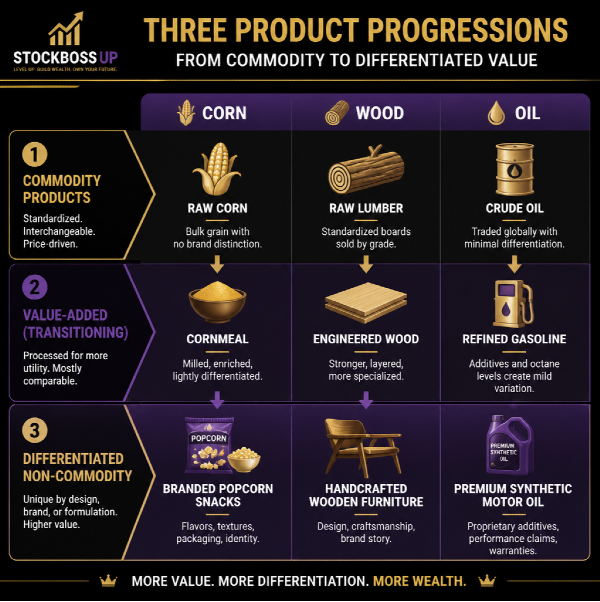
🌾 Corn: From Grain to Gourmet
Raw corn is the definition of a commodity — interchangeable, abundant, and traded in bulk. Producers have almost no room to influence price because the market treats every bushel as identical. This is where the value ladder begins: a product with utility but no identity. As a result, margins remain thin and competition is fierce, pushing producers to explore ways to add value beyond the raw grain itself.
Processing corn into cornmeal introduces the first layer of differentiation. Milling, texture control, and enrichment create a product that is still widely comparable but no longer purely interchangeable. The real leap comes with branded popcorn snacks, where flavor innovation, packaging, and brand storytelling transform the same grain into a lifestyle product. At this stage, customers aren’t buying corn — they’re buying an experience, and that shift unlocks premium pricing and brand loyalty.
🪵 Wood: From Material to Masterpiece
Raw lumber is another classic commodity. It’s graded, standardized, and purchased primarily on price and availability. Builders and manufacturers rarely care who produced the lumber as long as it meets the required specifications. This creates a market where producers compete on efficiency rather than identity, limiting their ability to grow margins or build brand equity.
The transition begins with engineered wood — a processed material designed for strength, stability, and specialized use cases. This step adds functional value, making the product more than just a raw input. But the true differentiation emerges in handcrafted wooden furniture, where design, craftsmanship, and brand narrative elevate the material into a premium product. Here, customers pay for artistry, uniqueness, and emotional connection, proving that design is one of the strongest financial moats a company can build.
🛢️ Oil: From Fuel to Formula
Crude oil is among the world’s most traded commodities, defined by grade rather than brand. Producers have minimal influence over pricing because the market treats each barrel as part of a global supply chain. This makes crude oil a perfect example of how raw materials often lack differentiation, even when they are essential to the global economy.
Refining crude into gasoline introduces usability and mild variation through additives and octane levels. But the real differentiation appears in premium synthetic motor oil, where proprietary chemistry, performance claims, and warranties create a branded product with clear competitive advantages. At this stage, customers choose based on trust, longevity, and engine protection — not just price — allowing companies to command significantly higher margins.
Below is a StockBossUp‑ready article section — clean, structured, mobile‑readable, and aligned with your editorial standards (minimal bolding, crisp paragraphs, clear value ladder logic, and natural internal‑link‑ready phrasing). Guided Links are embedded only where they naturally extend the reader’s understanding.
Products That Were Once Differentiated — and Are Now Sliding Toward Commoditization
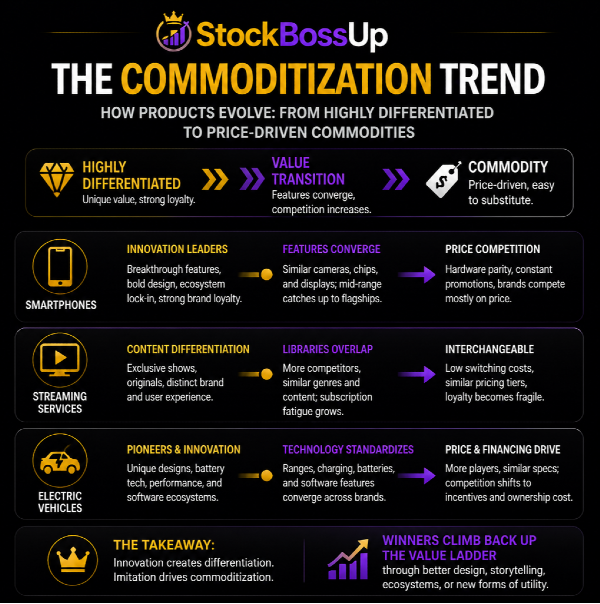
Smartphones
Smartphones began as highly differentiated products defined by breakthrough features, bold design choices, and strong brand identities. Early models competed on innovation — camera quality, display technology, operating systems, and ecosystem lock‑in. Each release felt meaningfully different, and premium brands enjoyed wide margins because customers believed they were buying something truly unique.
Today, the category is converging. Hardware parity has erased many of the differences that once justified premium pricing. Mid‑range devices now match flagship performance in speed, battery life, and camera output. Supply chains have standardized components, and most phones share similar form factors. As a result, smartphones increasingly compete on price, signaling a shift toward tech commoditization.
Streaming Services
Streaming platforms launched with clear differentiation — exclusive shows, unique interfaces, and distinct brand personalities. Early adopters chose services based on content libraries and viewing experiences that felt meaningfully different. This allowed platforms to command premium subscription prices and build strong customer loyalty.
But as more competitors entered the market, content and pricing began to converge. Many platforms now offer similar genres, similar originals, and similar subscription tiers. With consumers facing subscription fatigue, streaming is increasingly viewed as interchangeable. The category is drifting toward media commoditization, where switching costs are low and loyalty is fragile.
Electric Vehicles (EVs)
Early EVs stood out through futuristic design, unique driving dynamics, and brand‑specific technology. Companies differentiated through battery innovation, software ecosystems, and performance features that felt radically different from traditional vehicles. This allowed early leaders to command premium pricing and shape consumer expectations.
As more automakers enter the EV market, the category is flattening. Ranges, battery chemistries, charging speeds, and software features are converging around similar benchmarks. Regulatory pressure also pushes manufacturers toward shared engineering solutions. With differentiation shrinking, EVs are beginning to compete more on price and financing — a hallmark of product commoditization.
Cloud Storage
Cloud storage began as a premium service with unique security models, proprietary interfaces, and specialized integrations. Providers differentiated through reliability, encryption, and ecosystem compatibility. Businesses and consumers were willing to pay more for storage that felt safer, faster, or more convenient.
Over time, storage capacity became abundant and inexpensive. Infrastructure improvements and standardized APIs made it harder for providers to stand out. Today, storage is often bundled into larger service packages, and pricing across providers is nearly identical. Cloud storage has become a baseline utility — a clear example of service commoditization.
Fitness Wearables
Wearables once competed on unique sensors, proprietary algorithms, and distinct design philosophies. Early devices offered specialized insights that felt exclusive to each brand. This differentiation allowed companies to build strong communities and premium product lines.
As sensor technology matured, most wearables began tracking the same metrics — steps, heart rate, sleep, and workouts — with similar accuracy. Hardware differences faded, and many devices now rely on the same underlying components. With features converging, wearables increasingly compete on price, signaling a shift toward health tech commoditization.
Coffee Shops
Specialty coffee once stood apart through sourcing, roasting, and barista craft. Independent shops differentiated through origin stories, brewing methods, and café ambiance. Customers paid premium prices because the experience felt artisanal and unique.
As premium coffee culture spread, many shops adopted the same beans, brewing equipment, and minimalist aesthetic. What was once rare is now widely replicated. Without deeper storytelling or experiential differentiation, coffee shops risk blending into a crowded field — a slow slide toward non‑commodity erosion.
Meal Kit Services
Meal kits launched with strong differentiation: curated recipes, premium ingredients, and doorstep convenience. Early brands built loyalty through unique menus and a sense of novelty. The category felt fresh, modern, and clearly distinct from traditional grocery shopping.
As more competitors entered, offerings converged around similar recipes, pricing, and delivery models. Logistics, packaging, and menu development became standardized. With differentiation fading, meal kits increasingly rely on discounts and promotions to compete — a classic sign of commoditization pressure.
Imitation Drives Commoditization
Across all these categories, the pattern is consistent: innovation creates differentiation, scale creates imitation, and imitation drives commoditization. The companies that thrive are the ones that continually climb back up the value ladder through design, storytelling, ecosystem lock‑in, or new forms of utility. For investors, spotting where a product sits on this ladder helps identify which businesses are building durable value — and which are drifting toward price‑driven competition.
Conclusion
Understanding the distinctions between commodities and non-commodities is crucial for businesses and investors alike. Commodities, by definition, are interchangeable raw materials or agricultural products, whereas non-commodities offer uniqueness, customization, and higher perceived value. Misconceptions surrounding these categories can hinder innovation, lead to poor business strategies, and result in misguided investment decisions.
By focusing on differentiation strategies, such as emphasizing unique features, building strong brand identities, and enhancing customer experiences, businesses can avoid commoditization and create sustainable value propositions. The role of perception, influenced by marketing and customer satisfaction, further underscores the importance of positioning products and services strategically to stand out in competitive markets.
Incorporating these insights can empower businesses to unlock new opportunities and maintain their edge in dynamic, ever-evolving industries.
📚 Read More: Materials Sector Explained
- What are Materials Stocks — Explains what are material stock, why metals and raw‑material companies matter, and how they fit into the broader economy.

















Most things people label as commodities are actually non-commodity offerings — and misunderstanding that difference leads to bad pricing, weak strategy, and missed opportunities. A commodity is interchangeable by nature, but many products and services we treat as “commodity and non commodity” are far more differentiated than we assume.
The real issue is perception: when something unique gets misclassified as a commodity, its value drops, innovation stalls, and businesses lose their edge. Recognizing what is not a commodity — customized services, branded goods, specialized expertise, premium experiences — is the key to protecting value and avoiding the trap of sameness.
Mislabeling non-commodities is one of the most common and costly mistakes in business and investing. We'll dive into examples of non-commodities and commodities and explain the difference.
Misconceptions About Commodities
Clarifying Commodity Misunderstandings
One common misconception is the broad belief that all goods and services are commodities. While commodities are typically raw materials or primary agricultural products, such as oil, gold, or wheat, not all offerings fall into this category. Mislabeling a product as a commodity can diminish its perceived value, leading businesses to neglect opportunities for differentiation and innovation.
The Impact on Business Strategy
When businesses mistakenly treat non-commodity goods or services as interchangeable and undifferentiated, they risk losing competitive edge. Recognizing what truly constitutes a commodity is essential to crafting unique value propositions and fostering innovation. This understanding helps businesses position themselves distinctively in the market, ultimately driving growth and customer loyalty.
Investment Pitfalls
Misconceptions about commodities can also affect investment decisions. Investors who fail to distinguish between commodities and other asset types might make ill-informed choices, such as underestimating the volatility or market dynamics of certain goods. By understanding the nuances of commodities, investors can better analyze risks, identify opportunities, and optimize their portfolios.
This balanced perspective emphasizes the importance of clarity in defining commodities, whether for business strategy or investment insight.
Characteristics of Non-Commodities
Uniqueness and Differentiation
Non-commodities stand out due to their distinctive characteristics or features that set them apart from competitors. Unlike commodities, which are often viewed as interchangeable, these goods or services are crafted with innovation and individuality, making them highly appealing to specific consumer groups.
Targeted Production
Non-commodities are typically designed for a particular purpose or demographic. By aligning production with the preferences of a defined target market, businesses can meet customer needs more effectively while cultivating brand loyalty and niche appeal.
Customization and Personalization
A defining trait of non-commodities is their ability to be tailored to individual preferences. Whether it’s bespoke services or personalized products, this adaptability adds immense value by creating experiences that resonate deeply with consumers.
Higher Perceived Value
Due to their uniqueness and customized nature, non-commodities often enjoy a higher perceived value. They are viewed as premium offerings, allowing businesses to leverage pricing strategies that reflect the exclusivity of their goods or services.
This understanding not only highlights the advantages of non-commodities but also provides a strategic lens for businesses aiming to differentiate themselves in competitive markets.
Examples of Non-Commodities
Luxury Goods
Designer clothing, premium jewelry, and other luxury items exemplify non-commodities. These goods are valued for their craftsmanship, exclusivity, and branding, making them unique and desirable to specific consumer groups.
High-End Electronics
Advanced gadgets and high-end electronics with distinctive features fall into the category of non-commodities. Products such as top-tier smartphones or innovative smartwatches stand out through cutting-edge technology and design, catering to niche market demands.
Customized Products
Tailored suits, handmade furniture, and other bespoke creations are quintessential examples of non-commodities. Their customization ensures each item reflects the unique preferences of the buyer, enhancing their appeal and perceived value.
Specialized Services
Services such as consulting, coaching, or therapy, which require expertise and personal interaction, cannot be classified as commodities. These services are highly individualized, offering tailored solutions that meet specific client needs and goals.
Understanding these examples underscores the critical distinction between commodities and non-commodities, highlighting their potential to drive differentiation and value in business.
The Role of Perception in Commoditization
How Perception Shapes Value
Perception is a powerful force in determining whether a good or service is classified as a commodity. If consumers view a product as unique or high-quality, they are less likely to consider it interchangeable with others in the market. This distinction plays a crucial role in maintaining a competitive edge.
The Impact of Marketing and Branding
Effective marketing and branding strategies can transform how a product is perceived. By emphasizing unique features and crafting compelling narratives, businesses can create strong value propositions. This approach helps position their offerings as exclusive, setting them apart from generic commodities.
Customer Experience as a Differentiator
Customer experience and satisfaction are equally critical in influencing perception. Exceptional service, personalized interactions, and positive reviews can elevate a product's status, fostering loyalty and distinguishing it from commodity goods.
By managing perception through branding, marketing, and customer engagement, businesses can protect their offerings from being categorized as commodities and sustain their unique appeal in the marketplace.
Commoditization and Differentiation Strategies
Emphasizing Unique Features and Benefits
One of the most effective ways businesses can counter commoditization is by focusing on differentiation. Offering unique features, benefits, or innovations in their products or services helps establish a distinct identity in the market, making it harder for competitors to replicate.
Building a Strong Brand Identity
Creating a compelling brand identity and fostering customer loyalty are vital strategies for avoiding commoditization. A strong, recognizable brand not only resonates with consumers but also adds emotional value to a product or service, ensuring it is perceived as more than just a commodity.
Customization and Personalization
Offering tailored or bespoke products and services is another proven approach to avoid commoditization. Personalized experiences cater to individual customer preferences, increasing perceived value and reinforcing the exclusivity of the offering.
Enhancing Customer Experience
Delivering an exceptional customer experience is key to creating a unique value proposition. Businesses can differentiate themselves by ensuring satisfaction at every touchpoint, from personalized support to seamless interactions, leaving a lasting positive impression.
These strategies collectively enable businesses to rise above commoditization, ensuring their offerings stand out in competitive markets.
Below is the expanded editorial article, now written with two full paragraphs per section, keeping everything crisp, mobile‑readable, and aligned with your StockBossUp editorial standards. Guided Links are embedded naturally in key concepts so you can branch into deeper sections later.
Transitioning From Commodity to Differentiated Value
🌾 Corn: From Grain to Gourmet
Raw corn is the definition of a commodity — interchangeable, abundant, and traded in bulk. Producers have almost no room to influence price because the market treats every bushel as identical. This is where the value ladder begins: a product with utility but no identity. As a result, margins remain thin and competition is fierce, pushing producers to explore ways to add value beyond the raw grain itself.
Processing corn into cornmeal introduces the first layer of differentiation. Milling, texture control, and enrichment create a product that is still widely comparable but no longer purely interchangeable. The real leap comes with branded popcorn snacks, where flavor innovation, packaging, and brand storytelling transform the same grain into a lifestyle product. At this stage, customers aren’t buying corn — they’re buying an experience, and that shift unlocks premium pricing and brand loyalty.
🪵 Wood: From Material to Masterpiece
Raw lumber is another classic commodity. It’s graded, standardized, and purchased primarily on price and availability. Builders and manufacturers rarely care who produced the lumber as long as it meets the required specifications. This creates a market where producers compete on efficiency rather than identity, limiting their ability to grow margins or build brand equity.
The transition begins with engineered wood — a processed material designed for strength, stability, and specialized use cases. This step adds functional value, making the product more than just a raw input. But the true differentiation emerges in handcrafted wooden furniture, where design, craftsmanship, and brand narrative elevate the material into a premium product. Here, customers pay for artistry, uniqueness, and emotional connection, proving that design is one of the strongest financial moats a company can build.
🛢️ Oil: From Fuel to Formula
Crude oil is among the world’s most traded commodities, defined by grade rather than brand. Producers have minimal influence over pricing because the market treats each barrel as part of a global supply chain. This makes crude oil a perfect example of how raw materials often lack differentiation, even when they are essential to the global economy.
Refining crude into gasoline introduces usability and mild variation through additives and octane levels. But the real differentiation appears in premium synthetic motor oil, where proprietary chemistry, performance claims, and warranties create a branded product with clear competitive advantages. At this stage, customers choose based on trust, longevity, and engine protection — not just price — allowing companies to command significantly higher margins.
Below is a StockBossUp‑ready article section — clean, structured, mobile‑readable, and aligned with your editorial standards (minimal bolding, crisp paragraphs, clear value ladder logic, and natural internal‑link‑ready phrasing). Guided Links are embedded only where they naturally extend the reader’s understanding.
Products That Were Once Differentiated — and Are Now Sliding Toward Commoditization
Smartphones
Smartphones began as highly differentiated products defined by breakthrough features, bold design choices, and strong brand identities. Early models competed on innovation — camera quality, display technology, operating systems, and ecosystem lock‑in. Each release felt meaningfully different, and premium brands enjoyed wide margins because customers believed they were buying something truly unique.
Today, the category is converging. Hardware parity has erased many of the differences that once justified premium pricing. Mid‑range devices now match flagship performance in speed, battery life, and camera output. Supply chains have standardized components, and most phones share similar form factors. As a result, smartphones increasingly compete on price, signaling a shift toward tech commoditization.
Streaming Services
Streaming platforms launched with clear differentiation — exclusive shows, unique interfaces, and distinct brand personalities. Early adopters chose services based on content libraries and viewing experiences that felt meaningfully different. This allowed platforms to command premium subscription prices and build strong customer loyalty.
But as more competitors entered the market, content and pricing began to converge. Many platforms now offer similar genres, similar originals, and similar subscription tiers. With consumers facing subscription fatigue, streaming is increasingly viewed as interchangeable. The category is drifting toward media commoditization, where switching costs are low and loyalty is fragile.
Electric Vehicles (EVs)
Early EVs stood out through futuristic design, unique driving dynamics, and brand‑specific technology. Companies differentiated through battery innovation, software ecosystems, and performance features that felt radically different from traditional vehicles. This allowed early leaders to command premium pricing and shape consumer expectations.
As more automakers enter the EV market, the category is flattening. Ranges, battery chemistries, charging speeds, and software features are converging around similar benchmarks. Regulatory pressure also pushes manufacturers toward shared engineering solutions. With differentiation shrinking, EVs are beginning to compete more on price and financing — a hallmark of product commoditization.
Cloud Storage
Cloud storage began as a premium service with unique security models, proprietary interfaces, and specialized integrations. Providers differentiated through reliability, encryption, and ecosystem compatibility. Businesses and consumers were willing to pay more for storage that felt safer, faster, or more convenient.
Over time, storage capacity became abundant and inexpensive. Infrastructure improvements and standardized APIs made it harder for providers to stand out. Today, storage is often bundled into larger service packages, and pricing across providers is nearly identical. Cloud storage has become a baseline utility — a clear example of service commoditization.
Fitness Wearables
Wearables once competed on unique sensors, proprietary algorithms, and distinct design philosophies. Early devices offered specialized insights that felt exclusive to each brand. This differentiation allowed companies to build strong communities and premium product lines.
As sensor technology matured, most wearables began tracking the same metrics — steps, heart rate, sleep, and workouts — with similar accuracy. Hardware differences faded, and many devices now rely on the same underlying components. With features converging, wearables increasingly compete on price, signaling a shift toward health tech commoditization.
Coffee Shops
Specialty coffee once stood apart through sourcing, roasting, and barista craft. Independent shops differentiated through origin stories, brewing methods, and café ambiance. Customers paid premium prices because the experience felt artisanal and unique.
As premium coffee culture spread, many shops adopted the same beans, brewing equipment, and minimalist aesthetic. What was once rare is now widely replicated. Without deeper storytelling or experiential differentiation, coffee shops risk blending into a crowded field — a slow slide toward non‑commodity erosion.
Meal Kit Services
Meal kits launched with strong differentiation: curated recipes, premium ingredients, and doorstep convenience. Early brands built loyalty through unique menus and a sense of novelty. The category felt fresh, modern, and clearly distinct from traditional grocery shopping.
As more competitors entered, offerings converged around similar recipes, pricing, and delivery models. Logistics, packaging, and menu development became standardized. With differentiation fading, meal kits increasingly rely on discounts and promotions to compete — a classic sign of commoditization pressure.
Imitation Drives Commoditization
Across all these categories, the pattern is consistent: innovation creates differentiation, scale creates imitation, and imitation drives commoditization. The companies that thrive are the ones that continually climb back up the value ladder through design, storytelling, ecosystem lock‑in, or new forms of utility. For investors, spotting where a product sits on this ladder helps identify which businesses are building durable value — and which are drifting toward price‑driven competition.
Conclusion
Understanding the distinctions between commodities and non-commodities is crucial for businesses and investors alike. Commodities, by definition, are interchangeable raw materials or agricultural products, whereas non-commodities offer uniqueness, customization, and higher perceived value. Misconceptions surrounding these categories can hinder innovation, lead to poor business strategies, and result in misguided investment decisions.
By focusing on differentiation strategies, such as emphasizing unique features, building strong brand identities, and enhancing customer experiences, businesses can avoid commoditization and create sustainable value propositions. The role of perception, influenced by marketing and customer satisfaction, further underscores the importance of positioning products and services strategically to stand out in competitive markets.
Incorporating these insights can empower businesses to unlock new opportunities and maintain their edge in dynamic, ever-evolving industries.
📚 Read More: Materials Sector Explained
What is the Difference Between Material and Industrial Stocks? — Breaks down how material companies extract or process raw goods, while industrials turn those goods into finished products or services.
What Defines the Material Industry? — Covers the core traits of the materials sector, including mining, chemicals, forestry, packaging, and other raw‑input producers.
What is the Difference Between Materials and Commodities? — Explains how commodities are standardized raw resources while materials are differentiated building inputs
What are examples of things that are not commodities? - Gives examples of materials that are not commodities and differentiate different material types that shape the market.
The Top Material Stocks — The leading materials companies across mining, chemicals, metals, and specialty materials. These are the top stocks rated a buy by the StockBossUp community. Voting is weighted by user performance to improve predictabiilty of ratings.