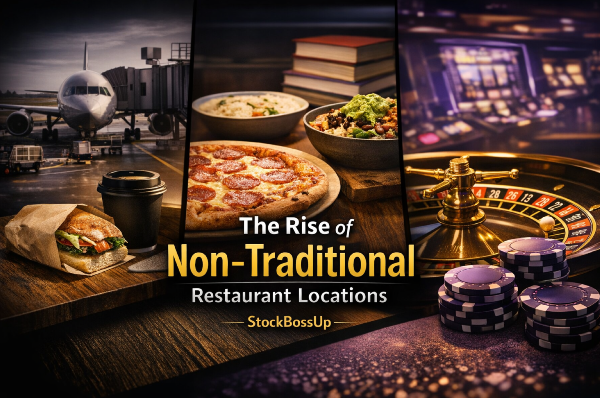
🔑 Key Takeaways: The Rise of Non‑Traditional Restaurant Locations
✈️ Airports redefine restaurant profitability
Airports deliver unmatched foot traffic and predictable waves of customers. Restaurants here earn more per square foot than almost any other location because travelers spend freely and stay longer. Brands use these spaces to test new menus and technology, learning faster than in traditional street settings.
🎓 Colleges create lifelong brand loyalty
College campuses provide steady demand and a young audience that shapes future dining trends. Students eat multiple times a day and often choose convenience over complexity. When a brand becomes part of campus life, it builds loyalty that lasts well beyond graduation.
🎰 Casinos turn dining into entertainment
Casinos blend food with experience. Guests spend more freely, stay longer, and seek memorable meals between games. Restaurants benefit from high margins and diverse customer behavior, while casinos use dining to keep visitors engaged and returning.
💡 Non‑traditional sites solve the traffic problem
Airports, colleges, and casinos offer built‑in demand that traditional locations can’t match. They provide stability, higher margins, and room for innovation. As travel, education, and entertainment grow, these venues will define the next wave of restaurant expansion.
Many restaurant stock brands are fighting for growth in a market where new store openings are harder to justify. Costs are rising. Competition is intense. And customer habits are shifting fast. Yet one major problem sits at the center of this challenge: most brands still depend on traditional street locations, even though those sites no longer guarantee steady traffic. The answer to this problem is not obvious at first. It hides in places most people overlook. These places are busy, controlled, and built around constant movement. But the real reason they matter becomes clear only after understanding how they change the economics of food service.
Why Are Restaurants Turning to Unusual Locations?
Restaurants are moving into airports, colleges, and casinos because these places offer something rare: built‑in demand. People in these spaces are not just passing by. They are waiting, studying, traveling, or playing. They stay longer. They return often. And they spend more freely. This shift is not about chasing trends. It is about finding stable ground in a changing industry.
These locations also reduce the risk of slow days. A street‑level restaurant might see traffic drop during bad weather or local events. But an airport terminal stays busy even during storms. A college dining hall fills up during exam season. A casino floor never sleeps. These patterns create a steady flow of customers that many brands cannot find elsewhere.
Another reason for the shift is the rise of flexible formats. Restaurants no longer need large dining rooms. They can operate in small footprints with limited menus. This makes it easier to fit into tight spaces like gates, student centers, or casino corridors. It also lowers labor needs and reduces waste.
Some brands even use these locations to test new ideas. A college campus might get a new menu item before the rest of the country. An airport might debut a digital‑only ordering system. These tests help companies learn faster and adjust before rolling out changes nationwide.
How Do Airports Create a Different Kind of Restaurant Economy?
Airports are one of the most powerful non‑traditional locations for restaurants. They offer high traffic, long dwell times, and customers who are willing to spend more than usual. Travelers often buy food because they have limited choices and limited time. This creates a unique environment where even simple menu items can perform well.
Airport restaurants also benefit from predictable waves of customers. Morning flights bring breakfast crowds. Midday flights bring lunch traffic. Delays create long lines at coffee shops and quick‑service counters. These patterns help operators plan staffing and inventory with more accuracy.
One unique fact about airport dining is that some brands earn more per square foot in airports than in any other type of location. This happens because airports compress thousands of people into small areas. Even a small counter can serve hundreds of customers per hour.
Another interesting detail is that many airport restaurants are not run by the brands themselves. They are operated by concession companies that license the brand. This allows restaurants to expand without managing the complex rules of airport operations.
Airport Restaurant Performance Snapshot
| Location Type |
Avg. Daily Foot Traffic |
Typical Menu Prices |
Labor Needs |
| Airport Gate Areas |
Very High |
Higher Than Street Locations |
Moderate |
| Airport Food Courts |
High |
Moderate |
Moderate |
| Airport Grab‑and‑Go |
High |
Lower |
Low |
Why Do Colleges Offer a Hidden Advantage for Restaurant Brands?
College campuses are another strong opportunity for restaurants. Students eat multiple times a day. They stay on campus for long hours. And they often look for quick, affordable meals. This creates a steady demand that many brands value.
Colleges also offer something rare: a young customer base that shapes future trends. When students fall in love with a brand during school, they often stay loyal after graduation. This long‑term value makes college locations more than just a short‑term revenue play.
Another benefit is the ability to operate with smaller menus. Students prefer speed and convenience. They do not need large dining rooms or complex dishes. This allows restaurants to run efficient operations with fewer employees.
Some colleges even partner with brands to accept meal plans. This creates guaranteed revenue. It also makes it easier for students to choose branded food over campus‑run dining halls.
One unique fact about college dining is that some campuses have higher restaurant density per square mile than major cities. This happens because thousands of students live, study, and socialize in compact areas.
College Dining Trends Overview
| Trend |
Impact on Restaurants |
| Rise of mobile ordering |
Faster service and shorter lines |
| Demand for healthier options |
More bowls, salads, and fresh items |
| Late‑night eating habits |
Extended hours and simplified menus |
| Loyalty to familiar brands |
Strong repeat business |
What Makes Casinos a High‑Value Target for Restaurants?
Casinos are built around entertainment, and food plays a major role in that experience. Guests stay for long periods. They take breaks between games. They look for quick meals, sit‑down dinners, and late‑night snacks. This creates a wide range of opportunities for restaurants.
Casinos also attract diverse customers. Some come for weekend trips. Others visit weekly. Many stay in attached hotels. This mix creates steady demand across different times of day.
Another advantage is the spending behavior of casino guests. People in entertainment environments tend to spend more freely. They are relaxed. They are celebrating. They are on vacation. This mindset helps restaurants sell higher‑margin items.
Casinos also use restaurants as part of their overall strategy. A good meal keeps guests on the property longer. This increases the chance they will return to the gaming floor. Because of this, casinos often invest heavily in food service.
Some casinos even feature celebrity chef restaurants. These locations draw visitors who want a special dining experience. They also help casinos stand out in competitive markets.
Casino Restaurant Mix
| Restaurant Type |
Customer Behavior |
Revenue Potential |
| Quick‑Service |
Fast meals between games |
Moderate |
| Casual Dining |
Social meals and group visits |
High |
| Upscale Dining |
Special occasions and hotel guests |
Very High |
Why Do These Locations Change the Rules of Restaurant Growth?
Non‑traditional locations change the economics of restaurant growth because they offer built‑in demand and controlled environments. Unlike street locations, these spaces do not depend on foot traffic from the general public. They rely on people who are already there for other reasons.
This shift reduces risk. A restaurant in a busy airport terminal does not worry about slow weekdays. A college location does not depend on weekend shoppers. A casino restaurant does not rely on lunch crowds from nearby offices.
These locations also support higher prices. Travelers expect to pay more at airports. Students pay for convenience. Casino guests pay for experience. This allows restaurants to maintain strong margins even with higher operating costs.
Another advantage is brand exposure. Airports introduce brands to travelers from around the world. Colleges introduce brands to young adults forming lifelong habits. Casinos introduce brands to guests seeking memorable experiences.
These environments also support innovation. Restaurants can test new formats, new menus, and new technology. They can learn quickly and adjust before expanding further.
How Do Restaurants Adapt Their Menus for These Spaces?
Menus in non‑traditional locations are often smaller and more focused. This helps restaurants serve customers quickly and reduce waste. It also makes it easier to train staff and manage inventory.
In airports, menus focus on speed. Items must be easy to prepare and easy to eat on the go. Breakfast sandwiches, wraps, and salads are common. Drinks are simple and fast to serve.
In colleges, menus focus on value and variety. Students want affordable meals that fit their busy schedules. Bowls, burritos, and customizable items perform well. Many brands also offer plant‑based options.
In casinos, menus focus on experience. Guests want comfort food, shareable items, and late‑night snacks. Upscale restaurants offer steaks, seafood, and signature dishes.
Some brands even create exclusive items for these locations. This helps them stand out and meet the needs of specific customer groups.
Menu Adaptation Examples
| Location |
Menu Focus |
Common Items |
| Airports |
Speed and portability |
Wraps, sandwiches, salads |
| Colleges |
Value and variety |
Bowls, burritos, pizza |
| Casinos |
Experience and comfort |
Steaks, pasta, shareables |
Why Do These Locations Offer More Stability Than Traditional Sites?
Traditional restaurant locations depend on local traffic patterns. They rely on office workers, shoppers, or neighborhood residents. When these patterns change, sales drop. This has happened in many cities as remote work grows and shopping shifts online.
Non‑traditional locations avoid these risks. Airports stay busy because travel demand is steady. Colleges stay active because students live and study on campus. Casinos stay open because entertainment never stops.
These environments also protect restaurants from seasonal swings. A street location might struggle during winter. But an airport or casino stays warm, bright, and full of people.
Another benefit is the ability to forecast demand. Airlines publish schedules months in advance. Colleges follow academic calendars. Casinos track guest behavior with precision. This helps restaurants plan more effectively.
What Challenges Do Restaurants Face in These Locations?
Even though non‑traditional locations offer strong advantages, they also come with challenges. Airports have strict security rules. Deliveries must follow tight schedules. Staffing can be difficult because workers need special badges.
Colleges require partnerships with campus dining services. These agreements can limit menu choices or pricing. They may also require revenue sharing.
Casinos have complex regulations. Restaurants must follow strict rules about alcohol, gaming areas, and customer flow. They also operate in environments with constant noise and activity.
Another challenge is the cost of entry. Airport and casino spaces can be expensive to build. They require specialized equipment and design. But the long‑term revenue potential often makes the investment worthwhile.
How Will These Locations Shape the Future of Restaurant Growth?
The future of restaurant growth will depend on finding stable, high‑traffic environments. Non‑traditional locations offer exactly that. They provide steady demand, strong margins, and opportunities for innovation.
More brands will move into airports as travel continues to rise. Colleges will attract new concepts focused on speed and value. Casinos will expand their dining options to compete for guests seeking memorable experiences.
Technology will also play a major role. Mobile ordering, digital kiosks, and automated kitchens will make it easier to operate in tight spaces. These tools will help restaurants serve more customers with fewer employees.
Some brands may even design new concepts specifically for these environments. These concepts will focus on speed, portability, and efficiency. They will use small footprints and flexible menus.
The biggest shift will come from understanding the problem introduced at the start of this article. Traditional locations no longer guarantee steady traffic. But airports, colleges, and casinos offer built‑in demand that solves this challenge. They provide the stability that many brands need to grow in a changing world.
Final Thoughts
Non‑traditional restaurant locations are no longer side projects. They are becoming core parts of growth strategies. They offer steady demand, strong margins, and unique customer experiences. They also help brands reach new audiences and test new ideas.
As the restaurant industry continues to evolve, these locations will play an even bigger role. They will shape how brands expand, how menus are designed, and how customers experience food on the go. The brands that embrace this shift will be the ones that thrive in the years ahead.
🏗️ Master the Terrain: Prime Restaurant Real Estate Insights
Unlock the hidden value in your portfolio by mastering the "where" and "how" of restaurant expansion. From high-traffic non-traditional sites to the algorithmic precision of modern site selection, explore how physical footprints dictate fiscal futures.
📍 Strategic Growth & Real Estate in Restaurant Businesses
Market Intel: In an era of shifting demographics, the transition from urban centers to optimized suburban drive-thrus is redefining long-term equity. Use the links above to deep dive into the data driving these shifts.










🔑 Key Takeaways: The Rise of Non‑Traditional Restaurant Locations
✈️ Airports redefine restaurant profitability
Airports deliver unmatched foot traffic and predictable waves of customers. Restaurants here earn more per square foot than almost any other location because travelers spend freely and stay longer. Brands use these spaces to test new menus and technology, learning faster than in traditional street settings.🎓 Colleges create lifelong brand loyalty
College campuses provide steady demand and a young audience that shapes future dining trends. Students eat multiple times a day and often choose convenience over complexity. When a brand becomes part of campus life, it builds loyalty that lasts well beyond graduation.🎰 Casinos turn dining into entertainment
Casinos blend food with experience. Guests spend more freely, stay longer, and seek memorable meals between games. Restaurants benefit from high margins and diverse customer behavior, while casinos use dining to keep visitors engaged and returning.💡 Non‑traditional sites solve the traffic problem
Airports, colleges, and casinos offer built‑in demand that traditional locations can’t match. They provide stability, higher margins, and room for innovation. As travel, education, and entertainment grow, these venues will define the next wave of restaurant expansion.Many restaurant stock brands are fighting for growth in a market where new store openings are harder to justify. Costs are rising. Competition is intense. And customer habits are shifting fast. Yet one major problem sits at the center of this challenge: most brands still depend on traditional street locations, even though those sites no longer guarantee steady traffic. The answer to this problem is not obvious at first. It hides in places most people overlook. These places are busy, controlled, and built around constant movement. But the real reason they matter becomes clear only after understanding how they change the economics of food service.
Why Are Restaurants Turning to Unusual Locations?
Restaurants are moving into airports, colleges, and casinos because these places offer something rare: built‑in demand. People in these spaces are not just passing by. They are waiting, studying, traveling, or playing. They stay longer. They return often. And they spend more freely. This shift is not about chasing trends. It is about finding stable ground in a changing industry.
These locations also reduce the risk of slow days. A street‑level restaurant might see traffic drop during bad weather or local events. But an airport terminal stays busy even during storms. A college dining hall fills up during exam season. A casino floor never sleeps. These patterns create a steady flow of customers that many brands cannot find elsewhere.
Another reason for the shift is the rise of flexible formats. Restaurants no longer need large dining rooms. They can operate in small footprints with limited menus. This makes it easier to fit into tight spaces like gates, student centers, or casino corridors. It also lowers labor needs and reduces waste.
Some brands even use these locations to test new ideas. A college campus might get a new menu item before the rest of the country. An airport might debut a digital‑only ordering system. These tests help companies learn faster and adjust before rolling out changes nationwide.
How Do Airports Create a Different Kind of Restaurant Economy?
Airports are one of the most powerful non‑traditional locations for restaurants. They offer high traffic, long dwell times, and customers who are willing to spend more than usual. Travelers often buy food because they have limited choices and limited time. This creates a unique environment where even simple menu items can perform well.
Airport restaurants also benefit from predictable waves of customers. Morning flights bring breakfast crowds. Midday flights bring lunch traffic. Delays create long lines at coffee shops and quick‑service counters. These patterns help operators plan staffing and inventory with more accuracy.
One unique fact about airport dining is that some brands earn more per square foot in airports than in any other type of location. This happens because airports compress thousands of people into small areas. Even a small counter can serve hundreds of customers per hour.
Another interesting detail is that many airport restaurants are not run by the brands themselves. They are operated by concession companies that license the brand. This allows restaurants to expand without managing the complex rules of airport operations.
Airport Restaurant Performance Snapshot
Why Do Colleges Offer a Hidden Advantage for Restaurant Brands?
College campuses are another strong opportunity for restaurants. Students eat multiple times a day. They stay on campus for long hours. And they often look for quick, affordable meals. This creates a steady demand that many brands value.
Colleges also offer something rare: a young customer base that shapes future trends. When students fall in love with a brand during school, they often stay loyal after graduation. This long‑term value makes college locations more than just a short‑term revenue play.
Another benefit is the ability to operate with smaller menus. Students prefer speed and convenience. They do not need large dining rooms or complex dishes. This allows restaurants to run efficient operations with fewer employees.
Some colleges even partner with brands to accept meal plans. This creates guaranteed revenue. It also makes it easier for students to choose branded food over campus‑run dining halls.
One unique fact about college dining is that some campuses have higher restaurant density per square mile than major cities. This happens because thousands of students live, study, and socialize in compact areas.
College Dining Trends Overview
What Makes Casinos a High‑Value Target for Restaurants?
Casinos are built around entertainment, and food plays a major role in that experience. Guests stay for long periods. They take breaks between games. They look for quick meals, sit‑down dinners, and late‑night snacks. This creates a wide range of opportunities for restaurants.
Casinos also attract diverse customers. Some come for weekend trips. Others visit weekly. Many stay in attached hotels. This mix creates steady demand across different times of day.
Another advantage is the spending behavior of casino guests. People in entertainment environments tend to spend more freely. They are relaxed. They are celebrating. They are on vacation. This mindset helps restaurants sell higher‑margin items.
Casinos also use restaurants as part of their overall strategy. A good meal keeps guests on the property longer. This increases the chance they will return to the gaming floor. Because of this, casinos often invest heavily in food service.
Some casinos even feature celebrity chef restaurants. These locations draw visitors who want a special dining experience. They also help casinos stand out in competitive markets.
Casino Restaurant Mix
Why Do These Locations Change the Rules of Restaurant Growth?
Non‑traditional locations change the economics of restaurant growth because they offer built‑in demand and controlled environments. Unlike street locations, these spaces do not depend on foot traffic from the general public. They rely on people who are already there for other reasons.
This shift reduces risk. A restaurant in a busy airport terminal does not worry about slow weekdays. A college location does not depend on weekend shoppers. A casino restaurant does not rely on lunch crowds from nearby offices.
These locations also support higher prices. Travelers expect to pay more at airports. Students pay for convenience. Casino guests pay for experience. This allows restaurants to maintain strong margins even with higher operating costs.
Another advantage is brand exposure. Airports introduce brands to travelers from around the world. Colleges introduce brands to young adults forming lifelong habits. Casinos introduce brands to guests seeking memorable experiences.
These environments also support innovation. Restaurants can test new formats, new menus, and new technology. They can learn quickly and adjust before expanding further.
How Do Restaurants Adapt Their Menus for These Spaces?
Menus in non‑traditional locations are often smaller and more focused. This helps restaurants serve customers quickly and reduce waste. It also makes it easier to train staff and manage inventory.
In airports, menus focus on speed. Items must be easy to prepare and easy to eat on the go. Breakfast sandwiches, wraps, and salads are common. Drinks are simple and fast to serve.
In colleges, menus focus on value and variety. Students want affordable meals that fit their busy schedules. Bowls, burritos, and customizable items perform well. Many brands also offer plant‑based options.
In casinos, menus focus on experience. Guests want comfort food, shareable items, and late‑night snacks. Upscale restaurants offer steaks, seafood, and signature dishes.
Some brands even create exclusive items for these locations. This helps them stand out and meet the needs of specific customer groups.
Menu Adaptation Examples
Why Do These Locations Offer More Stability Than Traditional Sites?
Traditional restaurant locations depend on local traffic patterns. They rely on office workers, shoppers, or neighborhood residents. When these patterns change, sales drop. This has happened in many cities as remote work grows and shopping shifts online.
Non‑traditional locations avoid these risks. Airports stay busy because travel demand is steady. Colleges stay active because students live and study on campus. Casinos stay open because entertainment never stops.
These environments also protect restaurants from seasonal swings. A street location might struggle during winter. But an airport or casino stays warm, bright, and full of people.
Another benefit is the ability to forecast demand. Airlines publish schedules months in advance. Colleges follow academic calendars. Casinos track guest behavior with precision. This helps restaurants plan more effectively.
What Challenges Do Restaurants Face in These Locations?
Even though non‑traditional locations offer strong advantages, they also come with challenges. Airports have strict security rules. Deliveries must follow tight schedules. Staffing can be difficult because workers need special badges.
Colleges require partnerships with campus dining services. These agreements can limit menu choices or pricing. They may also require revenue sharing.
Casinos have complex regulations. Restaurants must follow strict rules about alcohol, gaming areas, and customer flow. They also operate in environments with constant noise and activity.
Another challenge is the cost of entry. Airport and casino spaces can be expensive to build. They require specialized equipment and design. But the long‑term revenue potential often makes the investment worthwhile.
How Will These Locations Shape the Future of Restaurant Growth?
The future of restaurant growth will depend on finding stable, high‑traffic environments. Non‑traditional locations offer exactly that. They provide steady demand, strong margins, and opportunities for innovation.
More brands will move into airports as travel continues to rise. Colleges will attract new concepts focused on speed and value. Casinos will expand their dining options to compete for guests seeking memorable experiences.
Technology will also play a major role. Mobile ordering, digital kiosks, and automated kitchens will make it easier to operate in tight spaces. These tools will help restaurants serve more customers with fewer employees.
Some brands may even design new concepts specifically for these environments. These concepts will focus on speed, portability, and efficiency. They will use small footprints and flexible menus.
The biggest shift will come from understanding the problem introduced at the start of this article. Traditional locations no longer guarantee steady traffic. But airports, colleges, and casinos offer built‑in demand that solves this challenge. They provide the stability that many brands need to grow in a changing world.
Final Thoughts
Non‑traditional restaurant locations are no longer side projects. They are becoming core parts of growth strategies. They offer steady demand, strong margins, and unique customer experiences. They also help brands reach new audiences and test new ideas.
As the restaurant industry continues to evolve, these locations will play an even bigger role. They will shape how brands expand, how menus are designed, and how customers experience food on the go. The brands that embrace this shift will be the ones that thrive in the years ahead.
🏗️ Master the Terrain: Prime Restaurant Real Estate Insights
Unlock the hidden value in your portfolio by mastering the "where" and "how" of restaurant expansion. From high-traffic non-traditional sites to the algorithmic precision of modern site selection, explore how physical footprints dictate fiscal futures.
📍 Strategic Growth & Real Estate in Restaurant Businesses