🔑 Key Takeaways
⚡ Alternators and starters quietly power a massive installed base of vehicles
Even with EV growth accelerating, most vehicles on the road still rely on alternators and starters. That keeps demand steady for suppliers like Denso, Valeo, BorgWarner, and Mitsubishi Electric, especially in aging vehicle fleets and hybrid systems.
🏭 OEM supply is concentrated in a handful of global Tier 1 suppliers
A relatively small group of manufacturers dominates factory-installed alternators and starters. Companies like Denso, Valeo, Bosch-linked remanufacturing networks, and BorgWarner sit at the center of long-term OEM contracts and global production systems.
📈 Most public market exposure comes through diversified auto suppliers, not pure-play manufacturers
There are very few pure alternator or starter stocks. Investors typically get exposure through broader industrial and automotive companies like Denso, BorgWarner, Valeo, Aisin, and Mitsubishi Electric.
🔋 Electrification is quietly reshaping these components into smarter integrated systems
Start-stop systems and mild hybrid designs are turning traditional starters and alternators into integrated motor-generator units. The result is less mechanical simplicity and more electronics-heavy design evolution.
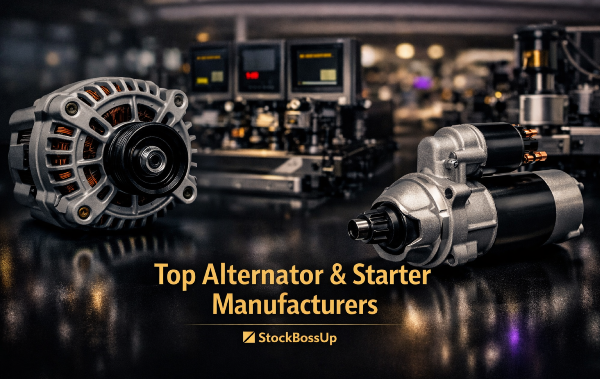
Top Alternator and Starter Manufacturers in the Stock Market
Alternators and starters are not flashy parts of the automotive world. They do not get the attention that EV batteries or autonomous driving systems receive.
But every internal combustion engine vehicle depends on them to function at all. One starts the engine. The other keeps everything alive once it’s running.
From an investment lens, this is a slow-moving but deeply entrenched market. It does not reinvent itself overnight. It evolves quietly, like an old machine getting smarter parts over time.
Why These Components Still Anchor the Global Fleet
Even with electric vehicles gaining share, the global vehicle fleet is still heavily weighted toward combustion engines and hybrids. That keeps alternators and starters firmly relevant.
These components follow predictable wear cycles. They fail over time, not suddenly across the entire market. That creates a steady replacement rhythm that supports both OEM and aftermarket demand.
Think of them as the “heartbeat and charging system” of traditional vehicles. Without them, nothing else really matters.
| Component |
What it does |
Why it still matters |
| Starter motor |
Cranks the engine |
Required for ignition |
| Alternator |
Charges electrical system |
Keeps systems alive |
| Voltage regulator |
Stabilizes output |
Protects electronics |
| Integrated motor units |
Hybrid support |
Bridges EV transition |
A less obvious driver here is vehicle aging. Older cars tend to stay on the road longer in many regions, which quietly supports replacement demand even as new vehicle mix shifts.
The Small Club That Builds Everything
At the OEM level, this market is not crowded. It is more like a small club with global branches.
Automakers rarely build alternators or starters themselves. They rely on Tier 1 suppliers with the scale and reliability to handle global production.
Denso is one of the most important players in this ecosystem, especially in Japan and global hybrid systems. Valeo plays a strong role in Europe, particularly as vehicles shift toward electrified drivetrains.
BorgWarner has expanded its footprint through acquisitions tied to drivetrain and electrical systems. Mitsubishi Electric and Aisin also contribute across broader vehicle electrical architecture.
| Supplier |
Strength |
Market role |
| Denso |
Full system integration |
Global OEM leader |
| Valeo |
Electrification focus |
European strength |
| BorgWarner |
Acquisitions + scale |
Transition player |
| Mitsubishi Electric |
Electrical systems |
Asia-heavy exposure |
| Aisin |
Drivetrain systems |
OEM integration |
The interesting part is how sticky these relationships are. Once a supplier is embedded in a platform, it tends to stay there for the life of the vehicle generation.
Where Investors Actually Get Exposure
There are almost no pure-play alternator or starter stocks in public markets. That changes how investors approach this space.
Instead of buying “the part,” investors buy companies that contain the part inside a much larger portfolio of automotive systems.
Denso is probably the closest thing to a core exposure. BorgWarner gives a more transition-heavy angle. Valeo provides European electrification exposure with legacy overlap.
Mitsubishi Electric and Aisin sit in the background as broader industrial-automotive hybrids.
| Company |
Exposure type |
Positioning |
| Denso |
Deep OEM systems |
Core exposure |
| Valeo |
Electrification mix |
Transition growth |
| BorgWarner |
Acquisitions-driven |
Structural pivot |
| Mitsubishi Electric |
Industrial + auto |
Diversified exposure |
| Aisin |
Drivetrain systems |
Stable OEM base |
The key takeaway is simple: this is a “basket exposure” industry, not a pure single-theme investment line.
The Aftermarket Keeps the Engine Turning (Literally)
Once vehicles leave the showroom, a different part of the industry takes over. The aftermarket becomes the real engine of demand.
Alternators and starters are ideal aftermarket products because they are durable but not permanent. They eventually wear out and can be rebuilt or replaced.
Distribution companies like Genuine Parts Company (NAPA) and Advance Auto Parts sit at the center of this replacement cycle. They keep repair shops supplied and vehicles running.
BBB Industries and other remanufacturers specialize in rebuilding these components and reselling them at lower cost.
| Player type |
Role in ecosystem |
Value driver |
| Distributors |
Parts availability |
Network scale |
| Retailers |
Consumer access |
Market reach |
| Remanufacturers |
Rebuilt components |
Margin efficiency |
| Repair shops |
Installation |
Demand execution |
One subtle dynamic here is that remanufactured parts often create surprisingly stable margins because input costs are lower and demand is relatively predictable.
Electrification Is Changing the Shape of the Parts, Not Removing Them
There is a common misconception that electrification eliminates starters and alternators entirely. The reality is more gradual.
Start-stop systems and mild hybrid designs still rely on starter-like functions. The difference is that these systems are becoming more electronically integrated.
Alternators are also evolving into smarter energy recovery systems in some hybrid setups.
It is less of a disappearance story and more of a redesign story.
| Vehicle type |
Component evolution |
Trend |
| ICE vehicles |
Traditional systems |
Gradual decline |
| Mild hybrids |
Integrated systems |
Growth phase |
| Full hybrids |
High integration |
Expansion |
| EVs |
No traditional units |
Structural shift |
The real change is that the job is staying the same, but the tools are getting more electronic and less mechanical.
Where This Market Quietly Heads Next
This segment is not disappearing into history. It is being absorbed into larger electrical system architectures.
The companies that win over time will be the ones that move from “component makers” to “system builders.” That means integrating electronics, software, and energy management into a single platform.
For investors, this creates a slow but important transition window. Legacy demand remains stable, but the growth narrative is increasingly tied to electrified vehicle systems.
In other words, alternators and starters are not fading out. They are just graduating into a more complex neighborhood inside the vehicle.














🔑 Key Takeaways
⚡ Alternators and starters quietly power a massive installed base of vehicles
Even with EV growth accelerating, most vehicles on the road still rely on alternators and starters. That keeps demand steady for suppliers like Denso, Valeo, BorgWarner, and Mitsubishi Electric, especially in aging vehicle fleets and hybrid systems.
🏭 OEM supply is concentrated in a handful of global Tier 1 suppliers
A relatively small group of manufacturers dominates factory-installed alternators and starters. Companies like Denso, Valeo, Bosch-linked remanufacturing networks, and BorgWarner sit at the center of long-term OEM contracts and global production systems.
📈 Most public market exposure comes through diversified auto suppliers, not pure-play manufacturers
There are very few pure alternator or starter stocks. Investors typically get exposure through broader industrial and automotive companies like Denso, BorgWarner, Valeo, Aisin, and Mitsubishi Electric.
🔋 Electrification is quietly reshaping these components into smarter integrated systems
Start-stop systems and mild hybrid designs are turning traditional starters and alternators into integrated motor-generator units. The result is less mechanical simplicity and more electronics-heavy design evolution.
Top Alternator and Starter Manufacturers in the Stock Market
Alternators and starters are not flashy parts of the automotive world. They do not get the attention that EV batteries or autonomous driving systems receive.
But every internal combustion engine vehicle depends on them to function at all. One starts the engine. The other keeps everything alive once it’s running.
From an investment lens, this is a slow-moving but deeply entrenched market. It does not reinvent itself overnight. It evolves quietly, like an old machine getting smarter parts over time.
Why These Components Still Anchor the Global Fleet
Even with electric vehicles gaining share, the global vehicle fleet is still heavily weighted toward combustion engines and hybrids. That keeps alternators and starters firmly relevant.
These components follow predictable wear cycles. They fail over time, not suddenly across the entire market. That creates a steady replacement rhythm that supports both OEM and aftermarket demand.
Think of them as the “heartbeat and charging system” of traditional vehicles. Without them, nothing else really matters.
A less obvious driver here is vehicle aging. Older cars tend to stay on the road longer in many regions, which quietly supports replacement demand even as new vehicle mix shifts.
The Small Club That Builds Everything
At the OEM level, this market is not crowded. It is more like a small club with global branches.
Automakers rarely build alternators or starters themselves. They rely on Tier 1 suppliers with the scale and reliability to handle global production.
Denso is one of the most important players in this ecosystem, especially in Japan and global hybrid systems. Valeo plays a strong role in Europe, particularly as vehicles shift toward electrified drivetrains.
BorgWarner has expanded its footprint through acquisitions tied to drivetrain and electrical systems. Mitsubishi Electric and Aisin also contribute across broader vehicle electrical architecture.
The interesting part is how sticky these relationships are. Once a supplier is embedded in a platform, it tends to stay there for the life of the vehicle generation.
Where Investors Actually Get Exposure
There are almost no pure-play alternator or starter stocks in public markets. That changes how investors approach this space.
Instead of buying “the part,” investors buy companies that contain the part inside a much larger portfolio of automotive systems.
Denso is probably the closest thing to a core exposure. BorgWarner gives a more transition-heavy angle. Valeo provides European electrification exposure with legacy overlap.
Mitsubishi Electric and Aisin sit in the background as broader industrial-automotive hybrids.
The key takeaway is simple: this is a “basket exposure” industry, not a pure single-theme investment line.
The Aftermarket Keeps the Engine Turning (Literally)
Once vehicles leave the showroom, a different part of the industry takes over. The aftermarket becomes the real engine of demand.
Alternators and starters are ideal aftermarket products because they are durable but not permanent. They eventually wear out and can be rebuilt or replaced.
Distribution companies like Genuine Parts Company (NAPA) and Advance Auto Parts sit at the center of this replacement cycle. They keep repair shops supplied and vehicles running.
BBB Industries and other remanufacturers specialize in rebuilding these components and reselling them at lower cost.
One subtle dynamic here is that remanufactured parts often create surprisingly stable margins because input costs are lower and demand is relatively predictable.
Electrification Is Changing the Shape of the Parts, Not Removing Them
There is a common misconception that electrification eliminates starters and alternators entirely. The reality is more gradual.
Start-stop systems and mild hybrid designs still rely on starter-like functions. The difference is that these systems are becoming more electronically integrated.
Alternators are also evolving into smarter energy recovery systems in some hybrid setups.
It is less of a disappearance story and more of a redesign story.
The real change is that the job is staying the same, but the tools are getting more electronic and less mechanical.
Where This Market Quietly Heads Next
This segment is not disappearing into history. It is being absorbed into larger electrical system architectures.
The companies that win over time will be the ones that move from “component makers” to “system builders.” That means integrating electronics, software, and energy management into a single platform.
For investors, this creates a slow but important transition window. Legacy demand remains stable, but the growth narrative is increasingly tied to electrified vehicle systems.
In other words, alternators and starters are not fading out. They are just graduating into a more complex neighborhood inside the vehicle.