How Menu Innovation Drives Restaurant Stock Growth
Restaurant stocks can look strong one quarter, then slow down the next. Sales flatten. Traffic drops. Investors start asking questions.
Here’s the problem: many restaurant brands run out of momentum even when they are popular. The dining rooms are still full. The brand still feels strong. But growth slows anyway. That gap between popularity and performance confuses a lot of investors.
Menu innovation often plays a bigger role than people expect. It can drive traffic, boost margins, and extend a brand’s life cycle. But it can also backfire if done wrong.
We’ll explore how menu innovation affects restaurant stocks, what patterns show up over time, and why some companies get it right while others struggle.
Why Do Some Menus Stop Driving Growth?
Menus are the core of any restaurant. They shape the customer experience. But over time, even strong menus can lose their impact.
Customers get used to the same items. Excitement fades. Repeat visits slow down. This leads to flat same-store sales.
Chains like McDonald’s (MCD) have faced this issue many times. When menus feel stale, traffic often drops.
Restaurants need to balance consistency with change. Too much change can confuse customers. Too little can make the brand feel outdated.
Another factor is competition. New brands enter the market with fresh ideas. Older chains must respond or risk losing market share.
How Does Menu Innovation Actually Impact Stock Performance?
Menu innovation can directly affect key financial metrics. These include traffic, average ticket size, and margins.
When a new item succeeds, it brings customers back. It can also attract new customers. This increases same-store sales, which investors watch closely.
Companies like Chipotle Mexican Grill (CMG) have used limited-time items to drive traffic spikes. These launches often create buzz and increase demand.
Pricing also plays a role. Innovative items can justify higher prices. This helps improve margins.
But not all innovation works. Failed items can increase costs without boosting sales.
What Types of Menu Innovation Work Best?
Not all menu changes are equal. Some types of innovation consistently perform better.
Limited-time offers (LTOs) are one of the most effective tools. They create urgency. Customers feel they need to act quickly.
Seasonal items also perform well. They align with customer expectations and trends.
Another strong approach is menu simplification. Removing weak items can improve efficiency and speed.
Here’s a breakdown of common innovation strategies:
| Innovation Type |
Impact on Sales |
Risk Level |
Example Outcome |
| Limited-Time Offers |
High |
Medium |
Traffic spikes |
| Seasonal Items |
Moderate |
Low |
Stable growth |
| Menu Expansion |
Mixed |
High |
Can dilute brand |
| Menu Simplification |
Moderate |
Low |
Better margins |
| Premium Add-Ons |
High |
Medium |
Higher ticket size |
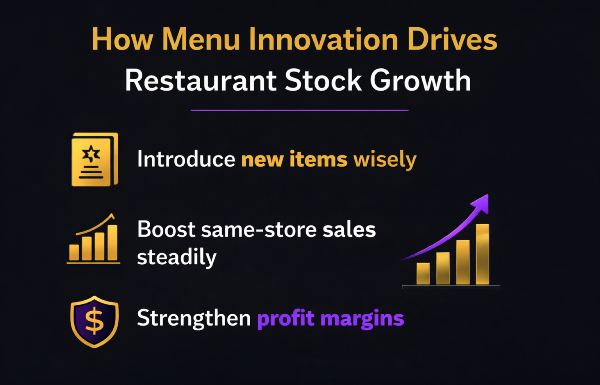
Each approach has trade-offs. The best companies use a mix of strategies.
Why Do Some Menu Innovations Fail?
Menu innovation can fail for several reasons. One common issue is complexity.
When menus become too large, operations slow down. This leads to longer wait times and lower customer satisfaction.
Another issue is poor alignment with the brand. Customers expect certain things from a restaurant. If new items do not match those expectations, they often fail.
Chains like Starbucks (SBUX) have tested many items over the years. Some worked well. Others were removed quickly.
Cost is another factor. New ingredients can increase expenses. If sales do not offset those costs, margins suffer.
There is also execution risk. Even a good idea can fail if it is not prepared consistently across locations.
How Do Trends Influence Menu Innovation?
Food trends play a big role in menu changes. Restaurants often follow trends to stay relevant.
Health-focused items have become more popular. Plant-based options have also grown in demand.
Companies like Yum! Brands (YUM) have tested plant-based products across different chains.
Another trend is customization. Customers want control over their meals. This has driven growth for brands like Chipotle Mexican Grill (CMG).
Digital ordering has also changed menus. Items must travel well for delivery. This affects what restaurants choose to offer.
One detail many people overlook: menu items designed for delivery often have higher margins because they reduce in-store labor needs.
Does Menu Innovation Improve Margins?
Menu innovation is not just about sales. It also affects profitability.
High-margin items can boost overall performance. These often include beverages, add-ons, and premium upgrades.
Chains like Domino’s Pizza (DPZ) use add-ons to increase order value. These small items can have a big impact on margins.
Simplifying the menu can also reduce costs. Fewer ingredients mean less waste and easier training.
However, innovation can increase costs if not managed carefully. New items may require new equipment or training.
Here’s a look at how different menu strategies affect margins:
| Strategy |
Margin Impact |
Operational Complexity |
| Premium Add-Ons |
High |
Low |
| Limited-Time Offers |
Medium |
Medium |
| Menu Expansion |
Low |
High |
| Simplification |
High |
Low |
| Trend-Based Items |
Medium |
Medium |
Balancing these factors is key to long-term success.
Why Do Investors Care So Much About Same-Store Sales?
Same-store sales measure how existing locations perform. This is one of the most important metrics for restaurant stocks.
Menu innovation often drives changes in this metric. A successful launch can boost same-store sales quickly.
Investors watch this closely. Strong same-store sales often lead to stock gains.
Companies like Wingstop (WING) have shown consistent growth in this area. Their focused menu helps maintain performance.
But short-term gains are not enough. Investors want to see sustained growth over time.
How Does Technology Support Menu Innovation?
Technology has changed how restaurants test and launch new items.
Data analytics allows companies to track customer preferences. This helps them design better menus.
Mobile apps also play a role. Restaurants can promote new items directly to customers.
Chains like Starbucks (SBUX) use their app to test new drinks and gather feedback.
Digital menus make it easier to update offerings. This allows faster innovation cycles.
One interesting detail: some restaurants now test new items in a single city before launching nationwide. This reduces risk and improves success rates.
Can Too Much Innovation Hurt a Brand?
Yes, too much innovation can be a problem. Constant changes can confuse customers.
A clear identity is important. Customers should know what a restaurant stands for.
Chains that change too often may lose their core audience. This can hurt long-term performance.
Consistency builds trust. Innovation should support the brand, not replace it.
Companies like McDonald’s (MCD) have learned to balance this over time. They innovate while keeping core items stable.
What Role Does Pricing Play in Menu Innovation?
Pricing is closely tied to innovation. New items often come with higher prices.
Premium items can increase average ticket size. This boosts revenue without increasing traffic.
But pricing must match value. If customers feel prices are too high, demand drops.
Inflation has made pricing even more important. Restaurants must manage costs while keeping customers satisfied.
Here’s a look at how pricing strategies affect performance:
| Pricing Strategy |
Customer Response |
Revenue Impact |
| Premium Pricing |
Mixed |
High potential |
| Value Deals |
Strong |
Lower margins |
| Bundling |
Positive |
Higher ticket size |
| Dynamic Pricing |
Emerging |
Variable |
The best strategies balance value and profitability.
Why Do Some Brands Excel at Menu Innovation?
Some companies consistently succeed with menu innovation. They follow a few key principles.
They test ideas before launching widely. This reduces risk.
They focus on core strengths. New items align with their brand identity.
They also move quickly. Fast execution helps them stay ahead of competitors.
Companies like Chipotle Mexican Grill (CMG) and Domino’s Pizza (DPZ) have shown strong execution in this area.
These brands use data to guide decisions. They adjust based on results.
Why Most Menu Innovation Strategies Fall Short
Many restaurants approach innovation the wrong way. They focus on trends instead of fundamentals.
Adding items without a clear strategy can hurt performance. It increases complexity and costs.
Another mistake is ignoring operations. A good idea must be easy to execute.
Some companies also fail to remove weak items. This leads to cluttered menus.
Over time, these issues can reduce efficiency and hurt margins.
So What Actually Drives Stock Growth Through Menu Innovation?
The answer is more nuanced than it seems.
Successful menu innovation is not about constant change. It is about focused, disciplined improvement.
The best-performing restaurant stocks use innovation to support their core business. They introduce new items that fit their brand. They manage costs carefully. They keep operations simple.
They also understand timing. They do not rush every trend. They choose the right moments to act.
This approach leads to steady same-store sales growth, stronger margins, and better long-term performance.
In the end, menu innovation works best when it is intentional, not reactive. That is the difference between short-term buzz and lasting stock growth.
🚀 Expand Your Edge: Elite Restaurant & Consumer Insights
Ready to dominate the sector? Our Investor Intelligence Hub is designed to help you navigate the complex world of restaurant equities with precision. From deep-dive fundamental analysis to macroeconomic strategy, explore our curated silos below to find your next big winner.
🍽️ Sector Fundamentals & Top Picks
📊 Deep-Dive Financial Analysis
🧠 Strategic Operations & Economics
🌍 Macro, Risk & Global Trends
💡 Investor Psychology & Behavioral Trends
🔍 Advanced Intelligence




How Menu Innovation Drives Restaurant Stock Growth
Restaurant stocks can look strong one quarter, then slow down the next. Sales flatten. Traffic drops. Investors start asking questions.
Here’s the problem: many restaurant brands run out of momentum even when they are popular. The dining rooms are still full. The brand still feels strong. But growth slows anyway. That gap between popularity and performance confuses a lot of investors.
Menu innovation often plays a bigger role than people expect. It can drive traffic, boost margins, and extend a brand’s life cycle. But it can also backfire if done wrong.
We’ll explore how menu innovation affects restaurant stocks, what patterns show up over time, and why some companies get it right while others struggle.
Why Do Some Menus Stop Driving Growth?
Menus are the core of any restaurant. They shape the customer experience. But over time, even strong menus can lose their impact.
Customers get used to the same items. Excitement fades. Repeat visits slow down. This leads to flat same-store sales.
Chains like McDonald’s (MCD) have faced this issue many times. When menus feel stale, traffic often drops.
Restaurants need to balance consistency with change. Too much change can confuse customers. Too little can make the brand feel outdated.
Another factor is competition. New brands enter the market with fresh ideas. Older chains must respond or risk losing market share.
How Does Menu Innovation Actually Impact Stock Performance?
Menu innovation can directly affect key financial metrics. These include traffic, average ticket size, and margins.
When a new item succeeds, it brings customers back. It can also attract new customers. This increases same-store sales, which investors watch closely.
Companies like Chipotle Mexican Grill (CMG) have used limited-time items to drive traffic spikes. These launches often create buzz and increase demand.
Pricing also plays a role. Innovative items can justify higher prices. This helps improve margins.
But not all innovation works. Failed items can increase costs without boosting sales.
What Types of Menu Innovation Work Best?
Not all menu changes are equal. Some types of innovation consistently perform better.
Limited-time offers (LTOs) are one of the most effective tools. They create urgency. Customers feel they need to act quickly.
Seasonal items also perform well. They align with customer expectations and trends.
Another strong approach is menu simplification. Removing weak items can improve efficiency and speed.
Here’s a breakdown of common innovation strategies:
Each approach has trade-offs. The best companies use a mix of strategies.
Why Do Some Menu Innovations Fail?
Menu innovation can fail for several reasons. One common issue is complexity.
When menus become too large, operations slow down. This leads to longer wait times and lower customer satisfaction.
Another issue is poor alignment with the brand. Customers expect certain things from a restaurant. If new items do not match those expectations, they often fail.
Chains like Starbucks (SBUX) have tested many items over the years. Some worked well. Others were removed quickly.
Cost is another factor. New ingredients can increase expenses. If sales do not offset those costs, margins suffer.
There is also execution risk. Even a good idea can fail if it is not prepared consistently across locations.
How Do Trends Influence Menu Innovation?
Food trends play a big role in menu changes. Restaurants often follow trends to stay relevant.
Health-focused items have become more popular. Plant-based options have also grown in demand.
Companies like Yum! Brands (YUM) have tested plant-based products across different chains.
Another trend is customization. Customers want control over their meals. This has driven growth for brands like Chipotle Mexican Grill (CMG).
Digital ordering has also changed menus. Items must travel well for delivery. This affects what restaurants choose to offer.
One detail many people overlook: menu items designed for delivery often have higher margins because they reduce in-store labor needs.
Does Menu Innovation Improve Margins?
Menu innovation is not just about sales. It also affects profitability.
High-margin items can boost overall performance. These often include beverages, add-ons, and premium upgrades.
Chains like Domino’s Pizza (DPZ) use add-ons to increase order value. These small items can have a big impact on margins.
Simplifying the menu can also reduce costs. Fewer ingredients mean less waste and easier training.
However, innovation can increase costs if not managed carefully. New items may require new equipment or training.
Here’s a look at how different menu strategies affect margins:
Balancing these factors is key to long-term success.
Why Do Investors Care So Much About Same-Store Sales?
Same-store sales measure how existing locations perform. This is one of the most important metrics for restaurant stocks.
Menu innovation often drives changes in this metric. A successful launch can boost same-store sales quickly.
Investors watch this closely. Strong same-store sales often lead to stock gains.
Companies like Wingstop (WING) have shown consistent growth in this area. Their focused menu helps maintain performance.
But short-term gains are not enough. Investors want to see sustained growth over time.
How Does Technology Support Menu Innovation?
Technology has changed how restaurants test and launch new items.
Data analytics allows companies to track customer preferences. This helps them design better menus.
Mobile apps also play a role. Restaurants can promote new items directly to customers.
Chains like Starbucks (SBUX) use their app to test new drinks and gather feedback.
Digital menus make it easier to update offerings. This allows faster innovation cycles.
One interesting detail: some restaurants now test new items in a single city before launching nationwide. This reduces risk and improves success rates.
Can Too Much Innovation Hurt a Brand?
Yes, too much innovation can be a problem. Constant changes can confuse customers.
A clear identity is important. Customers should know what a restaurant stands for.
Chains that change too often may lose their core audience. This can hurt long-term performance.
Consistency builds trust. Innovation should support the brand, not replace it.
Companies like McDonald’s (MCD) have learned to balance this over time. They innovate while keeping core items stable.
What Role Does Pricing Play in Menu Innovation?
Pricing is closely tied to innovation. New items often come with higher prices.
Premium items can increase average ticket size. This boosts revenue without increasing traffic.
But pricing must match value. If customers feel prices are too high, demand drops.
Inflation has made pricing even more important. Restaurants must manage costs while keeping customers satisfied.
Here’s a look at how pricing strategies affect performance:
The best strategies balance value and profitability.
Why Do Some Brands Excel at Menu Innovation?
Some companies consistently succeed with menu innovation. They follow a few key principles.
They test ideas before launching widely. This reduces risk.
They focus on core strengths. New items align with their brand identity.
They also move quickly. Fast execution helps them stay ahead of competitors.
Companies like Chipotle Mexican Grill (CMG) and Domino’s Pizza (DPZ) have shown strong execution in this area.
These brands use data to guide decisions. They adjust based on results.
Why Most Menu Innovation Strategies Fall Short
Many restaurants approach innovation the wrong way. They focus on trends instead of fundamentals.
Adding items without a clear strategy can hurt performance. It increases complexity and costs.
Another mistake is ignoring operations. A good idea must be easy to execute.
Some companies also fail to remove weak items. This leads to cluttered menus.
Over time, these issues can reduce efficiency and hurt margins.
So What Actually Drives Stock Growth Through Menu Innovation?
The answer is more nuanced than it seems.
Successful menu innovation is not about constant change. It is about focused, disciplined improvement.
The best-performing restaurant stocks use innovation to support their core business. They introduce new items that fit their brand. They manage costs carefully. They keep operations simple.
They also understand timing. They do not rush every trend. They choose the right moments to act.
This approach leads to steady same-store sales growth, stronger margins, and better long-term performance.
In the end, menu innovation works best when it is intentional, not reactive. That is the difference between short-term buzz and lasting stock growth.
🚀 Expand Your Edge: Elite Restaurant & Consumer Insights
Ready to dominate the sector? Our Investor Intelligence Hub is designed to help you navigate the complex world of restaurant equities with precision. From deep-dive fundamental analysis to macroeconomic strategy, explore our curated silos below to find your next big winner.
🍽️ Sector Fundamentals & Top Picks
📊 Deep-Dive Financial Analysis
🧠 Strategic Operations & Economics
🌍 Macro, Risk & Global Trends
💡 Investor Psychology & Behavioral Trends
🔍 Advanced Intelligence