Drive-Thru Economics: How It Impacts Restaurant Stock Performance
The drive-thru lane looks simple. Cars pull up, place an order, and move along. But behind that window sits a complex system that quietly shapes the financial health of major restaurant chains. Investors often focus on menu changes or expansion plans. They rarely focus on the speed of a speaker box or the layout of a parking lot.
Here’s the problem: many investors misjudge restaurant stocks because they ignore how drive-thru operations affect revenue, costs, and customer loyalty. This blind spot can lead to poor investment decisions. The real impact of drive-thru economics is not obvious at first glance. It shows up slowly in margins, traffic growth, and stock performance over time.
This article explores how drive-thru systems influence restaurant companies and their stock prices. The deeper insights may change how you evaluate fast-food investments.
Why Do Drive-Thru Lanes Matter More Than Dining Rooms?
Drive-thru lanes now generate a large share of revenue for quick-service restaurants. For companies like McDonald's (NYSE: MCD) and Starbucks (NASDAQ: SBUX), the drive-thru is often the main sales channel.
During peak hours, a single drive-thru lane can serve more customers than a full dining room. It reduces the need for seating space. It also lowers cleaning and maintenance costs.
Customers also prefer convenience. Many people want food without leaving their car. This behavior has grown stronger over the past decade. It changed even faster during the pandemic.
Restaurants that invested early in drive-thru infrastructure gained a major edge. Others had to catch up quickly or risk losing market share.
How Does Speed Translate Into Revenue Growth?
Speed is the core of drive-thru economics. The faster a restaurant serves customers, the more cars it can handle each hour.
Think of it like a factory line. If one car takes 4 minutes, the lane can serve 15 cars per hour. If that drops to 3 minutes, it can serve 20 cars. That is a 33% increase in capacity without adding a new location.
This directly impacts same-store sales. Faster service leads to higher volume. Higher volume drives revenue growth.
Chick-fil-A, though privately held, is known for high drive-thru efficiency. Public companies try to match this level of performance to stay competitive.
What Role Does Technology Play in Drive-Thru Efficiency?
Technology has become a major driver of performance. Many chains now use digital menu boards, AI-powered ordering systems, and mobile app integration.
Companies like Wendy’s (NASDAQ: WEN) have invested in AI to improve order accuracy and speed. These systems reduce human error and speed up transactions.
Mobile ordering also plays a key role. Customers can place orders before arriving. This reduces time at the speaker and improves throughput.
Starbucks has heavily pushed mobile ordering. In some locations, mobile orders make up more than 25% of total sales.
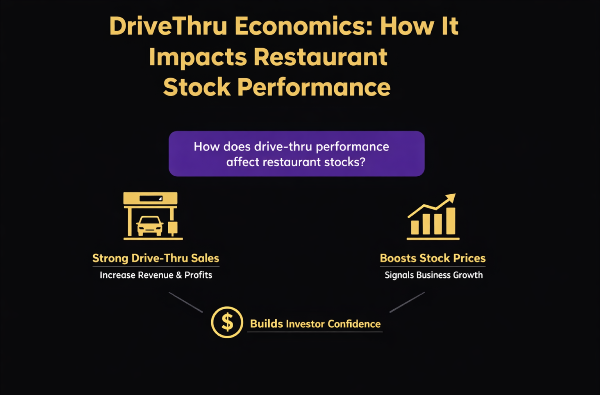
Why Do Small Delays Hurt Profits More Than You Think?
A delay of just 30 seconds may not seem like much. But across hundreds of stores, it adds up fast.
If a location loses two cars per hour due to delays, that could mean hundreds of lost transactions per day. Over a year, that turns into millions in missed revenue across a large chain.
Labor costs also rise when service slows down. Employees must work longer hours to handle the same demand.
This is why companies track drive-thru times closely. Even small improvements can have a large financial impact.
How Do Menu Design and Pricing Affect Drive-Thru Sales?
Menu complexity can slow down service. Too many options increase decision time. They also increase the chance of mistakes.
Many chains have simplified menus to improve speed. McDonald’s reduced menu items in recent years to streamline operations.
Pricing also plays a role. Value meals and bundles help customers order faster. They reduce decision fatigue and increase average ticket size.
Restaurants aim to balance variety with efficiency. Too much choice can hurt both speed and profits.
Why Are Drive-Thru Investments So Capital Intensive?
Building or upgrading a drive-thru is not cheap. It often requires redesigning the entire location.
Companies may add dual lanes, digital boards, or separate pickup windows. These upgrades can cost hundreds of thousands of dollars per store.
However, the return on investment can be strong. Higher throughput leads to higher sales and better margins over time.
Investors often look at capital spending trends to understand future growth. A company investing heavily in drive-thru upgrades may be preparing for long-term gains.
How Do Drive-Thru Metrics Influence Stock Valuation?
Investors track several key metrics tied to drive-thru performance:
- Same-store sales growth
- Average ticket size
- Customer traffic
- Operating margins
Improvement in these areas often leads to higher stock valuations.
For example, strong same-store sales growth at McDonald's (NYSE: MCD) has often been linked to operational improvements, including drive-thru efficiency.
When companies report faster service times or higher throughput, the market often reacts positively.
What Happens When Drive-Thru Performance Declines?
A slowdown in drive-thru performance can signal deeper problems. It may point to staffing issues, poor training, or outdated technology.
This can lead to lower customer satisfaction. Over time, customers may switch to competitors.
Stock prices can reflect these changes quickly. Investors tend to react to early signs of declining performance.
Key Drive-Thru Metrics Across Major Chains
| Company |
Avg Drive-Thru Time (Seconds) |
Mobile Order Share |
Same-Store Sales Growth |
| McDonald's (MCD) |
~300 |
Moderate |
Strong |
| Starbucks (SBUX) |
~270 |
High |
Moderate |
| Wendy’s (WEN) |
~320 |
Growing |
Moderate |
| Taco Bell (YUM) |
~260 |
Moderate |
Strong |
Estimates based on industry reports and company disclosures.
Why Do Some Chains Excel While Others Struggle?
Not all drive-thru systems are equal. Layout design plays a major role. Some locations are built for high traffic flow. Others are not.
Training also matters. Well-trained staff can handle orders faster and more accurately.
Chains like Taco Bell, owned by Yum! Brands (NYSE: YUM), focus heavily on operational efficiency. This helps them maintain strong performance.
How Does Customer Behavior Shape Drive-Thru Economics?
Customer habits have shifted toward convenience. Many people now prefer eating on the go.
This trend benefits drive-thru-focused chains. It also pushes companies to improve speed and accuracy.
Interestingly, research shows that customers are more likely to add extra items when ordering from a car compared to inside the store. This increases average ticket size.
Another detail is that weather can impact drive-thru sales. Rain or cold temperatures often lead to higher drive-thru traffic.
Can Drive-Thru Innovation Create Competitive Advantage?
Yes, innovation can set a company apart. Some chains are experimenting with new concepts.
Chipotle (NYSE: CMG) introduced “Chipotlane” pickup lanes for digital orders. This model reduces wait times and improves efficiency.
These innovations can drive growth and attract investors. They show that a company is adapting to changing consumer behavior.
What Risks Should Investors Watch?
Drive-thru operations face several risks:
- Labor shortages
- Rising wages
- Equipment failures
- Traffic congestion
These issues can reduce efficiency and increase costs.
Investors should watch for signs of operational strain. Companies that manage these risks well tend to perform better over time.
How Do Margins Improve With Better Drive-Thru Systems?
Margins improve when costs stay stable and revenue grows. Faster service increases sales without adding much cost.
Digital ordering reduces labor needs. Automated systems handle tasks that once required employees.
Over time, these improvements can significantly boost profitability.
Financial Impact of Drive-Thru Optimization
| Factor |
Impact on Revenue |
Impact on Costs |
Net Effect |
| Faster service |
High increase |
Low change |
Strong positive |
| Mobile ordering |
Moderate increase |
Moderate decrease |
Positive |
| Menu simplification |
Moderate increase |
Low decrease |
Positive |
| Dual-lane systems |
High increase |
High upfront cost |
Long-term gain |
Why Do Investors Often Miss This Factor?
Drive-thru performance is not always visible in financial reports. It is often buried in operational data.
Investors tend to focus on headline numbers. They may miss the underlying drivers of growth.
This creates opportunities for those who look deeper. Understanding drive-thru economics can give investors an edge.
What Is the Long-Term Outlook for Drive-Thru Growth?
The future looks strong for drive-thru systems. Technology will continue to improve speed and accuracy.
Autonomous ordering systems and AI will likely play a bigger role. These tools can reduce costs and improve customer experience.
Companies that invest early may gain a lasting advantage.
So What’s the Real Lesson Investors Should Take Away?
The answer to the problem introduced at the start is simple but often overlooked. Drive-thru economics is not just an operational detail. It is a core driver of financial performance.
Investors who ignore it may miss key signals. Those who understand it can better predict which companies will grow.
The next time you evaluate a restaurant stock, look beyond the menu. Pay attention to the drive-thru lane. It may tell you more about the company’s future than its earnings report.
🚀 Expand Your Edge: Elite Restaurant & Consumer Insights
Ready to dominate the sector? Our Investor Intelligence Hub is designed to help you navigate the complex world of restaurant equities with precision. From deep-dive fundamental analysis to macroeconomic strategy, explore our curated silos below to find your next big winner.
🍽️ Sector Fundamentals & Top Picks
📊 Deep-Dive Financial Analysis
🧠 Strategic Operations & Economics
🌍 Macro, Risk & Global Trends
💡 Investor Psychology & Behavioral Trends
🔍 Advanced Intelligence


Drive-Thru Economics: How It Impacts Restaurant Stock Performance
The drive-thru lane looks simple. Cars pull up, place an order, and move along. But behind that window sits a complex system that quietly shapes the financial health of major restaurant chains. Investors often focus on menu changes or expansion plans. They rarely focus on the speed of a speaker box or the layout of a parking lot.
Here’s the problem: many investors misjudge restaurant stocks because they ignore how drive-thru operations affect revenue, costs, and customer loyalty. This blind spot can lead to poor investment decisions. The real impact of drive-thru economics is not obvious at first glance. It shows up slowly in margins, traffic growth, and stock performance over time.
This article explores how drive-thru systems influence restaurant companies and their stock prices. The deeper insights may change how you evaluate fast-food investments.
Why Do Drive-Thru Lanes Matter More Than Dining Rooms?
Drive-thru lanes now generate a large share of revenue for quick-service restaurants. For companies like McDonald's (NYSE: MCD) and Starbucks (NASDAQ: SBUX), the drive-thru is often the main sales channel.
During peak hours, a single drive-thru lane can serve more customers than a full dining room. It reduces the need for seating space. It also lowers cleaning and maintenance costs.
Customers also prefer convenience. Many people want food without leaving their car. This behavior has grown stronger over the past decade. It changed even faster during the pandemic.
Restaurants that invested early in drive-thru infrastructure gained a major edge. Others had to catch up quickly or risk losing market share.
How Does Speed Translate Into Revenue Growth?
Speed is the core of drive-thru economics. The faster a restaurant serves customers, the more cars it can handle each hour.
Think of it like a factory line. If one car takes 4 minutes, the lane can serve 15 cars per hour. If that drops to 3 minutes, it can serve 20 cars. That is a 33% increase in capacity without adding a new location.
This directly impacts same-store sales. Faster service leads to higher volume. Higher volume drives revenue growth.
Chick-fil-A, though privately held, is known for high drive-thru efficiency. Public companies try to match this level of performance to stay competitive.
What Role Does Technology Play in Drive-Thru Efficiency?
Technology has become a major driver of performance. Many chains now use digital menu boards, AI-powered ordering systems, and mobile app integration.
Companies like Wendy’s (NASDAQ: WEN) have invested in AI to improve order accuracy and speed. These systems reduce human error and speed up transactions.
Mobile ordering also plays a key role. Customers can place orders before arriving. This reduces time at the speaker and improves throughput.
Starbucks has heavily pushed mobile ordering. In some locations, mobile orders make up more than 25% of total sales.
Why Do Small Delays Hurt Profits More Than You Think?
A delay of just 30 seconds may not seem like much. But across hundreds of stores, it adds up fast.
If a location loses two cars per hour due to delays, that could mean hundreds of lost transactions per day. Over a year, that turns into millions in missed revenue across a large chain.
Labor costs also rise when service slows down. Employees must work longer hours to handle the same demand.
This is why companies track drive-thru times closely. Even small improvements can have a large financial impact.
How Do Menu Design and Pricing Affect Drive-Thru Sales?
Menu complexity can slow down service. Too many options increase decision time. They also increase the chance of mistakes.
Many chains have simplified menus to improve speed. McDonald’s reduced menu items in recent years to streamline operations.
Pricing also plays a role. Value meals and bundles help customers order faster. They reduce decision fatigue and increase average ticket size.
Restaurants aim to balance variety with efficiency. Too much choice can hurt both speed and profits.
Why Are Drive-Thru Investments So Capital Intensive?
Building or upgrading a drive-thru is not cheap. It often requires redesigning the entire location.
Companies may add dual lanes, digital boards, or separate pickup windows. These upgrades can cost hundreds of thousands of dollars per store.
However, the return on investment can be strong. Higher throughput leads to higher sales and better margins over time.
Investors often look at capital spending trends to understand future growth. A company investing heavily in drive-thru upgrades may be preparing for long-term gains.
How Do Drive-Thru Metrics Influence Stock Valuation?
Investors track several key metrics tied to drive-thru performance:
Improvement in these areas often leads to higher stock valuations.
For example, strong same-store sales growth at McDonald's (NYSE: MCD) has often been linked to operational improvements, including drive-thru efficiency.
When companies report faster service times or higher throughput, the market often reacts positively.
What Happens When Drive-Thru Performance Declines?
A slowdown in drive-thru performance can signal deeper problems. It may point to staffing issues, poor training, or outdated technology.
This can lead to lower customer satisfaction. Over time, customers may switch to competitors.
Stock prices can reflect these changes quickly. Investors tend to react to early signs of declining performance.
Key Drive-Thru Metrics Across Major Chains
Estimates based on industry reports and company disclosures.
Why Do Some Chains Excel While Others Struggle?
Not all drive-thru systems are equal. Layout design plays a major role. Some locations are built for high traffic flow. Others are not.
Training also matters. Well-trained staff can handle orders faster and more accurately.
Chains like Taco Bell, owned by Yum! Brands (NYSE: YUM), focus heavily on operational efficiency. This helps them maintain strong performance.
How Does Customer Behavior Shape Drive-Thru Economics?
Customer habits have shifted toward convenience. Many people now prefer eating on the go.
This trend benefits drive-thru-focused chains. It also pushes companies to improve speed and accuracy.
Interestingly, research shows that customers are more likely to add extra items when ordering from a car compared to inside the store. This increases average ticket size.
Another detail is that weather can impact drive-thru sales. Rain or cold temperatures often lead to higher drive-thru traffic.
Can Drive-Thru Innovation Create Competitive Advantage?
Yes, innovation can set a company apart. Some chains are experimenting with new concepts.
Chipotle (NYSE: CMG) introduced “Chipotlane” pickup lanes for digital orders. This model reduces wait times and improves efficiency.
These innovations can drive growth and attract investors. They show that a company is adapting to changing consumer behavior.
What Risks Should Investors Watch?
Drive-thru operations face several risks:
These issues can reduce efficiency and increase costs.
Investors should watch for signs of operational strain. Companies that manage these risks well tend to perform better over time.
How Do Margins Improve With Better Drive-Thru Systems?
Margins improve when costs stay stable and revenue grows. Faster service increases sales without adding much cost.
Digital ordering reduces labor needs. Automated systems handle tasks that once required employees.
Over time, these improvements can significantly boost profitability.
Financial Impact of Drive-Thru Optimization
Why Do Investors Often Miss This Factor?
Drive-thru performance is not always visible in financial reports. It is often buried in operational data.
Investors tend to focus on headline numbers. They may miss the underlying drivers of growth.
This creates opportunities for those who look deeper. Understanding drive-thru economics can give investors an edge.
What Is the Long-Term Outlook for Drive-Thru Growth?
The future looks strong for drive-thru systems. Technology will continue to improve speed and accuracy.
Autonomous ordering systems and AI will likely play a bigger role. These tools can reduce costs and improve customer experience.
Companies that invest early may gain a lasting advantage.
So What’s the Real Lesson Investors Should Take Away?
The answer to the problem introduced at the start is simple but often overlooked. Drive-thru economics is not just an operational detail. It is a core driver of financial performance.
Investors who ignore it may miss key signals. Those who understand it can better predict which companies will grow.
The next time you evaluate a restaurant stock, look beyond the menu. Pay attention to the drive-thru lane. It may tell you more about the company’s future than its earnings report.
🚀 Expand Your Edge: Elite Restaurant & Consumer Insights
Ready to dominate the sector? Our Investor Intelligence Hub is designed to help you navigate the complex world of restaurant equities with precision. From deep-dive fundamental analysis to macroeconomic strategy, explore our curated silos below to find your next big winner.
🍽️ Sector Fundamentals & Top Picks
📊 Deep-Dive Financial Analysis
🧠 Strategic Operations & Economics
🌍 Macro, Risk & Global Trends
💡 Investor Psychology & Behavioral Trends
🔍 Advanced Intelligence