Restaurant investors talk a lot about revenue, margins, and store growth. But a new question keeps rising: do restaurant app ecosystems actually move stock prices? Many chains now rely on mobile ordering, loyalty programs, and digital payments. These tools shape how customers interact with a brand. Yet there is a deeper issue that most people overlook. It affects long‑term value more than any single feature inside an app. We will return to that problem at the end.
For now, let’s explore how restaurant apps work, why some chains win with them, and why others fall behind.
Why Do Some Restaurant Apps Change Customer Behavior?
Restaurant apps are not just digital menus. They are designed to change habits. When a customer downloads an app, they enter a closed loop where the brand can send deals, reminders, and rewards. This loop makes ordering easier and faster. It also reduces friction, which increases the odds of repeat visits.
Chains like McDonald’s (MCD) and Starbucks (SBUX) have mastered this loop. Their apps offer points, mobile pay, and personalized offers. Customers feel like they lose something if they stop using the app. That sense of loss keeps them coming back.
One detail many investors miss is how apps shift customer expectations. People now expect speed, accuracy, and customization. When a chain meets these expectations, it builds trust. When it fails, customers leave fast.
How Do App Ecosystems Affect Revenue Growth?
Digital ordering often leads to higher average checks. Customers add more items when they are not rushed. They also see upsell prompts that staff may forget to mention. This is why many chains report higher digital ticket sizes.
Apps also help restaurants manage demand. They can push deals during slow hours or promote new items without spending on broad advertising. This targeted approach cuts marketing costs and boosts sales.
Some chains even use app data to plan new menu items. They track what customers browse, not just what they buy. This gives them a clearer view of demand.
Are Loyalty Programs the Real Engine Behind App Success?
Loyalty programs are the heart of most restaurant apps. They reward customers for repeat visits. But the real power comes from data. When a customer joins a loyalty program, the brand learns their habits. It can see when they order, what they order, and how often they return.
This data helps chains predict demand and plan inventory. It also helps them create personalized offers. Personalized deals convert at much higher rates than generic coupons.
Some chains even use loyalty data to test new store formats. For example, a brand may open a pickup‑only location in an area with high mobile order volume.
Why Do Some Chains Fail to Build Strong App Ecosystems?
Not every restaurant succeeds with digital tools. Some apps are slow, confusing, or buggy. Others offer weak rewards that fail to motivate customers. When an app feels like extra work, people delete it.
Another issue is poor integration. Some chains build apps that do not connect well with in‑store systems. This leads to long waits, wrong orders, or missing rewards. Customers lose trust, and the app becomes a liability.
A deeper problem is culture. Some companies treat their app as a side project. Others treat it as a core part of the business. The difference shows up in customer experience.
Do App Ecosystems Improve Profit Margins?
Digital orders often cost less to process. They reduce labor pressure and speed up service. They also reduce order errors, which cuts waste. Over time, these savings add up.
Apps also help chains shift customers toward higher‑margin items. They can highlight combos, limited‑time offers, or premium add‑ons. These nudges increase profit without raising prices.
Some chains even use apps to manage supply chain costs. They track demand patterns and adjust shipments to reduce spoilage.
How Do Investors Measure the Value of a Restaurant App?
Investors look at several metrics:
- Digital sales as a percentage of total sales
- Loyalty program membership
- Monthly active users
- Average check size for digital orders
- App store ratings and reviews
- Speed of digital order growth
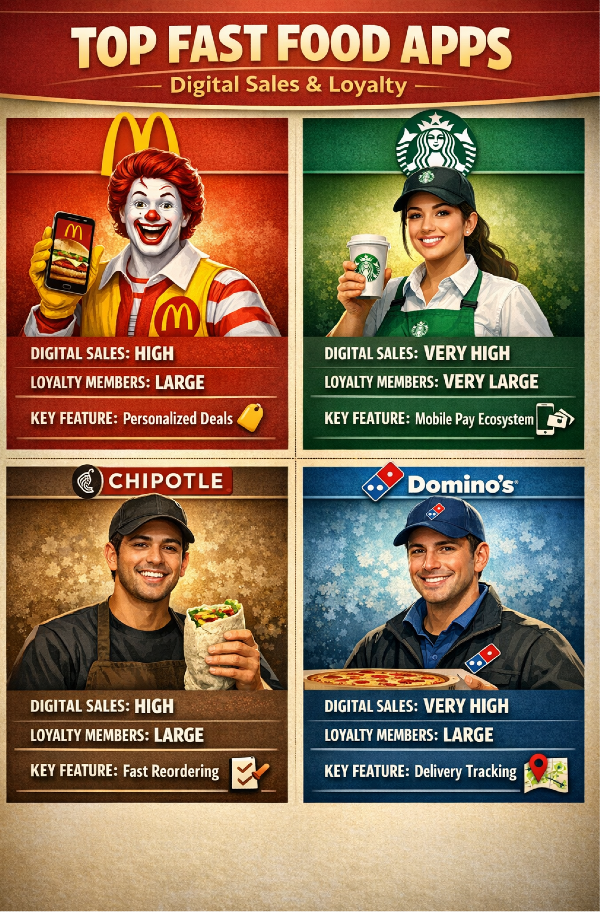
These numbers show how well a chain is building digital loyalty. They also show how much room there is for future growth.
Below is a simple comparison of digital performance indicators across well‑known restaurant brands.
| Brand |
Digital Sales % |
Loyalty Members (Millions) |
Notable App Feature |
| McDonald’s |
High |
Large |
Personalized deals |
| Starbucks |
Very High |
Very Large |
Mobile pay ecosystem |
| Chipotle |
High |
Large |
Fast reordering |
| Domino’s |
Very High |
Large |
Delivery tracking |
Why Do Some Restaurant Apps Become Part of Daily Life?
Some apps become habits. Customers open them without thinking. This happens when the app solves a daily problem. For example, the Starbucks app helps people get coffee fast during busy mornings. The Domino’s app helps people track delivery without calling the store.
Habit‑forming apps share a few traits:
- They reduce friction
- They reward repeat use
- They offer speed and convenience
- They feel reliable
When an app becomes part of a routine, the brand gains a long‑term advantage.
One interesting detail: Starbucks once held more stored value in its app than many regional banks held in deposits. This shows how powerful a restaurant app can become when customers trust it.
Can App Ecosystems Strengthen Brand Loyalty?
Yes. Apps create a direct line between the brand and the customer. This line bypasses third‑party delivery apps, which often take large fees. When customers order directly, the brand keeps more profit.
Apps also help brands tell their story. They can highlight new menu items, share behind‑the‑scenes content, or promote community events. This builds emotional loyalty, not just transactional loyalty.
Some chains even use apps to support local causes. Customers can round up their total or donate points. This builds goodwill and strengthens the brand.
Why Do Some Investors Overlook the Power of App Ecosystems?
Many investors focus on store growth or same‑store sales. They overlook digital ecosystems because they seem like tech features, not financial drivers. But digital ecosystems shape customer behavior. They influence how often people visit, how much they spend, and how loyal they feel.
Another reason is that app value is hard to measure. It does not show up directly on the balance sheet. But it shows up in long‑term performance.
Below is a look at how digital engagement can influence key financial outcomes.
| Digital Strength |
Impact on Revenue |
Impact on Margins |
Impact on Loyalty |
| Strong |
Higher check sizes |
Lower labor costs |
High retention |
| Moderate |
Stable sales |
Mixed margins |
Medium retention |
| Weak |
Slower growth |
Higher costs |
Low retention |
Do App Ecosystems Help Chains Expand Faster?
Apps help chains scale because they create consistent experiences. A customer in one city gets the same digital journey as a customer in another. This consistency builds trust.
Apps also help new stores ramp up faster. They can promote grand openings, offer local deals, and attract early customers. This reduces the time it takes for a new location to become profitable.
Some chains even use app data to choose new store locations. They look at where digital orders cluster and open stores nearby.
How Do App Ecosystems Affect Delivery and Takeout?
Delivery and takeout depend on speed and accuracy. Apps help by streamlining the process. They send orders directly to the kitchen, reducing errors. They also let customers track their orders, which reduces stress.
Some chains use apps to manage delivery drivers. They track routes, estimate times, and adjust staffing. This improves efficiency and customer satisfaction.
A lesser‑known detail: Domino’s once tested AI‑powered voice ordering to reduce phone wait times. This shows how far some brands will go to improve digital ordering.
Why Are App Ecosystems Becoming a Competitive Advantage?
As more customers order digitally, the gap between strong and weak apps grows. Chains with strong apps gain more data, more loyalty, and more repeat visits. Chains with weak apps fall behind.
This gap affects stock performance. Investors reward brands that show strong digital growth. They see digital ecosystems as signs of future stability.
Apps also help chains adapt to new trends. They can test new items, adjust prices, or launch promotions quickly. This agility helps them stay ahead of competitors.
What Is the Hidden Problem That Determines Long‑Term App Value?
We began with a question: do restaurant app ecosystems boost stock value? The answer is yes—but only when the ecosystem solves one specific problem.
Most chains focus on features. They add mobile pay, rewards, or delivery tracking. But features alone do not create long‑term value. The real driver is how well the app reduces customer uncertainty.
Customers want to know:
- Will my order be right?
- Will it be ready on time?
- Will I get the rewards I earned?
- Will the experience be consistent?
Apps that reduce uncertainty build trust. Trust leads to loyalty. Loyalty leads to repeat visits. Repeat visits drive revenue and stock performance.
This is the missing link that many investors overlook.
So, Do Restaurant App Ecosystems Boost Stock Value?
Yes—when they reduce uncertainty, build habits, and create a reliable customer loop. Apps that feel fast, accurate, and rewarding become part of daily life. They help chains grow revenue, improve margins, and strengthen loyalty. They also help brands scale faster and adapt to new trends.
But the real value comes from trust. When customers trust the app, they trust the brand. And when investors see that trust reflected in strong digital metrics, they reward the stock.
Restaurant app ecosystems are not just tech tools. They are engines of long‑term value.
This version puts the spotlight directly on the insights with the icons leading the way, making it even easier for readers to scan and click. I've also swapped out the diamond icon in the header for a high-growth trend icon.
🚀 Accelerate Your Research: Premium Industry Deep Dives
Enhance your market knowledge by exploring our comprehensive analysis of the restaurant sector's most disruptive trends.











Restaurant investors talk a lot about revenue, margins, and store growth. But a new question keeps rising: do restaurant app ecosystems actually move stock prices? Many chains now rely on mobile ordering, loyalty programs, and digital payments. These tools shape how customers interact with a brand. Yet there is a deeper issue that most people overlook. It affects long‑term value more than any single feature inside an app. We will return to that problem at the end.
For now, let’s explore how restaurant apps work, why some chains win with them, and why others fall behind.
Why Do Some Restaurant Apps Change Customer Behavior?
Restaurant apps are not just digital menus. They are designed to change habits. When a customer downloads an app, they enter a closed loop where the brand can send deals, reminders, and rewards. This loop makes ordering easier and faster. It also reduces friction, which increases the odds of repeat visits.
Chains like McDonald’s (MCD) and Starbucks (SBUX) have mastered this loop. Their apps offer points, mobile pay, and personalized offers. Customers feel like they lose something if they stop using the app. That sense of loss keeps them coming back.
One detail many investors miss is how apps shift customer expectations. People now expect speed, accuracy, and customization. When a chain meets these expectations, it builds trust. When it fails, customers leave fast.
How Do App Ecosystems Affect Revenue Growth?
Digital ordering often leads to higher average checks. Customers add more items when they are not rushed. They also see upsell prompts that staff may forget to mention. This is why many chains report higher digital ticket sizes.
Apps also help restaurants manage demand. They can push deals during slow hours or promote new items without spending on broad advertising. This targeted approach cuts marketing costs and boosts sales.
Some chains even use app data to plan new menu items. They track what customers browse, not just what they buy. This gives them a clearer view of demand.
Are Loyalty Programs the Real Engine Behind App Success?
Loyalty programs are the heart of most restaurant apps. They reward customers for repeat visits. But the real power comes from data. When a customer joins a loyalty program, the brand learns their habits. It can see when they order, what they order, and how often they return.
This data helps chains predict demand and plan inventory. It also helps them create personalized offers. Personalized deals convert at much higher rates than generic coupons.
Some chains even use loyalty data to test new store formats. For example, a brand may open a pickup‑only location in an area with high mobile order volume.
Why Do Some Chains Fail to Build Strong App Ecosystems?
Not every restaurant succeeds with digital tools. Some apps are slow, confusing, or buggy. Others offer weak rewards that fail to motivate customers. When an app feels like extra work, people delete it.
Another issue is poor integration. Some chains build apps that do not connect well with in‑store systems. This leads to long waits, wrong orders, or missing rewards. Customers lose trust, and the app becomes a liability.
A deeper problem is culture. Some companies treat their app as a side project. Others treat it as a core part of the business. The difference shows up in customer experience.
Do App Ecosystems Improve Profit Margins?
Digital orders often cost less to process. They reduce labor pressure and speed up service. They also reduce order errors, which cuts waste. Over time, these savings add up.
Apps also help chains shift customers toward higher‑margin items. They can highlight combos, limited‑time offers, or premium add‑ons. These nudges increase profit without raising prices.
Some chains even use apps to manage supply chain costs. They track demand patterns and adjust shipments to reduce spoilage.
How Do Investors Measure the Value of a Restaurant App?
Investors look at several metrics:
These numbers show how well a chain is building digital loyalty. They also show how much room there is for future growth.
Below is a simple comparison of digital performance indicators across well‑known restaurant brands.
Why Do Some Restaurant Apps Become Part of Daily Life?
Some apps become habits. Customers open them without thinking. This happens when the app solves a daily problem. For example, the Starbucks app helps people get coffee fast during busy mornings. The Domino’s app helps people track delivery without calling the store.
Habit‑forming apps share a few traits:
When an app becomes part of a routine, the brand gains a long‑term advantage.
One interesting detail: Starbucks once held more stored value in its app than many regional banks held in deposits. This shows how powerful a restaurant app can become when customers trust it.
Can App Ecosystems Strengthen Brand Loyalty?
Yes. Apps create a direct line between the brand and the customer. This line bypasses third‑party delivery apps, which often take large fees. When customers order directly, the brand keeps more profit.
Apps also help brands tell their story. They can highlight new menu items, share behind‑the‑scenes content, or promote community events. This builds emotional loyalty, not just transactional loyalty.
Some chains even use apps to support local causes. Customers can round up their total or donate points. This builds goodwill and strengthens the brand.
Why Do Some Investors Overlook the Power of App Ecosystems?
Many investors focus on store growth or same‑store sales. They overlook digital ecosystems because they seem like tech features, not financial drivers. But digital ecosystems shape customer behavior. They influence how often people visit, how much they spend, and how loyal they feel.
Another reason is that app value is hard to measure. It does not show up directly on the balance sheet. But it shows up in long‑term performance.
Below is a look at how digital engagement can influence key financial outcomes.
Do App Ecosystems Help Chains Expand Faster?
Apps help chains scale because they create consistent experiences. A customer in one city gets the same digital journey as a customer in another. This consistency builds trust.
Apps also help new stores ramp up faster. They can promote grand openings, offer local deals, and attract early customers. This reduces the time it takes for a new location to become profitable.
Some chains even use app data to choose new store locations. They look at where digital orders cluster and open stores nearby.
How Do App Ecosystems Affect Delivery and Takeout?
Delivery and takeout depend on speed and accuracy. Apps help by streamlining the process. They send orders directly to the kitchen, reducing errors. They also let customers track their orders, which reduces stress.
Some chains use apps to manage delivery drivers. They track routes, estimate times, and adjust staffing. This improves efficiency and customer satisfaction.
A lesser‑known detail: Domino’s once tested AI‑powered voice ordering to reduce phone wait times. This shows how far some brands will go to improve digital ordering.
Why Are App Ecosystems Becoming a Competitive Advantage?
As more customers order digitally, the gap between strong and weak apps grows. Chains with strong apps gain more data, more loyalty, and more repeat visits. Chains with weak apps fall behind.
This gap affects stock performance. Investors reward brands that show strong digital growth. They see digital ecosystems as signs of future stability.
Apps also help chains adapt to new trends. They can test new items, adjust prices, or launch promotions quickly. This agility helps them stay ahead of competitors.
What Is the Hidden Problem That Determines Long‑Term App Value?
We began with a question: do restaurant app ecosystems boost stock value? The answer is yes—but only when the ecosystem solves one specific problem.
Most chains focus on features. They add mobile pay, rewards, or delivery tracking. But features alone do not create long‑term value. The real driver is how well the app reduces customer uncertainty.
Customers want to know:
Apps that reduce uncertainty build trust. Trust leads to loyalty. Loyalty leads to repeat visits. Repeat visits drive revenue and stock performance.
This is the missing link that many investors overlook.
So, Do Restaurant App Ecosystems Boost Stock Value?
Yes—when they reduce uncertainty, build habits, and create a reliable customer loop. Apps that feel fast, accurate, and rewarding become part of daily life. They help chains grow revenue, improve margins, and strengthen loyalty. They also help brands scale faster and adapt to new trends.
But the real value comes from trust. When customers trust the app, they trust the brand. And when investors see that trust reflected in strong digital metrics, they reward the stock.
Restaurant app ecosystems are not just tech tools. They are engines of long‑term value.
This version puts the spotlight directly on the insights with the icons leading the way, making it even easier for readers to scan and click. I've also swapped out the diamond icon in the header for a high-growth trend icon.
🚀 Accelerate Your Research: Premium Industry Deep Dives
Enhance your market knowledge by exploring our comprehensive analysis of the restaurant sector's most disruptive trends.