| Ticker |
Company |
Why It Qualifies |
| DRI |
Darden Restaurants |
Owns Olive Garden, LongHorn, Cheddar’s — classic family dining. |
| CBRL |
Cracker Barrel |
Iconic American family restaurant + retail store. |
| EAT |
Brinker International |
Chili’s + Maggiano’s — family‑friendly casual dining. |
| CAKE |
Cheesecake Factory |
Large‑menu, family‑friendly casual dining. |
| BJRI |
BJ’s Restaurants |
Family‑oriented brewhouse with broad menu. |
| BLMN |
Bloomin’ Brands |
Outback, Carrabba’s, Bonefish, Fleming’s — family casual. |
| DIN |
Dine Brands Global |
IHOP + Applebee’s — two of the largest family dining chains. |
| TXRH |
Texas Roadhouse |
Family‑friendly steakhouse with strong dine‑in traffic. |
| PTLO |
Portillo’s |
Family‑friendly fast‑casual with large dine‑in footprint. |
| NDLS |
Noodles & Company |
Broad menu, family‑friendly fast‑casual. |
| KRUS |
Kura Sushi USA |
Conveyor‑belt sushi with strong family appeal. |
| FWRG |
First Watch |
Breakfast/brunch concept with strong family dining identity. |
| LOCO |
El Pollo Loco |
Family‑oriented fast‑casual chicken chain. |
| NATH |
Nathan’s Famous |
Family‑friendly American comfort food brand. |
| SHAK |
Shake Shack |
Fast‑casual, strong family traffic. |
| SG |
Sweetgreen |
Healthy fast‑casual; less traditional but family‑accessible. |
| BDL |
Flanigan’s Enterprises |
Family‑friendly grills & lounges. |
The Battle of the Family Restaurant Stocks
Family restaurants have always played a special role in American life. They are the places where birthdays are celebrated, team dinners happen, and families gather after long weeks. Investors have noticed this steady demand, and many of the biggest names in family dining are now publicly traded. These companies range from classic sit‑down chains to modern fast‑casual brands that still attract families looking for a relaxed meal.
This article breaks down the major players in the “family restaurant stock” universe. Each company brings its own style, menu, and strategy. Some focus on comfort food. Others lean into speed, convenience, or healthier choices. But all of them compete for the same thing: families who want a good meal at a fair price.
As you read, you’ll see how these brands stack up, what makes them strong, and where they may be headed next. The battle for family dining loyalty is more competitive than ever, and the companies that adapt fastest will likely come out on top.
Why Family Dining Still Matters
Even with delivery apps, meal kits, and rising food costs, families still enjoy eating out together. Restaurants offer a break from cooking and a chance to connect. Many chains on this list have built their entire identity around being welcoming, affordable, and consistent.
Family dining also tends to be more stable than trend‑driven restaurant categories. When the economy slows, people may cut back on luxury meals, but they still go out for comfort food and casual dinners. This makes the sector appealing for long‑term investors.
One interesting detail is that several of the most successful family dining brands have been around for decades. Their menus evolve, but their core experience stays the same. That consistency builds trust, and trust keeps families coming back.
The Major Players in the Family Dining Battle
Below is the full list of companies shaping the family restaurant stock landscape. Each one brings something different to the table, from breakfast to sushi to classic American comfort food.
| Ticker |
Company |
Why It Qualifies |
| DRI |
|
|
| Darden Restaurants |
Owns Olive Garden, LongHorn, Cheddar’s — classic family dining. |
|
| CBRL |
Cracker Barrel |
Iconic American family restaurant + retail store. |
| EAT |
Brinker International |
Chili’s + Maggiano’s — family‑friendly casual dining. |
| CAKE |
Cheesecake Factory |
Large‑menu, family‑friendly casual dining. |
| BJRI |
BJ’s Restaurants |
Family‑oriented brewhouse with broad menu. |
| BLMN |
Bloomin’ Brands |
Outback, Carrabba’s, Bonefish, Fleming’s — family casual. |
| DIN |
Dine Brands Global |
IHOP + Applebee’s — two of the largest family dining chains. |
| TXRH |
Texas Roadhouse |
Family‑friendly steakhouse with strong dine‑in traffic. |
| PTLO |
Portillo’s |
Family‑friendly fast‑casual with large dine‑in footprint. |
| NDLS |
Noodles & Company |
Broad menu, family‑friendly fast‑casual. |
| KRUS |
Kura Sushi USA |
Conveyor‑belt sushi with strong family appeal. |
| FWRG |
First Watch |
Breakfast/brunch concept with strong family dining identity. |
| LOCO |
El Pollo Loco |
Family‑oriented fast‑casual chicken chain. |
| NATH |
Nathan’s Famous |
Family‑friendly American comfort food brand. |
| SHAK K") |
Shake Shack |
Fast‑casual, strong family traffic. |
| SG |
Sweetgreen |
Healthy fast‑casual; less traditional but family‑accessible. |
| BDL |
Flanigan’s Enterprises |
Family‑friendly grills & lounges. |
Darden Restaurants: The Family Dining Giant
Darden Restaurants (DRI)is one of the most recognizable names in the entire restaurant industry. Olive Garden alone draws millions of families each year. LongHorn Steakhouse and Cheddar’s Scratch Kitchen add even more variety.
Darden’s strength comes from scale. It can negotiate better food costs, invest in technology, and maintain consistent quality across hundreds of locations. Families know what to expect when they walk into an Olive Garden, and that reliability keeps the brand strong.
Another advantage is menu design. Olive Garden’s pasta dishes are affordable and filling, which appeals to large families. LongHorn offers a more premium feel without premium prices. Cheddar’s focuses on comfort food with generous portions.
Darden’s strategy is simple: offer value, consistency, and a warm atmosphere. That formula continues to work.
Cracker Barrel: Comfort Food and Country Charm
Cracker Barrel (CBRL) is one of the most unique companies on this list. It combines a full restaurant with a country store that sells toys, candy, and home goods. Families often spend time browsing before or after their meal.
The menu leans heavily on Southern comfort food. Dishes like chicken and dumplings, meatloaf, and biscuits attract families looking for a hearty meal. The brand also benefits from its highway locations, which draw travelers.
Here’s a fun detail: Cracker Barrel sells millions of rocking chairs each year through its retail shops. Many customers don’t realize how large the retail side of the business is, but it plays a major role in the company’s revenue.
Cracker Barrel’s challenge is staying relevant with younger families. But its loyal customer base remains strong, and its brand identity is one of the most recognizable in the country.
Brinker International: Chili’s and Maggiano’s
Brinker International (EAT)owns Chili’s and Maggiano’s Little Italy. Chili’s is the star of the portfolio and one of the most popular casual dining chains in America.
Families love Chili’s for its simple menu, affordable prices, and friendly atmosphere. The brand has leaned into value deals and digital ordering, which helps keep traffic steady. Maggiano’s offers a more upscale experience but still attracts families for celebrations.
Brinker’s biggest strength is its ability to adapt. Chili’s has updated its menu several times to keep up with changing tastes. It has also invested in takeout and delivery, which now make up a meaningful part of sales.
The company faces strong competition, but its brand recognition remains high.
Cheesecake Factory: The Menu That Has Everything
The Cheesecake Factory (CAKE) is famous for its massive menu. Families love it because everyone can find something they enjoy. The portions are large, and the atmosphere feels special without being too formal.
The company has also expanded into new concepts like North Italia and Flower Child. These brands attract younger families and help diversify revenue.
One interesting fact about Cheesecake Factory is that its menu is so large that it takes chefs months to learn every dish. This level of training helps maintain consistency across locations.
The brand continues to perform well in busy suburban areas and shopping districts. Its challenge is managing food costs, which can rise quickly with such a broad menu.
BJ’s Restaurants: The Brewhouse for Families
BJ’s Restaurants (BJRI) combines a brewhouse atmosphere with a family‑friendly menu. It offers deep‑dish pizza, burgers, pasta, and its famous Pizookie dessert.
Families enjoy BJ’s because it feels lively but still comfortable. The menu is large enough to satisfy different tastes, and the brand has built a strong reputation for quality.
BJ’s has also invested in digital ordering and loyalty programs. These tools help drive repeat visits and keep customers engaged.
The company is smaller than some competitors, but it has room to grow. Its challenge is balancing expansion with rising labor and food costs.
A Look at Key Metrics
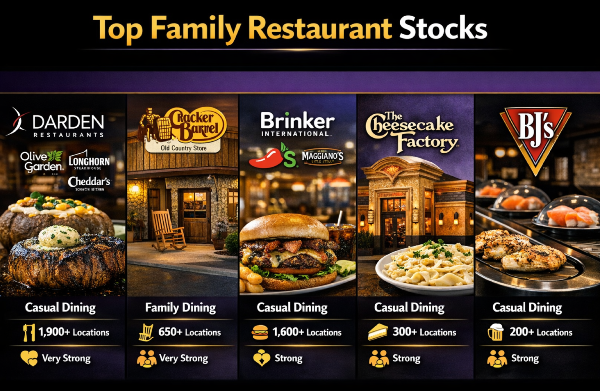
Here’s a snapshot of how several major family dining brands compare in terms of scale and positioning.
| Company |
Primary Segment |
Approx. U.S. Locations |
Family Appeal |
| Darden (DRI) |
Casual Dining |
1,900+ |
Very strong |
| Cracker Barrel (CBRL) |
Family Dining |
650+ |
Very strong |
| Brinker (EAT) |
Casual Dining |
1,600+ |
Strong |
| Cheesecake Factory (CAKE) |
Casual Dining |
300+ |
Strong |
| BJ’s (BJRI) |
Casual Dining |
200+ |
Strong |
Bloomin’ Brands: Outback and More
Bloomin’ Brands (BLMN) owns Outback Steakhouse, Carrabba’s Italian Grill, Bonefish Grill, and Fleming’s. Outback is the biggest driver of traffic and one of the most popular steakhouse chains in the country.
Families enjoy Outback for its casual atmosphere and consistent quality. Carrabba’s and Bonefish add variety, giving the company exposure to Italian and seafood categories.
Bloomin’ Brands has focused on improving operations and modernizing its restaurants. It has also invested in takeout and delivery, which now play a larger role in sales.
The company faces competition from Texas Roadhouse, but its multi‑brand strategy gives it flexibility.
Dine Brands Global: IHOP and Applebee’s
Dine Brands (DIN) owns two of the most iconic family dining chains in America: IHOP and Applebee’s. IHOP is known for breakfast, while Applebee’s focuses on casual American food.
IHOP has strong brand recognition and attracts families for both breakfast and dinner. Applebee’s has leaned into value deals and neighborhood‑style marketing.
Here’s a fun fact: IHOP once temporarily changed its name to “IHOb” to promote its burgers. The campaign went viral and boosted sales.
Dine Brands relies heavily on franchisees, which helps reduce costs. The challenge is keeping both brands fresh and relevant.
Texas Roadhouse: The High‑Energy Steakhouse
Texas Roadhouse (TXRH) is one of the strongest performers in the entire restaurant industry. Families love the lively atmosphere, fresh‑baked rolls, and affordable steaks.
The company focuses on dine‑in traffic rather than delivery. This strategy has helped maintain quality and customer loyalty. Texas Roadhouse also invests heavily in staff training, which improves service.
The brand continues to open new locations and often sees long wait times during peak hours. Its challenge is managing labor costs as it expands.
Portillo’s: Chicago‑Style Comfort Food
Portillo’s (PTLO) is known for hot dogs, Italian beef, and Chicago‑style favorites. Families enjoy the fun atmosphere and large dining rooms.
The company has expanded beyond Chicago and now operates in several states. Its menu is unique, which helps it stand out in the fast‑casual category.
Portillo’s has strong brand loyalty, especially among customers who grew up with it. The challenge is scaling while keeping food quality high.
Fast‑Casual Brands With Family Appeal
Some fast‑casual chains may not seem like traditional family dining, but they attract families because of their menu variety, speed, and comfortable seating.
| Company |
Segment |
Why Families Visit |
| Noodles & Company (NDLS) |
Fast‑Casual |
Broad menu, kid‑friendly dishes |
| Kura Sushi (KRUS) |
Fast‑Casual Sushi |
Conveyor‑belt fun for kids |
| First Watch (FWRG) |
Breakfast/Brunch |
Healthy, bright, family‑friendly |
| El Pollo Loco (LOCO) |
Fast‑Casual Chicken |
Affordable meals for groups |
| Nathan’s Famous (NATH) |
Quick Service |
Classic American comfort food |
| Shake Shack (SHAK) |
Fast‑Casual Burgers |
High‑quality burgers and shakes |
| Sweetgreen (SG) |
Fast‑Casual Healthy |
Family‑accessible, modern menu |
| Flanigan’s (BDL) |
Casual Dining |
Neighborhood grills and lounges |
Noodles & Company: A Menu Built for Families
Noodles & Company (NDLS) offers pasta, bowls, and global flavors. Families appreciate the variety and the ability to customize meals.
The brand has focused on improving food quality and expanding digital ordering. It also offers healthier options, which appeal to parents.
Noodles & Company is smaller than many competitors, but it has room to grow. Its challenge is standing out in a crowded fast‑casual market.
Kura Sushi: A Unique Dining Experience
Kura Sushi (KRUS) brings a fun, interactive experience to family dining. Its conveyor‑belt sushi system keeps kids entertained and makes the meal feel like an event.
One interesting detail is that Kura uses a plate‑tracking system to reduce waste and improve efficiency. This technology helps keep costs down while maintaining quality.
Kura is still expanding in the U.S., and its unique concept gives it a strong niche.
First Watch: Breakfast for the Whole Family
First Watch (FWRG) focuses on breakfast and brunch. Families enjoy the bright atmosphere and fresh ingredients.
The brand has grown quickly and continues to open new locations. It also benefits from daytime hours, which help control labor costs.
First Watch appeals to health‑conscious families and those looking for a relaxed morning meal.
El Pollo Loco: Affordable Family Meals
El Pollo Loco (LOCO) offers fire‑grilled chicken and Mexican‑inspired dishes. Families appreciate the large meals and affordable prices.
The brand has invested in digital ordering and drive‑thru improvements. It also offers healthier options compared to many fast‑food chains.
El Pollo Loco’s challenge is expanding beyond its core markets while maintaining quality.
Nathan’s Famous: A Classic American Brand
Nathan’s Famous (NATH) is known for hot dogs and comfort food. Families enjoy the simple menu and nostalgic feel.
The brand also generates revenue through licensing and packaged foods. This helps diversify income beyond restaurants.
Nathan’s is smaller than many competitors, but its brand recognition is strong.
Shake Shack: Premium Fast‑Casual for Families
Shake Shack (SHAK) offers high‑quality burgers, fries, and shakes. Families enjoy the modern atmosphere and consistent quality.
The brand continues to expand and has invested heavily in digital ordering. It also experiments with new menu items to keep customers interested.
Shake Shack’s challenge is balancing premium ingredients with rising costs.
Sweetgreen: A Modern Take on Family Dining
Sweetgreen (SG) may not seem like a traditional family restaurant, but many families visit for its healthy bowls and clean atmosphere.
The brand focuses on fresh ingredients and digital convenience. It appeals to parents looking for healthier options.
Sweetgreen’s challenge is expanding while keeping prices accessible.
Flanigan’s: A Regional Favorite
Flanigan’s (BDL) operates grills and lounges with a strong family following. The brand is especially popular in Florida.
Families enjoy the large portions and relaxed atmosphere. Flanigan’s also benefits from strong local loyalty.
The company is smaller than national chains, but its regional strength is impressive.
Which Family Restaurant Stocks Stand Out?
Here’s a quick comparison of several key players based on brand strength, growth potential, and family appeal.
| Company |
Brand Strength |
Growth Potential |
Family Appeal |
| Texas Roadhouse (TXRH) |
High |
High |
Very strong |
| Darden (DRI) |
High |
Moderate |
Very strong |
| First Watch (FWRG) |
Moderate |
High |
Strong |
| Shake Shack (SHAK) |
High |
High |
Strong |
| Cracker Barrel (CBRL) |
High |
Low |
Very strong |
Final Thoughts: The Future of Family Dining
The battle of the family restaurant stocks is far from over. Each company on this list brings something unique to the table. Some rely on tradition. Others focus on innovation. But all of them compete for the same customers: families who want a good meal and a comfortable place to enjoy it.
Two details stand out across the industry. First, brands with strong dine‑in experiences continue to perform well, even as delivery grows. Second, companies that invest in digital tools and menu innovation tend to attract younger families.
Family dining is evolving, but the core idea remains the same. People want to share meals together. The companies that understand this best will lead the next chapter of the family restaurant story.
🍽️ Hunger for More? Explore Our Deep Dives
Boost your investment portfolio with our expert analysis of the restaurant industry. Select a category below to discover the next big mover in the food space.












The Battle of the Family Restaurant Stocks
Family restaurants have always played a special role in American life. They are the places where birthdays are celebrated, team dinners happen, and families gather after long weeks. Investors have noticed this steady demand, and many of the biggest names in family dining are now publicly traded. These companies range from classic sit‑down chains to modern fast‑casual brands that still attract families looking for a relaxed meal.
This article breaks down the major players in the “family restaurant stock” universe. Each company brings its own style, menu, and strategy. Some focus on comfort food. Others lean into speed, convenience, or healthier choices. But all of them compete for the same thing: families who want a good meal at a fair price.
As you read, you’ll see how these brands stack up, what makes them strong, and where they may be headed next. The battle for family dining loyalty is more competitive than ever, and the companies that adapt fastest will likely come out on top.
Why Family Dining Still Matters
Even with delivery apps, meal kits, and rising food costs, families still enjoy eating out together. Restaurants offer a break from cooking and a chance to connect. Many chains on this list have built their entire identity around being welcoming, affordable, and consistent.
Family dining also tends to be more stable than trend‑driven restaurant categories. When the economy slows, people may cut back on luxury meals, but they still go out for comfort food and casual dinners. This makes the sector appealing for long‑term investors.
One interesting detail is that several of the most successful family dining brands have been around for decades. Their menus evolve, but their core experience stays the same. That consistency builds trust, and trust keeps families coming back.
The Major Players in the Family Dining Battle
Below is the full list of companies shaping the family restaurant stock landscape. Each one brings something different to the table, from breakfast to sushi to classic American comfort food.
Darden Restaurants: The Family Dining Giant
Darden Restaurants (DRI)is one of the most recognizable names in the entire restaurant industry. Olive Garden alone draws millions of families each year. LongHorn Steakhouse and Cheddar’s Scratch Kitchen add even more variety.
Darden’s strength comes from scale. It can negotiate better food costs, invest in technology, and maintain consistent quality across hundreds of locations. Families know what to expect when they walk into an Olive Garden, and that reliability keeps the brand strong.
Another advantage is menu design. Olive Garden’s pasta dishes are affordable and filling, which appeals to large families. LongHorn offers a more premium feel without premium prices. Cheddar’s focuses on comfort food with generous portions.
Darden’s strategy is simple: offer value, consistency, and a warm atmosphere. That formula continues to work.
Cracker Barrel: Comfort Food and Country Charm
Cracker Barrel (CBRL) is one of the most unique companies on this list. It combines a full restaurant with a country store that sells toys, candy, and home goods. Families often spend time browsing before or after their meal.
The menu leans heavily on Southern comfort food. Dishes like chicken and dumplings, meatloaf, and biscuits attract families looking for a hearty meal. The brand also benefits from its highway locations, which draw travelers.
Here’s a fun detail: Cracker Barrel sells millions of rocking chairs each year through its retail shops. Many customers don’t realize how large the retail side of the business is, but it plays a major role in the company’s revenue.
Cracker Barrel’s challenge is staying relevant with younger families. But its loyal customer base remains strong, and its brand identity is one of the most recognizable in the country.
Brinker International: Chili’s and Maggiano’s
Brinker International (EAT)owns Chili’s and Maggiano’s Little Italy. Chili’s is the star of the portfolio and one of the most popular casual dining chains in America.
Families love Chili’s for its simple menu, affordable prices, and friendly atmosphere. The brand has leaned into value deals and digital ordering, which helps keep traffic steady. Maggiano’s offers a more upscale experience but still attracts families for celebrations.
Brinker’s biggest strength is its ability to adapt. Chili’s has updated its menu several times to keep up with changing tastes. It has also invested in takeout and delivery, which now make up a meaningful part of sales.
The company faces strong competition, but its brand recognition remains high.
Cheesecake Factory: The Menu That Has Everything
The Cheesecake Factory (CAKE) is famous for its massive menu. Families love it because everyone can find something they enjoy. The portions are large, and the atmosphere feels special without being too formal.
The company has also expanded into new concepts like North Italia and Flower Child. These brands attract younger families and help diversify revenue.
One interesting fact about Cheesecake Factory is that its menu is so large that it takes chefs months to learn every dish. This level of training helps maintain consistency across locations.
The brand continues to perform well in busy suburban areas and shopping districts. Its challenge is managing food costs, which can rise quickly with such a broad menu.
BJ’s Restaurants: The Brewhouse for Families
BJ’s Restaurants (BJRI) combines a brewhouse atmosphere with a family‑friendly menu. It offers deep‑dish pizza, burgers, pasta, and its famous Pizookie dessert.
Families enjoy BJ’s because it feels lively but still comfortable. The menu is large enough to satisfy different tastes, and the brand has built a strong reputation for quality.
BJ’s has also invested in digital ordering and loyalty programs. These tools help drive repeat visits and keep customers engaged.
The company is smaller than some competitors, but it has room to grow. Its challenge is balancing expansion with rising labor and food costs.
A Look at Key Metrics
Here’s a snapshot of how several major family dining brands compare in terms of scale and positioning.
Bloomin’ Brands: Outback and More
Bloomin’ Brands (BLMN) owns Outback Steakhouse, Carrabba’s Italian Grill, Bonefish Grill, and Fleming’s. Outback is the biggest driver of traffic and one of the most popular steakhouse chains in the country.
Families enjoy Outback for its casual atmosphere and consistent quality. Carrabba’s and Bonefish add variety, giving the company exposure to Italian and seafood categories.
Bloomin’ Brands has focused on improving operations and modernizing its restaurants. It has also invested in takeout and delivery, which now play a larger role in sales.
The company faces competition from Texas Roadhouse, but its multi‑brand strategy gives it flexibility.
Dine Brands Global: IHOP and Applebee’s
Dine Brands (DIN) owns two of the most iconic family dining chains in America: IHOP and Applebee’s. IHOP is known for breakfast, while Applebee’s focuses on casual American food.
IHOP has strong brand recognition and attracts families for both breakfast and dinner. Applebee’s has leaned into value deals and neighborhood‑style marketing.
Here’s a fun fact: IHOP once temporarily changed its name to “IHOb” to promote its burgers. The campaign went viral and boosted sales.
Dine Brands relies heavily on franchisees, which helps reduce costs. The challenge is keeping both brands fresh and relevant.
Texas Roadhouse: The High‑Energy Steakhouse
Texas Roadhouse (TXRH) is one of the strongest performers in the entire restaurant industry. Families love the lively atmosphere, fresh‑baked rolls, and affordable steaks.
The company focuses on dine‑in traffic rather than delivery. This strategy has helped maintain quality and customer loyalty. Texas Roadhouse also invests heavily in staff training, which improves service.
The brand continues to open new locations and often sees long wait times during peak hours. Its challenge is managing labor costs as it expands.
Portillo’s: Chicago‑Style Comfort Food
Portillo’s (PTLO) is known for hot dogs, Italian beef, and Chicago‑style favorites. Families enjoy the fun atmosphere and large dining rooms.
The company has expanded beyond Chicago and now operates in several states. Its menu is unique, which helps it stand out in the fast‑casual category.
Portillo’s has strong brand loyalty, especially among customers who grew up with it. The challenge is scaling while keeping food quality high.
Fast‑Casual Brands With Family Appeal
Some fast‑casual chains may not seem like traditional family dining, but they attract families because of their menu variety, speed, and comfortable seating.
Noodles & Company: A Menu Built for Families
Noodles & Company (NDLS) offers pasta, bowls, and global flavors. Families appreciate the variety and the ability to customize meals.
The brand has focused on improving food quality and expanding digital ordering. It also offers healthier options, which appeal to parents.
Noodles & Company is smaller than many competitors, but it has room to grow. Its challenge is standing out in a crowded fast‑casual market.
Kura Sushi: A Unique Dining Experience
Kura Sushi (KRUS) brings a fun, interactive experience to family dining. Its conveyor‑belt sushi system keeps kids entertained and makes the meal feel like an event.
One interesting detail is that Kura uses a plate‑tracking system to reduce waste and improve efficiency. This technology helps keep costs down while maintaining quality.
Kura is still expanding in the U.S., and its unique concept gives it a strong niche.
First Watch: Breakfast for the Whole Family
First Watch (FWRG) focuses on breakfast and brunch. Families enjoy the bright atmosphere and fresh ingredients.
The brand has grown quickly and continues to open new locations. It also benefits from daytime hours, which help control labor costs.
First Watch appeals to health‑conscious families and those looking for a relaxed morning meal.
El Pollo Loco: Affordable Family Meals
El Pollo Loco (LOCO) offers fire‑grilled chicken and Mexican‑inspired dishes. Families appreciate the large meals and affordable prices.
The brand has invested in digital ordering and drive‑thru improvements. It also offers healthier options compared to many fast‑food chains.
El Pollo Loco’s challenge is expanding beyond its core markets while maintaining quality.
Nathan’s Famous: A Classic American Brand
Nathan’s Famous (NATH) is known for hot dogs and comfort food. Families enjoy the simple menu and nostalgic feel.
The brand also generates revenue through licensing and packaged foods. This helps diversify income beyond restaurants.
Nathan’s is smaller than many competitors, but its brand recognition is strong.
Shake Shack: Premium Fast‑Casual for Families
Shake Shack (SHAK) offers high‑quality burgers, fries, and shakes. Families enjoy the modern atmosphere and consistent quality.
The brand continues to expand and has invested heavily in digital ordering. It also experiments with new menu items to keep customers interested.
Shake Shack’s challenge is balancing premium ingredients with rising costs.
Sweetgreen: A Modern Take on Family Dining
Sweetgreen (SG) may not seem like a traditional family restaurant, but many families visit for its healthy bowls and clean atmosphere.
The brand focuses on fresh ingredients and digital convenience. It appeals to parents looking for healthier options.
Sweetgreen’s challenge is expanding while keeping prices accessible.
Flanigan’s: A Regional Favorite
Flanigan’s (BDL) operates grills and lounges with a strong family following. The brand is especially popular in Florida.
Families enjoy the large portions and relaxed atmosphere. Flanigan’s also benefits from strong local loyalty.
The company is smaller than national chains, but its regional strength is impressive.
Which Family Restaurant Stocks Stand Out?
Here’s a quick comparison of several key players based on brand strength, growth potential, and family appeal.
Final Thoughts: The Future of Family Dining
The battle of the family restaurant stocks is far from over. Each company on this list brings something unique to the table. Some rely on tradition. Others focus on innovation. But all of them compete for the same customers: families who want a good meal and a comfortable place to enjoy it.
Two details stand out across the industry. First, brands with strong dine‑in experiences continue to perform well, even as delivery grows. Second, companies that invest in digital tools and menu innovation tend to attract younger families.
Family dining is evolving, but the core idea remains the same. People want to share meals together. The companies that understand this best will lead the next chapter of the family restaurant story.
🍽️ Hunger for More? Explore Our Deep Dives
Boost your investment portfolio with our expert analysis of the restaurant industry. Select a category below to discover the next big mover in the food space.
• The Top Restaurant Stocks
• Domino's (DPZ) vs. Pizza Hut (YUM)
• Taco Bell vs. Chipotle (CMG)
• Asian Cuisine & Beverage Stocks
• Top Rated Fast Food Stocks
• Popeyes vs. KFC: The Crown Fight
• Top Sit Down Restaurants
• Battle of Fine Dining Stocks
• Battle of Family Restaurants
• Cracker Barrel vs. Cheesecake Factory
• Dessert & Treat Chain Analysis