🍜 Every Asian Cuisine Stock You Can Invest In on U.S. Stock Markets)
Below is the full universe of Asian‑cuisine restaurant stocks currently available to U.S. investors. These include Chinese, Japanese, Korean, Thai, and pan‑Asian concepts.
Some restaurants on the OTC markets were excluded due to low liquidity.
🇨🇳 Chinese Cuisine Stocks
| Company |
Ticker |
Cuisine Focus |
Exchange |
| Yum China |
YUMC |
KFC China, Pizza Hut China, Little Sheep (hot pot) |
NYSE |
| TH International (Tims China) |
THCH |
Tim Hortons China (Western brand but China‑focused operator) |
NASDAQ |
| Super Hi International |
HDL |
Haidilao Hot Pot |
NASDAQ |
| Chagee Holdings |
CHA |
Chinese tea beverages |
NASDAQ |
| Jollibee Foods (owns Yonghe King in China) |
JBFCY |
Chinese fast‑casual via Yonghe King |
OTC (U.S. ADR) |
🇯🇵 Japanese Cuisine Stocks
| Company |
Ticker |
Cuisine Focus |
Exchange |
| Kura Sushi USA |
KRUS |
Conveyor‑belt sushi |
NASDAQ |
🇹🇭 Thai Cuisine Stocks
| Company |
Ticker |
Cuisine Focus |
Exchange |
| Minor International (owns Thai Express, The Coffee Club) |
MNILY |
Thai & pan‑Asian |
OTC |
🌏 Pan‑Asian / Multi‑Asian Concepts
| Company |
Ticker |
Cuisine Focus |
Exchange |
| Panda Restaurant Group |
Private |
Panda Express |
— |
| P.F. Chang’s |
Private |
Chinese/Asian fusion |
— |
| First Watch |
FWRG |
Not Asian‑focused but offers Asian‑inspired dishes |
NASDAQ |
| Noodles & Company |
NDLS |
Pan‑Asian noodles (not exclusively Asian) |
NASDAQ |
| Sweetgreen |
SG |
Not Asian‑focused but includes Asian‑inspired bowls |
NYSE |
🧋 Asian Beverage & Tea Chains (Investable)
| Company |
Ticker |
Focus |
Exchange |
| Chagee Holdings |
CHA |
Chinese tea |
NASDAQ |
| Haidilao’s beverage subsidiaries |
via HDL |
Hot pot + beverage |
NASDAQ |
Asian Cuisine Stock Battle: Which U.S.-Listed Company Comes Out on Top?
Asian cuisine has become one of the fastest‑growing parts of the restaurant world. More Americans are choosing sushi, hot pot, milk tea, and Asian‑style coffee as part of their weekly routine. This shift has created a new group of restaurant stocks that give investors a chance to ride the wave. These companies are not only growing inside the United States. Many of them are expanding across Asia, Europe, and the Middle East.
The five companies in this breakdown are:
- Yum China (YUMC)
- Kura Sushi USA (KRUS)
- Super Hi International / Haidilao (HDL)
- Chagee Holdings (CHA)
- TH International / Tims China (THCH)
Note you can rate other asian cuisine stocks in this list beyond these five!
Each one competes in a different part of the Asian food and beverage world. That makes this battle more interesting. It is not just sushi vs. hot pot. It is also tea vs. coffee and fast‑casual vs. full‑service dining.
Let’s break down the strengths and weaknesses of each company and see who wins the Asian Cuisine Stock Battle.
The Rise of Asian Cuisine in the U.S. Market
Asian cuisine has grown from a niche category to a mainstream force. Sushi is now a common lunch choice. Hot pot restaurants are opening in major cities. Milk tea shops are popping up in malls and college towns. Even fast‑food chains are adding Asian‑inspired items to their menus.
One reason for this growth is the shift toward lighter meals. Many Asian dishes use fresh vegetables, lean proteins, and simple ingredients. This appeals to younger consumers who want healthier options without giving up flavor.
Another reason is the rise of global travel and social media. People are exposed to new foods faster than ever. A dish that was once unknown can become a trend overnight. This has helped Asian cuisine spread far beyond its original communities.
A unique fact about this trend is that conveyor‑belt sushi, once seen as a novelty, has become a stable business model in the U.S. This format reduces labor costs and increases table turnover, which helps companies like Kura Sushi USA grow faster than traditional restaurants.
Meet the Competitors
Before we compare them, here is a quick overview of the five major companies in the battle.
Yum China (YUMC)
Yum China operates KFC, Pizza Hut, and several local Chinese brands. It is the largest restaurant company in China. Even though its brands are not all Asian cuisine, its scale and reach make it a major player.
Kura Sushi USA (KRUS)
Kura Sushi USA brings Japanese conveyor‑belt sushi to the American market. It focuses on automation, consistency, and a fun dining experience.
Super Hi International / Haidilao (HDL)
Haidilao is one of the world’s most famous hot pot chains. It is known for its service, fresh ingredients, and fast expansion.
Chagee Holdings (CHA)
Chagee is a premium tea brand offering milk tea, fruit tea, and fresh‑brewed drinks. It targets younger consumers who want high‑quality beverages.
TH International / Tims China (THCH)
TH International operates Tim Hortons in China. While Tim Hortons is a Canadian brand, the China business has added Asian‑inspired drinks and foods to fit local tastes.
Table 1: Quick Snapshot of the Competitors
| Company |
Ticker |
Category |
Core Strength |
| Yum China |
YUMC |
Fast food |
Scale and brand power |
| Kura Sushi USA |
KRUS |
Sushi |
Automation and efficiency |
| Super Hi / Haidilao |
HDL |
Hot pot |
Strong customer loyalty |
| Chagee Holdings |
CHA |
Tea |
Premium beverage growth |
| TH International |
THCH |
Coffee |
Fast expansion in China |
Round 1: Revenue Growth Potential
Revenue growth is one of the most important factors in this battle. Investors want companies that can scale. Asian cuisine brands have an advantage because they appeal to younger consumers. They also tend to expand faster than traditional Western chains.
Yum China has the largest revenue base. Its growth is steady but slower because it is already massive. Kura Sushi USA is growing fast because it is still early in its expansion. Haidilao has strong growth potential as it enters new markets. Chagee is growing quickly thanks to the milk tea boom. TH International is expanding fast but still working toward profitability.
One interesting fact is that Haidilao once opened restaurants so quickly that it became one of the fastest‑growing full‑service chains in the world. This pace slowed during the pandemic, but the company is now returning to expansion mode.
Round 2: Brand Strength and Customer Loyalty
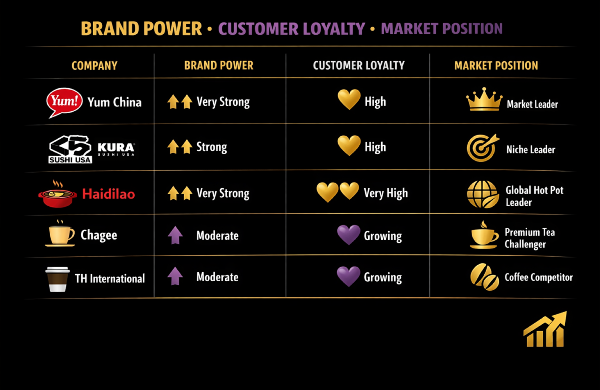
Brand strength is a major factor in long‑term success. Yum China has the strongest brand portfolio. KFC is one of the most recognized names in China. Kura Sushi USA has a loyal customer base that enjoys the conveyor‑belt experience. Haidilao is known for its service and quality. Chagee has a premium image that appeals to younger consumers. TH International is still building its brand in China.
Brand loyalty is especially strong in hot pot and sushi. These foods create memorable experiences. People often return with friends and family. This helps companies grow through word of mouth.
Round 3: Financial Strength and Stability
Financial strength matters because it determines how well a company can survive downturns. Yum China has the strongest balance sheet. It has cash reserves and steady cash flow. Kura Sushi USA is profitable and growing. Haidilao has strong revenue but must manage costs carefully. Chagee is still early in its growth cycle. TH International is working toward profitability.
Investors often look at debt levels, cash flow, and margins. Yum China leads in all three. Kura Sushi USA has strong margins thanks to automation. Haidilao has high operating costs because it is a full‑service restaurant. Chagee and TH International are still scaling.
Round 4: Innovation and Technology
Innovation is a key part of the Asian cuisine market. Kura Sushi USA uses automation to reduce labor costs. Its conveyor‑belt system is efficient and fun. Yum China uses digital ordering and delivery systems. Haidilao uses robots in some locations. Chagee focuses on premium ingredients and fast service. TH International uses mobile ordering and loyalty programs.
Technology helps these companies grow faster. It also improves the customer experience. Younger consumers expect digital convenience. Companies that invest in technology tend to perform better over time.
| Company |
Automation |
Digital Ordering |
Product Innovation |
| Yum China |
High |
Very high |
Moderate |
| Kura Sushi USA |
Very high |
High |
Moderate |
| Haidilao |
Moderate |
High |
High |
| Chagee |
Low |
Moderate |
High |
| TH International |
Moderate |
High |
Moderate |
Round 5: Long‑Term Growth Potential
Long‑term growth depends on expansion plans, customer trends, and brand strength. Yum China has steady long‑term potential. Kura Sushi USA has strong potential because it is still early in its expansion. Haidilao has global potential. Chagee can grow as the tea market expands. TH International has room to grow in China.
One unique fact is that the global milk tea market is expected to grow faster than the global coffee market over the next decade. This gives Chagee a strong long‑term advantage.
Final Verdict: Who Wins the Asian Cuisine Stock Battle?
Each company brings something different to the table. Yum China is the most stable. Kura Sushi USA is the most innovative. Haidilao has the strongest customer loyalty. Chagee has the fastest‑growing category. TH International has strong expansion potential.
If we had to pick one overall winner, Kura Sushi USA stands out. It has strong growth, a unique business model, and rising brand power. Yum China is the safest choice. Haidilao is the best for long‑term global expansion. Chagee is the best for category growth. TH International is the most speculative.
🍽️ Hungry for More? Explore Our Deep Dives
Boost your investment portfolio with our expert analysis of the restaurant industry. Select a category below to discover the next big mover in the food space.















🍜 Every Asian Cuisine Stock You Can Invest In on U.S. Stock Markets)
Below is the full universe of Asian‑cuisine restaurant stocks currently available to U.S. investors. These include Chinese, Japanese, Korean, Thai, and pan‑Asian concepts.
Some restaurants on the OTC markets were excluded due to low liquidity.
🇨🇳 Chinese Cuisine Stocks
🇯🇵 Japanese Cuisine Stocks
🇹🇭 Thai Cuisine Stocks
🌏 Pan‑Asian / Multi‑Asian Concepts
🧋 Asian Beverage & Tea Chains (Investable)
Asian Cuisine Stock Battle: Which U.S.-Listed Company Comes Out on Top?
Asian cuisine has become one of the fastest‑growing parts of the restaurant world. More Americans are choosing sushi, hot pot, milk tea, and Asian‑style coffee as part of their weekly routine. This shift has created a new group of restaurant stocks that give investors a chance to ride the wave. These companies are not only growing inside the United States. Many of them are expanding across Asia, Europe, and the Middle East.
The five companies in this breakdown are:
Note you can rate other asian cuisine stocks in this list beyond these five!
Each one competes in a different part of the Asian food and beverage world. That makes this battle more interesting. It is not just sushi vs. hot pot. It is also tea vs. coffee and fast‑casual vs. full‑service dining.
Let’s break down the strengths and weaknesses of each company and see who wins the Asian Cuisine Stock Battle.
The Rise of Asian Cuisine in the U.S. Market
Asian cuisine has grown from a niche category to a mainstream force. Sushi is now a common lunch choice. Hot pot restaurants are opening in major cities. Milk tea shops are popping up in malls and college towns. Even fast‑food chains are adding Asian‑inspired items to their menus.
One reason for this growth is the shift toward lighter meals. Many Asian dishes use fresh vegetables, lean proteins, and simple ingredients. This appeals to younger consumers who want healthier options without giving up flavor.
Another reason is the rise of global travel and social media. People are exposed to new foods faster than ever. A dish that was once unknown can become a trend overnight. This has helped Asian cuisine spread far beyond its original communities.
A unique fact about this trend is that conveyor‑belt sushi, once seen as a novelty, has become a stable business model in the U.S. This format reduces labor costs and increases table turnover, which helps companies like Kura Sushi USA grow faster than traditional restaurants.
Meet the Competitors
Before we compare them, here is a quick overview of the five major companies in the battle.
Yum China (YUMC)
Yum China operates KFC, Pizza Hut, and several local Chinese brands. It is the largest restaurant company in China. Even though its brands are not all Asian cuisine, its scale and reach make it a major player.
Kura Sushi USA (KRUS)
Kura Sushi USA brings Japanese conveyor‑belt sushi to the American market. It focuses on automation, consistency, and a fun dining experience.
Super Hi International / Haidilao (HDL)
Haidilao is one of the world’s most famous hot pot chains. It is known for its service, fresh ingredients, and fast expansion.
Chagee Holdings (CHA)
Chagee is a premium tea brand offering milk tea, fruit tea, and fresh‑brewed drinks. It targets younger consumers who want high‑quality beverages.
TH International / Tims China (THCH)
TH International operates Tim Hortons in China. While Tim Hortons is a Canadian brand, the China business has added Asian‑inspired drinks and foods to fit local tastes.
Table 1: Quick Snapshot of the Competitors
Round 1: Revenue Growth Potential
Revenue growth is one of the most important factors in this battle. Investors want companies that can scale. Asian cuisine brands have an advantage because they appeal to younger consumers. They also tend to expand faster than traditional Western chains.
Yum China has the largest revenue base. Its growth is steady but slower because it is already massive. Kura Sushi USA is growing fast because it is still early in its expansion. Haidilao has strong growth potential as it enters new markets. Chagee is growing quickly thanks to the milk tea boom. TH International is expanding fast but still working toward profitability.
One interesting fact is that Haidilao once opened restaurants so quickly that it became one of the fastest‑growing full‑service chains in the world. This pace slowed during the pandemic, but the company is now returning to expansion mode.
Round 2: Brand Strength and Customer Loyalty
Brand strength is a major factor in long‑term success. Yum China has the strongest brand portfolio. KFC is one of the most recognized names in China. Kura Sushi USA has a loyal customer base that enjoys the conveyor‑belt experience. Haidilao is known for its service and quality. Chagee has a premium image that appeals to younger consumers. TH International is still building its brand in China.
Brand loyalty is especially strong in hot pot and sushi. These foods create memorable experiences. People often return with friends and family. This helps companies grow through word of mouth.
Round 3: Financial Strength and Stability
Financial strength matters because it determines how well a company can survive downturns. Yum China has the strongest balance sheet. It has cash reserves and steady cash flow. Kura Sushi USA is profitable and growing. Haidilao has strong revenue but must manage costs carefully. Chagee is still early in its growth cycle. TH International is working toward profitability.
Investors often look at debt levels, cash flow, and margins. Yum China leads in all three. Kura Sushi USA has strong margins thanks to automation. Haidilao has high operating costs because it is a full‑service restaurant. Chagee and TH International are still scaling.
Round 4: Innovation and Technology
Innovation is a key part of the Asian cuisine market. Kura Sushi USA uses automation to reduce labor costs. Its conveyor‑belt system is efficient and fun. Yum China uses digital ordering and delivery systems. Haidilao uses robots in some locations. Chagee focuses on premium ingredients and fast service. TH International uses mobile ordering and loyalty programs.
Technology helps these companies grow faster. It also improves the customer experience. Younger consumers expect digital convenience. Companies that invest in technology tend to perform better over time.
Round 5: Long‑Term Growth Potential
Long‑term growth depends on expansion plans, customer trends, and brand strength. Yum China has steady long‑term potential. Kura Sushi USA has strong potential because it is still early in its expansion. Haidilao has global potential. Chagee can grow as the tea market expands. TH International has room to grow in China.
One unique fact is that the global milk tea market is expected to grow faster than the global coffee market over the next decade. This gives Chagee a strong long‑term advantage.
Final Verdict: Who Wins the Asian Cuisine Stock Battle?
Each company brings something different to the table. Yum China is the most stable. Kura Sushi USA is the most innovative. Haidilao has the strongest customer loyalty. Chagee has the fastest‑growing category. TH International has strong expansion potential.
If we had to pick one overall winner, Kura Sushi USA stands out. It has strong growth, a unique business model, and rising brand power. Yum China is the safest choice. Haidilao is the best for long‑term global expansion. Chagee is the best for category growth. TH International is the most speculative.
🍽️ Hungry for More? Explore Our Deep Dives
Boost your investment portfolio with our expert analysis of the restaurant industry. Select a category below to discover the next big mover in the food space.
• The Top Restaurant Stocks
• Domino's (DPZ) vs. Pizza Hut (YUM)
• Taco Bell vs. Chipotle (CMG)
• Asian Cuisine & Beverage Stocks
• Top Rated Fast Food Stocks
• Popeyes vs. KFC: The Crown Fight
• Top Sit Down Restaurants
• Battle of Fine Dining Stocks
• Battle of Family Restaurants
• Cracker Barrel vs. Cheesecake Factory
• Dessert & Treat Chain Analysis