🔑 Key Takeaways
🍔 Restaurant valuation needs context, not shortcuts
Restaurant stocks can’t be judged by a single ratio. Heavy fixed costs, real estate ownership, and franchising distort simple metrics. Investors must understand how each model—asset‑heavy or asset‑light—changes the meaning of both P/E and EV/EBITDA before making decisions.
💰 EV/EBITDA reveals operating strength better than P/E
EV/EBITDA focuses on the business engine by removing interest, taxes, and depreciation. It compares chains on equal footing regardless of debt. This ratio often exposes strong operations hidden behind high interest costs or heavy depreciation.
📉 A low P/E can hide high risk
Cheap‑looking restaurant stocks often carry heavy debt or weak growth. When P/E is low but EV/EBITDA isn’t, it signals leverage or declining margins. Investors should check debt/EBITDA and free cash flow before assuming value.
*(Unique fact: One major chain’s land holdings once exceeded its market cap—proof that accounting can mask real worth.)*
🏆 The best insight comes from blending both ratios
EV/EBITDA judges the business; P/E judges the equity. When both align, investors see the full picture of operating health and shareholder value. The smartest approach is to start with EV/EBITDA, then confirm with P/E to catch distortions from debt or taxes.
*(Unique fact: Some restaurant buildings depreciate twice as fast on paper as they do in reality, skewing earnings and making EV/EBITDA more reliable.)*
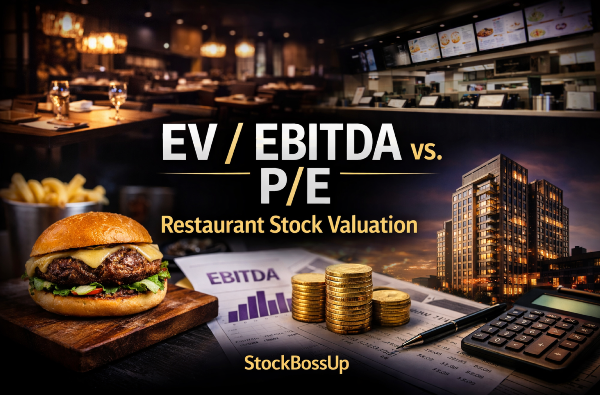
Restaurant Stock Valuation: EV/EBITDA vs P/E (And Why Most Investors Use Them Wrong)
Most restaurant investors rely on the P/E ratio to judge whether a stock is cheap or expensive. Yet many of the strongest restaurant chains looked “overpriced” on P/E right before they delivered their biggest gains. That gap between what investors expect and what actually happens creates a real problem: the most common valuation tool often sends the wrong signal at the most important moment.
The deeper issue is not the ratios themselves. It’s that restaurant businesses behave differently from most other sectors. Their mix of real estate, debt, franchising, and fixed costs can twist simple metrics into shapes that hide the truth. The solution is not obvious at first, and many investors miss it for years. We’ll return to that solution at the end.
Before we get there, we need to understand why restaurant stocks require special tools, why P/E and EV/EBITDA tell different stories, and how each ratio reacts to debt, leases, and growth.
Why Do Restaurant Stocks Need Their Own Valuation Approach?
Restaurant stocks look simple from the outside. Food goes in, cash comes out. But the business model hides layers that can distort traditional valuation ratios.
Restaurants deal with:
- Heavy fixed costs like rent, labor, and equipment
- Real estate choices that change long‑term economics
- A mix of company‑owned and franchised units
- Debt cycles tied to remodels, expansion, and buybacks
These factors can make earnings look messy. They can also make two similar chains appear very different on paper.
That’s why investors lean on two major tools:
- Price‑to‑Earnings (P/E)
- Enterprise Value to EBITDA (EV/EBITDA)
Each tool has strengths. Each has blind spots. And each answers a different question about the business.
Key idea: The right metric depends on the question you’re asking, not on a universal rule.
What Does P/E Really Tell You About a Restaurant?
The P/E ratio compares a company’s share price to its net earnings per share. In simple terms, it answers:
“How many dollars am I paying for one dollar of accounting profit?”
Investors like P/E because it’s easy to understand and widely quoted. It connects directly to earnings, which drive long‑term returns. But for restaurants, P/E can be misleading.
P/E is affected by:
- Interest expense
- Taxes
- Depreciation
- One‑time gains or losses
A chain that owns a lot of real estate may show lower earnings due to depreciation. A franchise‑heavy chain may show smoother earnings because franchise fees are stable. Both can distort the P/E ratio.
Below is a simple comparison of how P/E reacts to different restaurant models:
| Model Type |
Impact on Earnings |
Effect on P/E |
Why It Happens |
| Asset‑heavy |
Lower earnings due to depreciation |
Higher P/E |
Buildings and equipment reduce net income |
| Asset‑light |
Smoother earnings from franchise fees |
Lower P/E |
Less depreciation and fewer one‑time charges |
| High‑debt |
Lower earnings from interest |
Higher P/E |
Interest expense drags down net income |
| Low‑debt |
Cleaner earnings |
Lower P/E |
Less interest drag |
P/E is useful, but it often reflects financing choices more than business strength.
Why Do Restaurant Investors Rely So Much on EV/EBITDA?
EV/EBITDA compares the total value of the business to its operating earnings before interest, taxes, and non‑cash charges. It answers:
“How many dollars am I paying for one dollar of core operating cash earnings?”
Enterprise value includes:
This makes EV/EBITDA powerful for restaurants because it levels the playing field between chains with different debt loads or real estate strategies.
EV/EBITDA helps investors:
- Compare asset‑heavy and asset‑light models
- Remove the noise of depreciation
- Judge operating strength separate from financing decisions
One unique detail about restaurant accounting: some chains depreciate buildings over 20 years even though many structures last 40 years or more. That gap can make earnings look weaker than the actual economics. EV/EBITDA smooths that out.
How Do Debt and Interest Change the Story?
Restaurants borrow for many reasons:
- New unit growth
- Remodels
- Acquisitions
- Share buybacks
Debt affects P/E and EV/EBITDA in very different ways.
P/E reacts strongly to debt because interest expense reduces earnings. A chain with heavy debt may look expensive on P/E even if operations are solid.
EV/EBITDA handles debt differently:
- Debt increases enterprise value
- Interest does not reduce EBITDA
This means:
- A high‑debt chain may look expensive on P/E but reasonable on EV/EBITDA
- A low‑debt chain may look safe on P/E but pricey on EV/EBITDA
Here’s a quick comparison:
| Scenario |
P/E Reaction |
EV/EBITDA Reaction |
What It Means |
| High debt, strong EBITDA |
High P/E |
Moderate EV/EBITDA |
Interest hides operating strength |
| Low debt, modest EBITDA |
Low P/E |
High EV/EBITDA |
Clean earnings hide weak operations |
| Paying down debt |
Falling P/E |
Stable EV/EBITDA |
Earnings rise as interest drops |
Sometimes a “high” P/E stock is simply a high‑debt stock with decent operations.
Why Do Asset‑Light and Asset‑Heavy Models Look So Different?
Restaurant chains fall into two broad categories:
- Asset‑heavy: Own land and buildings
- Asset‑light: Franchise most units
These models create very different financial profiles.
Asset‑heavy chains:
- Have large depreciation
- Show lower earnings
- Often look expensive on P/E
Asset‑light chains:
- Have smoother earnings
- Show higher margins
- Often look cheaper on P/E
EV/EBITDA helps compare them by adding back depreciation. But even EV/EBITDA can miss something important: some chains own land that has appreciated for decades, yet the value never shows up in EBITDA.
That hidden value can be meaningful. In fact, one major restaurant chain discovered that the land under its oldest stores was worth more than the entire company’s market cap during a real estate review.
Why Do Some “Expensive” Restaurant Stocks Keep Rising?
Investors often see a restaurant stock trading at a high P/E and assume it’s overpriced. Yet many of the best performers stay expensive for years.
The market may be paying up because:
In these cases:
- P/E looks high because investors expect earnings to grow
- EV/EBITDA may still look reasonable if EBITDA is rising fast
A high P/E is not always a warning sign. Sometimes it reflects a long runway for growth.
When Does a Low P/E Become a Value Trap?
A low P/E can look attractive, but restaurant stocks often trade cheaply for a reason.
Common warning signs include:
- Flat or declining same‑store sales
- Rising labor or food costs
- Weak brand perception
- Slow or negative unit growth
A chain may look cheap on P/E but risky on EV/EBITDA if debt is high. Free cash flow may also be thin after maintenance capex and interest.
Below is a simple comparison of value traps:
| Warning Sign |
P/E Signal |
EV/EBITDA Signal |
Risk |
| High debt |
Low P/E |
High EV/EBITDA |
Leverage risk |
| Weak margins |
Low P/E |
Moderate EV/EBITDA |
Cost pressure |
| Slow growth |
Low P/E |
Low EV/EBITDA |
Limited upside |
| Heavy remodel needs |
Low P/E |
High EV/EBITDA |
Cash drain |
Low P/E plus high debt is often a polite label for high risk.
Why Do Investors Use EV/EBITDA in Practice?
EV/EBITDA is most useful when applied with structure. A simple checklist helps investors avoid common mistakes.
Compare within peer groups
Quick service vs quick service. Casual dining vs casual dining. Different segments have different typical multiples.
Adjust for growth
A 12x EV/EBITDA stock growing 5% may be pricier than a 16x stock growing 15%.
Watch leverage
Debt/EBITDA matters as much as the multiple itself.
Consider brand quality
Stronger brands deserve richer multiples.
Here’s a practical comparison:
| Factor |
Low Multiple |
High Multiple |
What It Suggests |
| Growth |
Slow |
Fast |
Higher multiple justified |
| Leverage |
High |
Low |
Lower multiple safer |
| Brand strength |
Weak |
Strong |
Premium pricing |
| Unit economics |
Poor |
Excellent |
Higher valuation |
This checklist helps investors avoid overpaying for hype or underestimating risk.
What Does P/E Still Do Better Than EV/EBITDA?
Despite its flaws, P/E remains valuable. It connects directly to earnings per share, which drive long‑term returns.
P/E is especially useful for:
- Mature chains with stable earnings
- Franchise‑heavy models with low reinvestment needs
- Comparing a company’s valuation to its own history
P/E helps investors judge how the market prices earnings power today.
Which Ratio Works Better During Turnarounds or Cycles?
Restaurants are cyclical. They face:
- Recessions
- Food cost spikes
- Labor shortages
- Shifts in consumer taste
During turnarounds:
- Earnings may be depressed
- P/E may be meaningless
- EV/EBITDA may still be usable
During deep cycles:
- EBITDA may fall but stay positive
- Net earnings may swing sharply
Investors often:
- Use EV/EBITDA to value the business through the cycle
- Use P/E once earnings stabilize
This two‑step approach helps avoid buying too early or too late.
How Do Buybacks and Capital Allocation Distort Ratios?
Restaurants often use free cash flow for:
- Buybacks
- Dividends
- Debt reduction
- New units
These choices can twist valuation ratios.
Buybacks reduce share count, which boosts EPS and lowers P/E even if total earnings stay flat. Debt‑funded buybacks increase leverage, which shows up in EV but not always clearly in P/E.
Heavy reinvestment may depress current earnings while building future EBITDA.
A company can:
- Look expensive on P/E but cheap on EV/EBITDA if earnings are temporarily low
- Look cheap on P/E but risky on EV/EBITDA if debt is high
The best CEOs think in cash‑on‑cash returns. Investors should too.
Can You Use Multiples Without Understanding the Business?
You shouldn’t. No ratio can replace understanding:
- Unit economics
- Brand strength
- Management quality
- Real estate strategy
- Lease commitments
EV/EBITDA and P/E are tools. They help investors avoid hype and spot quality. But used alone, they can mislead.
So Which Ratio Is Better: EV/EBITDA or P/E?
Here’s the part most investors miss.
You don’t need to pick a side.
Each ratio answers a different question:
- EV/EBITDA: “Is the business priced fairly relative to its operating cash earnings?”
- P/E: “Is the stock priced fairly relative to earnings available to shareholders?”
A simple way to blend them:
- Start with EV/EBITDA to judge the business.
- Then use P/E to judge the equity.
- Compare the two stories.
If EV/EBITDA says “cheap business” but P/E says “expensive stock,” debt or interest may be the issue.
If EV/EBITDA says “expensive business” but P/E is low, earnings may be inflated by one‑time gains or low capex.
The real edge comes from knowing which ratio to trust for which question.
🚀 Expand Your Edge: Elite Restaurant & Consumer Insights
Ready to dominate the sector? Our Investor Intelligence Hub is designed to help you navigate the complex world of restaurant equities with precision. From deep-dive fundamental analysis to macroeconomic strategy, explore our curated silos below to find your next big winner.
🍽️ Sector Fundamentals & Top Picks
📊 Deep-Dive Financial Analysis
🧠 Strategic Operations & Economics
🌍 Macro, Risk & Global Trends
💡 Investor Psychology & Behavioral Trends
🔍 Advanced Intelligence

















🔑 Key Takeaways
🍔 Restaurant valuation needs context, not shortcuts
Restaurant stocks can’t be judged by a single ratio. Heavy fixed costs, real estate ownership, and franchising distort simple metrics. Investors must understand how each model—asset‑heavy or asset‑light—changes the meaning of both P/E and EV/EBITDA before making decisions.💰 EV/EBITDA reveals operating strength better than P/E
EV/EBITDA focuses on the business engine by removing interest, taxes, and depreciation. It compares chains on equal footing regardless of debt. This ratio often exposes strong operations hidden behind high interest costs or heavy depreciation.📉 A low P/E can hide high risk
Cheap‑looking restaurant stocks often carry heavy debt or weak growth. When P/E is low but EV/EBITDA isn’t, it signals leverage or declining margins. Investors should check debt/EBITDA and free cash flow before assuming value. *(Unique fact: One major chain’s land holdings once exceeded its market cap—proof that accounting can mask real worth.)*🏆 The best insight comes from blending both ratios
EV/EBITDA judges the business; P/E judges the equity. When both align, investors see the full picture of operating health and shareholder value. The smartest approach is to start with EV/EBITDA, then confirm with P/E to catch distortions from debt or taxes. *(Unique fact: Some restaurant buildings depreciate twice as fast on paper as they do in reality, skewing earnings and making EV/EBITDA more reliable.)*Restaurant Stock Valuation: EV/EBITDA vs P/E (And Why Most Investors Use Them Wrong)
Most restaurant investors rely on the P/E ratio to judge whether a stock is cheap or expensive. Yet many of the strongest restaurant chains looked “overpriced” on P/E right before they delivered their biggest gains. That gap between what investors expect and what actually happens creates a real problem: the most common valuation tool often sends the wrong signal at the most important moment.
The deeper issue is not the ratios themselves. It’s that restaurant businesses behave differently from most other sectors. Their mix of real estate, debt, franchising, and fixed costs can twist simple metrics into shapes that hide the truth. The solution is not obvious at first, and many investors miss it for years. We’ll return to that solution at the end.
Before we get there, we need to understand why restaurant stocks require special tools, why P/E and EV/EBITDA tell different stories, and how each ratio reacts to debt, leases, and growth.
Why Do Restaurant Stocks Need Their Own Valuation Approach?
Restaurant stocks look simple from the outside. Food goes in, cash comes out. But the business model hides layers that can distort traditional valuation ratios.
Restaurants deal with:
These factors can make earnings look messy. They can also make two similar chains appear very different on paper.
That’s why investors lean on two major tools:
Each tool has strengths. Each has blind spots. And each answers a different question about the business.
Key idea: The right metric depends on the question you’re asking, not on a universal rule.
What Does P/E Really Tell You About a Restaurant?
The P/E ratio compares a company’s share price to its net earnings per share. In simple terms, it answers:
“How many dollars am I paying for one dollar of accounting profit?”
Investors like P/E because it’s easy to understand and widely quoted. It connects directly to earnings, which drive long‑term returns. But for restaurants, P/E can be misleading.
P/E is affected by:
A chain that owns a lot of real estate may show lower earnings due to depreciation. A franchise‑heavy chain may show smoother earnings because franchise fees are stable. Both can distort the P/E ratio.
Below is a simple comparison of how P/E reacts to different restaurant models:
P/E is useful, but it often reflects financing choices more than business strength.
Why Do Restaurant Investors Rely So Much on EV/EBITDA?
EV/EBITDA compares the total value of the business to its operating earnings before interest, taxes, and non‑cash charges. It answers:
“How many dollars am I paying for one dollar of core operating cash earnings?”
Enterprise value includes:
This makes EV/EBITDA powerful for restaurants because it levels the playing field between chains with different debt loads or real estate strategies.
EV/EBITDA helps investors:
One unique detail about restaurant accounting: some chains depreciate buildings over 20 years even though many structures last 40 years or more. That gap can make earnings look weaker than the actual economics. EV/EBITDA smooths that out.
How Do Debt and Interest Change the Story?
Restaurants borrow for many reasons:
Debt affects P/E and EV/EBITDA in very different ways.
P/E reacts strongly to debt because interest expense reduces earnings. A chain with heavy debt may look expensive on P/E even if operations are solid.
EV/EBITDA handles debt differently:
This means:
Here’s a quick comparison:
Sometimes a “high” P/E stock is simply a high‑debt stock with decent operations.
Why Do Asset‑Light and Asset‑Heavy Models Look So Different?
Restaurant chains fall into two broad categories:
These models create very different financial profiles.
Asset‑heavy chains:
Asset‑light chains:
EV/EBITDA helps compare them by adding back depreciation. But even EV/EBITDA can miss something important: some chains own land that has appreciated for decades, yet the value never shows up in EBITDA.
That hidden value can be meaningful. In fact, one major restaurant chain discovered that the land under its oldest stores was worth more than the entire company’s market cap during a real estate review.
Why Do Some “Expensive” Restaurant Stocks Keep Rising?
Investors often see a restaurant stock trading at a high P/E and assume it’s overpriced. Yet many of the best performers stay expensive for years.
The market may be paying up because:
In these cases:
A high P/E is not always a warning sign. Sometimes it reflects a long runway for growth.
When Does a Low P/E Become a Value Trap?
A low P/E can look attractive, but restaurant stocks often trade cheaply for a reason.
Common warning signs include:
A chain may look cheap on P/E but risky on EV/EBITDA if debt is high. Free cash flow may also be thin after maintenance capex and interest.
Below is a simple comparison of value traps:
Low P/E plus high debt is often a polite label for high risk.
Why Do Investors Use EV/EBITDA in Practice?
EV/EBITDA is most useful when applied with structure. A simple checklist helps investors avoid common mistakes.
Compare within peer groups
Quick service vs quick service. Casual dining vs casual dining. Different segments have different typical multiples.
Adjust for growth
A 12x EV/EBITDA stock growing 5% may be pricier than a 16x stock growing 15%.
Watch leverage
Debt/EBITDA matters as much as the multiple itself.
Consider brand quality
Stronger brands deserve richer multiples.
Here’s a practical comparison:
This checklist helps investors avoid overpaying for hype or underestimating risk.
What Does P/E Still Do Better Than EV/EBITDA?
Despite its flaws, P/E remains valuable. It connects directly to earnings per share, which drive long‑term returns.
P/E is especially useful for:
P/E helps investors judge how the market prices earnings power today.
Which Ratio Works Better During Turnarounds or Cycles?
Restaurants are cyclical. They face:
During turnarounds:
During deep cycles:
Investors often:
This two‑step approach helps avoid buying too early or too late.
How Do Buybacks and Capital Allocation Distort Ratios?
Restaurants often use free cash flow for:
These choices can twist valuation ratios.
Buybacks reduce share count, which boosts EPS and lowers P/E even if total earnings stay flat. Debt‑funded buybacks increase leverage, which shows up in EV but not always clearly in P/E.
Heavy reinvestment may depress current earnings while building future EBITDA.
A company can:
The best CEOs think in cash‑on‑cash returns. Investors should too.
Can You Use Multiples Without Understanding the Business?
You shouldn’t. No ratio can replace understanding:
EV/EBITDA and P/E are tools. They help investors avoid hype and spot quality. But used alone, they can mislead.
So Which Ratio Is Better: EV/EBITDA or P/E?
Here’s the part most investors miss.
You don’t need to pick a side.
Each ratio answers a different question:
A simple way to blend them:
If EV/EBITDA says “cheap business” but P/E says “expensive stock,” debt or interest may be the issue.
If EV/EBITDA says “expensive business” but P/E is low, earnings may be inflated by one‑time gains or low capex.
The real edge comes from knowing which ratio to trust for which question.
🚀 Expand Your Edge: Elite Restaurant & Consumer Insights
Ready to dominate the sector? Our Investor Intelligence Hub is designed to help you navigate the complex world of restaurant equities with precision. From deep-dive fundamental analysis to macroeconomic strategy, explore our curated silos below to find your next big winner.
🍽️ Sector Fundamentals & Top Picks
📊 Deep-Dive Financial Analysis
🧠 Strategic Operations & Economics
🌍 Macro, Risk & Global Trends
💡 Investor Psychology & Behavioral Trends
🔍 Advanced Intelligence