🍔 The Battle of the Burger Stocks
The burger industry has shaped American dining for more than half a century. It blends fast service, familiar menus, and strong brand loyalty. Today, investors can choose from several publicly traded burger companies, each with a different strategy and growth story. Some chains rely on global scale. Others focus on premium ingredients or regional appeal. This mix creates a competitive landscape where every company fights for market share and investor attention.
Burger stocks tend to perform well during stable economic periods. People still want quick meals, even when budgets tighten. This makes the sector appealing for investors who want steady demand and recognizable brands. But not all burger companies operate the same way. Some are asset‑light franchisors. Others run most of their own restaurants. These differences affect margins, risk, and long‑term performance.
This article compares the major burger stocks available on U.S. exchanges. The goal is to help investors understand how each company competes and where the strongest opportunities may be. The companies included are McDonald’s, Restaurant Brands International, Wendy’s, Jack in the Box, Shake Shack, Red Robin, and Good Times Restaurants. Each one brings a unique approach to the burger business.
Before diving into the details, it helps to understand the scale of the industry. Burgers remain one of the most ordered foods in the United States. They are easy to customize, simple to prepare, and familiar to customers of all ages. This gives burger chains a built‑in advantage over other restaurant categories. Even with rising competition from chicken and Mexican‑inspired chains, burgers continue to dominate quick‑service menus.
The companies in this comparison range from global giants to small regional players. This creates a wide spread in revenue, store count, and brand recognition. Investors should not assume that bigger always means better. Smaller chains can grow faster. Larger chains can deliver more stable cash flow. Understanding these differences is key to evaluating the sector.
Below is a quick reference table summarizing the burger stocks covered in this article. It sets the stage for the deeper analysis that follows.
| Company |
Ticker |
Exchange |
Notes |
| McDonald’s Corp. |
MCD |
NYSE |
Largest burger chain globally |
| Restaurant Brands International |
QSR |
NYSE |
Parent of Burger King |
| Wendy’s Co. |
WEN |
NASDAQ |
Major U.S. burger chain |
| Jack in the Box Inc. |
JACK |
NASDAQ |
Burger‑heavy QSR chain |
| Shake Shack Inc. |
SHAK |
NYSE |
Premium fast‑casual burger chain |
| Red Robin Gourmet Burgers |
RRGB |
NASDAQ |
Sit‑down gourmet burger chain |
| Good Times Restaurants |
GTIM |
NASDAQ |
Regional burger chain |
Comparing the Big Three
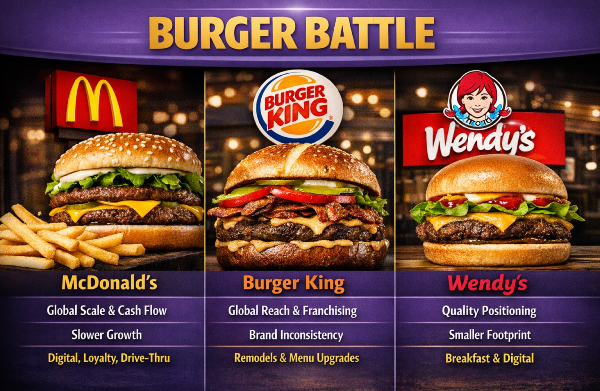
The three largest burger chains—McDonald’s, Burger King, and Wendy’s—control a significant share of the global burger market. Each one uses a different strategy to compete. The table below highlights some of the key differences.
| Brand |
Strength |
Risk |
Growth Focus |
| McDonald’s |
Global scale and strong cash flow |
Slower growth |
Digital, loyalty, drive‑thru |
| Burger King |
Global reach and franchising |
Brand inconsistency |
Remodels and menu upgrades |
| Wendy’s |
Quality positioning |
Smaller footprint |
Breakfast and digital |
This comparison shows how each company approaches the market. McDonald’s focuses on efficiency. Burger King focuses on modernization. Wendy’s focuses on quality. These differences shape their long‑term performance.
McDonald’s: The Global Powerhouse
McDonald’s is the most recognized burger brand in the world. Its scale gives it unmatched buying power, marketing reach, and operational efficiency. The company has shifted toward a franchise‑heavy model, which reduces costs and increases margins. This structure allows McDonald’s to generate strong cash flow even during economic downturns.
The company continues to invest in digital ordering, loyalty programs, and drive‑thru improvements. These upgrades help increase average check size and customer frequency. McDonald’s also benefits from a menu that balances value items with premium offerings. This flexibility helps the brand appeal to a wide range of customers.
One interesting detail about McDonald’s is that it is one of the largest real estate companies in the world by land ownership. This is not obvious to most customers, but it plays a major role in the company’s long‑term stability. Franchisees pay rent, which creates a steady revenue stream.
McDonald’s remains the most stable burger stock. It may not grow as fast as smaller chains, but it offers consistency and global reach. Investors who want a defensive restaurant stock often start here.
Restaurant Brands International: The Burger King Parent
Restaurant Brands International owns Burger King, Tim Hortons, Popeyes, and Firehouse Subs. Burger King is the second‑largest burger chain in the world. The brand has been working to modernize its restaurants and improve menu quality. These efforts aim to close the gap with McDonald’s and Wendy’s.
Burger King’s performance varies by region. Some international markets outperform the U.S. system. The company has been investing in remodels, digital upgrades, and marketing campaigns to strengthen the brand. These changes take time, but they can improve long‑term results.
RBI uses a pure franchising model. This keeps operating costs low and allows the company to scale quickly. The trade‑off is that it has less control over day‑to‑day operations. Investors should watch how franchisees respond to the company’s modernization plans.
Burger King has strong brand recognition, but it faces intense competition. The company’s success depends on its ability to improve consistency and customer experience. If the turnaround continues, RBI could deliver solid growth.
Wendy’s: The Challenger Brand
Wendy’s positions itself as a higher‑quality alternative to traditional fast food. The chain emphasizes fresh beef, premium toppings, and a more modern menu. This strategy helps Wendy’s stand out in a crowded market. The company has also invested heavily in digital ordering and delivery partnerships.
Wendy’s has a loyal customer base. Its menu innovations, such as the Pretzel Bacon Pub Cheeseburger, often generate strong buzz. The company also benefits from a balanced mix of value items and premium offerings. This helps attract both budget‑focused and quality‑focused customers.
Wendy’s growth strategy includes expanding its breakfast menu. Breakfast is a high‑margin category, and the company sees room to gain market share. If breakfast continues to grow, it could become a major revenue driver.
Wendy’s is smaller than McDonald’s and Burger King, but it competes effectively. The brand has a clear identity and strong marketing. Investors who want a mid‑sized burger stock with steady growth potential often consider Wendy’s.
How the Smaller Players Compare
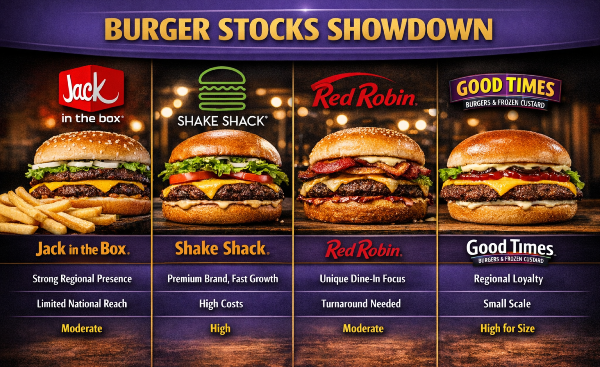
The smaller burger chains—Jack in the Box, Shake Shack, Red Robin, and Good Times—offer different risk and reward profiles. The table below summarizes their key traits.
| Company |
Strength |
Risk |
Growth Potential |
| Jack in the Box |
Strong regional presence |
Limited national reach |
Moderate |
| Shake Shack |
Premium brand and fast growth |
High costs |
High |
| Red Robin |
Unique dine‑in focus |
Turnaround needed |
Moderate |
| Good Times |
Regional loyalty |
Small scale |
High for size |
These companies compete in different segments of the burger market. Their performance depends on execution, brand strength, and customer loyalty.
Jack in the Box: The Regional Maverick
Jack in the Box operates primarily in the western United States. The chain offers a wide menu that includes burgers, tacos, chicken sandwiches, and breakfast items. This variety helps the brand appeal to a broad customer base. Jack in the Box also owns Del Taco, which expands its reach into Mexican‑inspired fast food.
The company uses a franchise‑heavy model. This reduces operating costs and increases margins. Jack in the Box has been working to improve franchisee relations and support systemwide growth. These efforts include store remodels and menu innovation.
Jack in the Box has a loyal following, especially in California and Texas. The brand’s late‑night menu and unique items help it stand out. Investors who want exposure to a quirky, regionally strong chain may find this stock appealing.
Shake Shack: The Premium Fast‑Casual Leader
Shake Shack is one of the fastest‑growing burger chains in the United States. It focuses on high‑quality ingredients, modern design, and a premium customer experience. The brand appeals to younger customers who want better ingredients and a more upscale feel.
Shake Shack operates many of its own restaurants. This gives the company more control over quality but increases costs. The chain has been expanding both domestically and internationally. New locations often generate strong initial sales.
One surprising fact about Shake Shack is that it began as a hot dog cart in New York City. Its growth from a single cart to a global brand shows the power of strong branding and customer loyalty.
Shake Shack’s growth potential is high, but so is its volatility. Investors should expect more price swings compared to larger chains. Still, the brand’s long‑term outlook remains strong.
Red Robin: The Sit‑Down Burger Experience
Red Robin operates in the casual dining segment. It offers gourmet burgers, table service, and a family‑friendly atmosphere. This makes it very different from fast‑food chains. Red Robin has been working to improve service speed, menu quality, and restaurant efficiency.
The company has faced challenges in recent years. Casual dining has become more competitive, and labor costs have increased. Red Robin has responded by simplifying its menu and improving operations. These changes aim to boost margins and customer satisfaction.
Red Robin’s success depends on its ability to attract families and groups. The chain’s dine‑in focus makes it sensitive to economic shifts. Investors should view this stock as a turnaround play rather than a stable performer.
Good Times Restaurants: The Small‑Cap Underdog
Good Times Restaurants operates Good Times Burgers & Frozen Custard, a regional chain based in Colorado. The company also owns Bad Daddy’s Burger Bar, a fast‑casual concept. Good Times is the smallest burger stock on this list, but it has a loyal regional following.
The company focuses on high‑quality ingredients and fresh preparation. Its smaller size allows it to adapt quickly to market trends. Good Times has been working to improve margins and grow its Bad Daddy’s concept.
Small‑cap restaurant stocks can be volatile. They also offer more room for growth. Investors who want exposure to a niche regional brand may find Good Times interesting.
Industry Trends Shaping the Battle
Several trends are influencing the future of burger stocks. Digital ordering continues to grow. Customers want convenience, and chains that invest in mobile apps and loyalty programs gain an advantage. Drive‑thru innovation also matters. Faster service leads to higher sales.
Menu innovation is another key trend. Chains are experimenting with plant‑based options, premium toppings, and limited‑time offers. These items help attract new customers and increase average check size.
Labor costs remain a challenge. Companies with strong franchising models can manage these costs more effectively. This gives McDonald’s, Burger King, and Jack in the Box an advantage over chains that operate most of their own restaurants.
Real estate strategy also plays a role. Companies with strong site selection and efficient layouts can improve margins. McDonald’s and Shake Shack excel in this area.
Final Thoughts: Which Burger Stock Wins the Battle?
The chioice is yours!
Each company offers something different. McDonald’s delivers stability. Burger King offers turnaround potential. Wendy’s provides quality positioning. Shake Shack brings premium growth. Jack in the Box delivers regional strength. Red Robin offers a unique dine‑in experience. Good Times gives investors a small‑cap growth story.
The best choice depends on an investor’s goals. Those who want steady performance may prefer McDonald’s or Wendy’s. Investors seeking growth may look at Shake Shack or Good Times. Those who want value or turnaround potential may consider Burger King or Red Robin.
The burger industry remains strong, and these companies continue to shape how Americans eat. As long as customers crave burgers, these stocks will stay relevant. The battle will continue, and investors who understand the differences between these companies will be better prepared to choose the right one for their portfolio.
🍽️ Hungry for More? Explore Our Deep Dives
Boost your investment portfolio with our expert analysis of the restaurant industry. Select a category below to discover the next big mover in the food space.











🍔 The Battle of the Burger Stocks
The burger industry has shaped American dining for more than half a century. It blends fast service, familiar menus, and strong brand loyalty. Today, investors can choose from several publicly traded burger companies, each with a different strategy and growth story. Some chains rely on global scale. Others focus on premium ingredients or regional appeal. This mix creates a competitive landscape where every company fights for market share and investor attention.
Burger stocks tend to perform well during stable economic periods. People still want quick meals, even when budgets tighten. This makes the sector appealing for investors who want steady demand and recognizable brands. But not all burger companies operate the same way. Some are asset‑light franchisors. Others run most of their own restaurants. These differences affect margins, risk, and long‑term performance.
This article compares the major burger stocks available on U.S. exchanges. The goal is to help investors understand how each company competes and where the strongest opportunities may be. The companies included are McDonald’s, Restaurant Brands International, Wendy’s, Jack in the Box, Shake Shack, Red Robin, and Good Times Restaurants. Each one brings a unique approach to the burger business.
Before diving into the details, it helps to understand the scale of the industry. Burgers remain one of the most ordered foods in the United States. They are easy to customize, simple to prepare, and familiar to customers of all ages. This gives burger chains a built‑in advantage over other restaurant categories. Even with rising competition from chicken and Mexican‑inspired chains, burgers continue to dominate quick‑service menus.
The companies in this comparison range from global giants to small regional players. This creates a wide spread in revenue, store count, and brand recognition. Investors should not assume that bigger always means better. Smaller chains can grow faster. Larger chains can deliver more stable cash flow. Understanding these differences is key to evaluating the sector.
Below is a quick reference table summarizing the burger stocks covered in this article. It sets the stage for the deeper analysis that follows.
Comparing the Big Three
The three largest burger chains—McDonald’s, Burger King, and Wendy’s—control a significant share of the global burger market. Each one uses a different strategy to compete. The table below highlights some of the key differences.
This comparison shows how each company approaches the market. McDonald’s focuses on efficiency. Burger King focuses on modernization. Wendy’s focuses on quality. These differences shape their long‑term performance.
McDonald’s: The Global Powerhouse
McDonald’s is the most recognized burger brand in the world. Its scale gives it unmatched buying power, marketing reach, and operational efficiency. The company has shifted toward a franchise‑heavy model, which reduces costs and increases margins. This structure allows McDonald’s to generate strong cash flow even during economic downturns.
The company continues to invest in digital ordering, loyalty programs, and drive‑thru improvements. These upgrades help increase average check size and customer frequency. McDonald’s also benefits from a menu that balances value items with premium offerings. This flexibility helps the brand appeal to a wide range of customers.
One interesting detail about McDonald’s is that it is one of the largest real estate companies in the world by land ownership. This is not obvious to most customers, but it plays a major role in the company’s long‑term stability. Franchisees pay rent, which creates a steady revenue stream.
McDonald’s remains the most stable burger stock. It may not grow as fast as smaller chains, but it offers consistency and global reach. Investors who want a defensive restaurant stock often start here.
Restaurant Brands International: The Burger King Parent
Restaurant Brands International owns Burger King, Tim Hortons, Popeyes, and Firehouse Subs. Burger King is the second‑largest burger chain in the world. The brand has been working to modernize its restaurants and improve menu quality. These efforts aim to close the gap with McDonald’s and Wendy’s.
Burger King’s performance varies by region. Some international markets outperform the U.S. system. The company has been investing in remodels, digital upgrades, and marketing campaigns to strengthen the brand. These changes take time, but they can improve long‑term results.
RBI uses a pure franchising model. This keeps operating costs low and allows the company to scale quickly. The trade‑off is that it has less control over day‑to‑day operations. Investors should watch how franchisees respond to the company’s modernization plans.
Burger King has strong brand recognition, but it faces intense competition. The company’s success depends on its ability to improve consistency and customer experience. If the turnaround continues, RBI could deliver solid growth.
Wendy’s: The Challenger Brand
Wendy’s positions itself as a higher‑quality alternative to traditional fast food. The chain emphasizes fresh beef, premium toppings, and a more modern menu. This strategy helps Wendy’s stand out in a crowded market. The company has also invested heavily in digital ordering and delivery partnerships.
Wendy’s has a loyal customer base. Its menu innovations, such as the Pretzel Bacon Pub Cheeseburger, often generate strong buzz. The company also benefits from a balanced mix of value items and premium offerings. This helps attract both budget‑focused and quality‑focused customers.
Wendy’s growth strategy includes expanding its breakfast menu. Breakfast is a high‑margin category, and the company sees room to gain market share. If breakfast continues to grow, it could become a major revenue driver.
Wendy’s is smaller than McDonald’s and Burger King, but it competes effectively. The brand has a clear identity and strong marketing. Investors who want a mid‑sized burger stock with steady growth potential often consider Wendy’s.
How the Smaller Players Compare
The smaller burger chains—Jack in the Box, Shake Shack, Red Robin, and Good Times—offer different risk and reward profiles. The table below summarizes their key traits.
These companies compete in different segments of the burger market. Their performance depends on execution, brand strength, and customer loyalty.
Jack in the Box: The Regional Maverick
Jack in the Box operates primarily in the western United States. The chain offers a wide menu that includes burgers, tacos, chicken sandwiches, and breakfast items. This variety helps the brand appeal to a broad customer base. Jack in the Box also owns Del Taco, which expands its reach into Mexican‑inspired fast food.
The company uses a franchise‑heavy model. This reduces operating costs and increases margins. Jack in the Box has been working to improve franchisee relations and support systemwide growth. These efforts include store remodels and menu innovation.
Jack in the Box has a loyal following, especially in California and Texas. The brand’s late‑night menu and unique items help it stand out. Investors who want exposure to a quirky, regionally strong chain may find this stock appealing.
Shake Shack: The Premium Fast‑Casual Leader
Shake Shack is one of the fastest‑growing burger chains in the United States. It focuses on high‑quality ingredients, modern design, and a premium customer experience. The brand appeals to younger customers who want better ingredients and a more upscale feel.
Shake Shack operates many of its own restaurants. This gives the company more control over quality but increases costs. The chain has been expanding both domestically and internationally. New locations often generate strong initial sales.
One surprising fact about Shake Shack is that it began as a hot dog cart in New York City. Its growth from a single cart to a global brand shows the power of strong branding and customer loyalty.
Shake Shack’s growth potential is high, but so is its volatility. Investors should expect more price swings compared to larger chains. Still, the brand’s long‑term outlook remains strong.
Red Robin: The Sit‑Down Burger Experience
Red Robin operates in the casual dining segment. It offers gourmet burgers, table service, and a family‑friendly atmosphere. This makes it very different from fast‑food chains. Red Robin has been working to improve service speed, menu quality, and restaurant efficiency.
The company has faced challenges in recent years. Casual dining has become more competitive, and labor costs have increased. Red Robin has responded by simplifying its menu and improving operations. These changes aim to boost margins and customer satisfaction.
Red Robin’s success depends on its ability to attract families and groups. The chain’s dine‑in focus makes it sensitive to economic shifts. Investors should view this stock as a turnaround play rather than a stable performer.
Good Times Restaurants: The Small‑Cap Underdog
Good Times Restaurants operates Good Times Burgers & Frozen Custard, a regional chain based in Colorado. The company also owns Bad Daddy’s Burger Bar, a fast‑casual concept. Good Times is the smallest burger stock on this list, but it has a loyal regional following.
The company focuses on high‑quality ingredients and fresh preparation. Its smaller size allows it to adapt quickly to market trends. Good Times has been working to improve margins and grow its Bad Daddy’s concept.
Small‑cap restaurant stocks can be volatile. They also offer more room for growth. Investors who want exposure to a niche regional brand may find Good Times interesting.
Industry Trends Shaping the Battle
Several trends are influencing the future of burger stocks. Digital ordering continues to grow. Customers want convenience, and chains that invest in mobile apps and loyalty programs gain an advantage. Drive‑thru innovation also matters. Faster service leads to higher sales.
Menu innovation is another key trend. Chains are experimenting with plant‑based options, premium toppings, and limited‑time offers. These items help attract new customers and increase average check size.
Labor costs remain a challenge. Companies with strong franchising models can manage these costs more effectively. This gives McDonald’s, Burger King, and Jack in the Box an advantage over chains that operate most of their own restaurants.
Real estate strategy also plays a role. Companies with strong site selection and efficient layouts can improve margins. McDonald’s and Shake Shack excel in this area.
Final Thoughts: Which Burger Stock Wins the Battle?
The chioice is yours!
Each company offers something different. McDonald’s delivers stability. Burger King offers turnaround potential. Wendy’s provides quality positioning. Shake Shack brings premium growth. Jack in the Box delivers regional strength. Red Robin offers a unique dine‑in experience. Good Times gives investors a small‑cap growth story.
The best choice depends on an investor’s goals. Those who want steady performance may prefer McDonald’s or Wendy’s. Investors seeking growth may look at Shake Shack or Good Times. Those who want value or turnaround potential may consider Burger King or Red Robin.
The burger industry remains strong, and these companies continue to shape how Americans eat. As long as customers crave burgers, these stocks will stay relevant. The battle will continue, and investors who understand the differences between these companies will be better prepared to choose the right one for their portfolio.
🍽️ Hungry for More? Explore Our Deep Dives
Boost your investment portfolio with our expert analysis of the restaurant industry. Select a category below to discover the next big mover in the food space.
• The Top Restaurant Stocks
• Domino's (DPZ) vs. Pizza Hut (YUM)
• Taco Bell vs. Chipotle (CMG)
• Asian Cuisine & Beverage Stocks
• Top Rated Fast Food Stocks
• Popeyes vs. KFC: The Crown Fight
• Top Sit Down Restaurants
• Battle of Fine Dining Stocks
• Battle of Family Restaurants
• Cracker Barrel vs. Cheesecake Factory
• Dessert & Treat Chain Analysis