🔑 Key Takeaways
⚡ Grid storage demand is quietly competing with EVs for the same battery supply chains
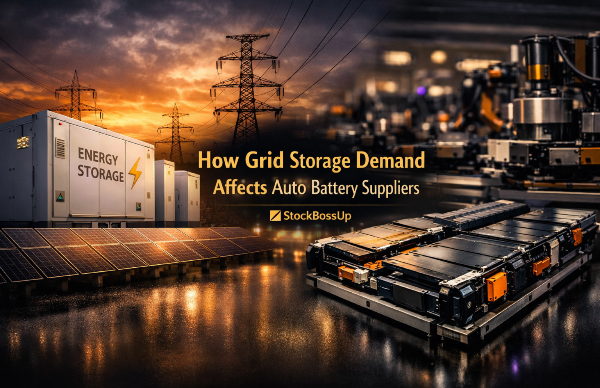
Utility-scale energy storage systems and electric vehicles both rely heavily on lithium-ion battery production. As grid storage expands, it pulls manufacturing capacity, raw materials, and investment attention away from auto battery supply chains, tightening global supply conditions.
🏭 Battery manufacturers are increasingly balancing two very different customer worlds
Companies like CATL, LG Energy Solution, Panasonic Energy, and BYD now serve both automakers and energy utilities. This dual demand structure forces manufacturers to allocate production between predictable automotive contracts and fast-growing grid storage projects.
📦 Raw material constraints amplify the competition between EV and grid demand
Lithium, nickel, cobalt, and graphite supply chains are shared between electric vehicles and grid storage systems. When grid demand spikes, it can increase input costs and tighten availability for auto battery suppliers.
🔋 Grid storage is reshaping how investors think about “auto battery companies”
Battery suppliers are no longer pure automotive plays. Their growth is increasingly tied to energy infrastructure expansion, making them hybrid industrial-energy companies rather than traditional auto suppliers.
How Grid Storage Demand Affects Auto Battery Suppliers
The battery industry is going through a subtle identity shift. It used to be mostly about cars. Now it is about cars and the entire power grid at the same time.
Electric vehicles are still the headline story. But behind the scenes, grid storage systems are growing fast enough to compete for the same factories, materials, and engineering capacity.
That overlap is where things get interesting. Because battery suppliers are no longer serving one industry. They are serving two giant systems that do not always want the same thing at the same time.
Why Grid Storage Suddenly Became a Massive Battery Buyer
Grid storage demand is rising because power systems are changing. Renewable energy sources like wind and solar do not produce electricity in a steady flow. They come in waves.
That creates a need for large-scale storage systems that can absorb excess energy and release it later. These systems are built using the same lithium-ion chemistry found in electric vehicles.
Battery companies like CATL, LG Energy Solution, and BYD are now supplying utility-scale projects alongside automotive contracts. That means the same production lines may be feeding both cars and power grids depending on demand conditions.
One less obvious detail is that grid storage systems often require longer cycle life than automotive batteries because they are charged and discharged far more frequently over their lifetime. That pushes manufacturers to design more durable cells for stationary use, even when margins differ.
| Demand Source |
Battery Use Case |
Demand Characteristics |
| Electric vehicles |
Mobility power |
Predictable, contract-driven |
| Grid storage |
Energy balancing |
Project-based, scalable |
| Consumer electronics |
Portable devices |
Stable but slow growth |
| Industrial systems |
Backup power |
Infrastructure-driven |
The result is a shared production ecosystem where multiple industries compete for the same physical output capacity.
When Auto Battery Suppliers Become Energy Infrastructure Companies
Auto battery suppliers are no longer just auto suppliers. They are increasingly energy infrastructure players with automotive divisions attached.
CATL is a good example. It supplies EV manufacturers but also builds large-scale energy storage systems for utility companies. LG Energy Solution follows a similar path, expanding into grid storage contracts while maintaining deep OEM relationships with automakers.
Panasonic Energy and BYD also operate in both worlds, shifting production depending on demand cycles and long-term contracts.
This creates a strange situation where a “car battery company” might spend part of its week building modules for vehicles and part of it building systems that stabilize entire power grids.
| Company |
Automotive Role |
Grid Storage Role |
| CATL |
Global EV leader |
Utility-scale storage provider |
| LG Energy Solution |
OEM supplier |
Expanding storage footprint |
| Panasonic Energy |
EV partner |
Select grid deployments |
| BYD |
Vertical EV integration |
Large storage systems |
A key dynamic here is flexibility. Many modern battery plants can shift output between automotive and grid contracts depending on pricing and demand, which makes allocation strategy almost as important as production capacity.
The Hidden Pressure Point: Raw Materials
Both EVs and grid storage systems depend on the same raw materials. Lithium, nickel, cobalt, and graphite sit at the center of both industries.
When grid storage demand rises quickly, it competes directly with automotive demand for these inputs. That can tighten supply chains even if EV demand is stable.
Mining and refining capacity does not scale quickly. That means short-term surges in grid storage deployment can ripple into EV pricing and margins.
| Material |
Primary Use |
Supply Sensitivity |
| Lithium |
Energy storage core |
High volatility |
| Nickel |
Energy density support |
Supply constrained |
| Cobalt |
Battery stability |
Geopolitically sensitive |
| Graphite |
Anode material |
Processing bottleneck |
Here is where things get interesting in a less obvious way. Battery manufacturers are not just competing for customers. They are competing for atoms that have to be mined, refined, and shipped before anything else can happen.
That makes supply chain timing just as important as technology itself.
Why Grid Storage Changes How Investors Value Auto Battery Companies
Grid storage introduces a second growth engine into what used to be a mostly automotive story. That changes how markets value battery suppliers.
Instead of being tied only to vehicle production cycles, these companies now have exposure to energy infrastructure expansion, which can follow very different demand patterns.
This creates a hybrid profile. Part automotive manufacturer, part energy infrastructure supplier, part commodity processor.
| Business Segment |
Growth Driver |
Volatility Profile |
| Automotive batteries |
EV adoption |
Medium |
| Grid storage |
Energy transition |
High but expanding |
| Industrial systems |
Infrastructure investment |
Stable |
| Consumer electronics |
Device cycles |
Low growth |
A second subtle detail is that grid storage contracts can scale in large, uneven steps. One year might be quiet, and the next could bring massive utility deployments that reshape revenue expectations quickly.
This makes forecasting harder, but also creates sharp upside cycles for suppliers positioned correctly.
Manufacturing Allocation Becomes the New Strategic Battlefield
Battery manufacturing is not just about capacity anymore. It is about allocation decisions.
If a factory can produce both EV batteries and grid storage systems, management has to decide how to split output between them. That decision is influenced by margins, contract terms, and long-term strategic positioning.
Automotive contracts are typically more stable. Grid storage contracts can be larger and faster-growing but more variable.
| Allocation Factor |
Automotive Demand |
Grid Storage Demand |
| Contract stability |
High |
Medium |
| Growth potential |
Moderate |
High |
| Margin consistency |
Predictable |
Variable |
| Production priority |
Long-term OEM |
Project-based |
In practice, this means battery suppliers are constantly balancing certainty versus opportunity. One side pays steadily. The other grows faster but less predictably.
That tension is now a core part of how the industry operates.
Where This Market Quietly Heads Next
The overlap between grid storage and auto batteries is not temporary. It is structural.
As more renewable energy comes online, grid storage demand is expected to remain a long-term pillar of battery consumption. At the same time, EV adoption continues to expand global automotive demand.
This creates a dual-growth environment, but also a resource-constrained one. The same factories, engineers, and materials are being pulled in multiple directions.
The companies that perform best in this environment are not just battery makers. They are allocation strategists, supply chain operators, and energy system builders all at once.
In the end, grid storage is not replacing automotive batteries. It is sitting next to them at the same table, ordering from the same menu, and occasionally taking the last available seat.










🔑 Key Takeaways
⚡ Grid storage demand is quietly competing with EVs for the same battery supply chains
Utility-scale energy storage systems and electric vehicles both rely heavily on lithium-ion battery production. As grid storage expands, it pulls manufacturing capacity, raw materials, and investment attention away from auto battery supply chains, tightening global supply conditions.
🏭 Battery manufacturers are increasingly balancing two very different customer worlds
Companies like CATL, LG Energy Solution, Panasonic Energy, and BYD now serve both automakers and energy utilities. This dual demand structure forces manufacturers to allocate production between predictable automotive contracts and fast-growing grid storage projects.
📦 Raw material constraints amplify the competition between EV and grid demand
Lithium, nickel, cobalt, and graphite supply chains are shared between electric vehicles and grid storage systems. When grid demand spikes, it can increase input costs and tighten availability for auto battery suppliers.
🔋 Grid storage is reshaping how investors think about “auto battery companies”
Battery suppliers are no longer pure automotive plays. Their growth is increasingly tied to energy infrastructure expansion, making them hybrid industrial-energy companies rather than traditional auto suppliers.
How Grid Storage Demand Affects Auto Battery Suppliers
The battery industry is going through a subtle identity shift. It used to be mostly about cars. Now it is about cars and the entire power grid at the same time.
Electric vehicles are still the headline story. But behind the scenes, grid storage systems are growing fast enough to compete for the same factories, materials, and engineering capacity.
That overlap is where things get interesting. Because battery suppliers are no longer serving one industry. They are serving two giant systems that do not always want the same thing at the same time.
Why Grid Storage Suddenly Became a Massive Battery Buyer
Grid storage demand is rising because power systems are changing. Renewable energy sources like wind and solar do not produce electricity in a steady flow. They come in waves.
That creates a need for large-scale storage systems that can absorb excess energy and release it later. These systems are built using the same lithium-ion chemistry found in electric vehicles.
Battery companies like CATL, LG Energy Solution, and BYD are now supplying utility-scale projects alongside automotive contracts. That means the same production lines may be feeding both cars and power grids depending on demand conditions.
One less obvious detail is that grid storage systems often require longer cycle life than automotive batteries because they are charged and discharged far more frequently over their lifetime. That pushes manufacturers to design more durable cells for stationary use, even when margins differ.
The result is a shared production ecosystem where multiple industries compete for the same physical output capacity.
When Auto Battery Suppliers Become Energy Infrastructure Companies
Auto battery suppliers are no longer just auto suppliers. They are increasingly energy infrastructure players with automotive divisions attached.
CATL is a good example. It supplies EV manufacturers but also builds large-scale energy storage systems for utility companies. LG Energy Solution follows a similar path, expanding into grid storage contracts while maintaining deep OEM relationships with automakers.
Panasonic Energy and BYD also operate in both worlds, shifting production depending on demand cycles and long-term contracts.
This creates a strange situation where a “car battery company” might spend part of its week building modules for vehicles and part of it building systems that stabilize entire power grids.
A key dynamic here is flexibility. Many modern battery plants can shift output between automotive and grid contracts depending on pricing and demand, which makes allocation strategy almost as important as production capacity.
The Hidden Pressure Point: Raw Materials
Both EVs and grid storage systems depend on the same raw materials. Lithium, nickel, cobalt, and graphite sit at the center of both industries.
When grid storage demand rises quickly, it competes directly with automotive demand for these inputs. That can tighten supply chains even if EV demand is stable.
Mining and refining capacity does not scale quickly. That means short-term surges in grid storage deployment can ripple into EV pricing and margins.
Here is where things get interesting in a less obvious way. Battery manufacturers are not just competing for customers. They are competing for atoms that have to be mined, refined, and shipped before anything else can happen.
That makes supply chain timing just as important as technology itself.
Why Grid Storage Changes How Investors Value Auto Battery Companies
Grid storage introduces a second growth engine into what used to be a mostly automotive story. That changes how markets value battery suppliers.
Instead of being tied only to vehicle production cycles, these companies now have exposure to energy infrastructure expansion, which can follow very different demand patterns.
This creates a hybrid profile. Part automotive manufacturer, part energy infrastructure supplier, part commodity processor.
A second subtle detail is that grid storage contracts can scale in large, uneven steps. One year might be quiet, and the next could bring massive utility deployments that reshape revenue expectations quickly.
This makes forecasting harder, but also creates sharp upside cycles for suppliers positioned correctly.
Manufacturing Allocation Becomes the New Strategic Battlefield
Battery manufacturing is not just about capacity anymore. It is about allocation decisions.
If a factory can produce both EV batteries and grid storage systems, management has to decide how to split output between them. That decision is influenced by margins, contract terms, and long-term strategic positioning.
Automotive contracts are typically more stable. Grid storage contracts can be larger and faster-growing but more variable.
In practice, this means battery suppliers are constantly balancing certainty versus opportunity. One side pays steadily. The other grows faster but less predictably.
That tension is now a core part of how the industry operates.
Where This Market Quietly Heads Next
The overlap between grid storage and auto batteries is not temporary. It is structural.
As more renewable energy comes online, grid storage demand is expected to remain a long-term pillar of battery consumption. At the same time, EV adoption continues to expand global automotive demand.
This creates a dual-growth environment, but also a resource-constrained one. The same factories, engineers, and materials are being pulled in multiple directions.
The companies that perform best in this environment are not just battery makers. They are allocation strategists, supply chain operators, and energy system builders all at once.
In the end, grid storage is not replacing automotive batteries. It is sitting next to them at the same table, ordering from the same menu, and occasionally taking the last available seat.