🔑 Key Takeaways
⚠️ Battery supply chains are highly exposed to global commodity and geopolitical shocks
Auto battery production depends on lithium, nickel, cobalt, and graphite. These materials are concentrated in specific regions, which creates pricing volatility and geopolitical risk that directly impacts margins for suppliers like CATL, LG Energy Solution, Panasonic Energy, and Exide Technologies.
🏭 Manufacturing bottlenecks create hidden constraints even when demand is strong
Battery factories are expensive and slow to scale. Even when EV and aftermarket demand is rising, production constraints, equipment shortages, and limited refining capacity can delay output and tighten supply for auto parts companies.
📦 Auto parts investors are exposed to both OEM demand cycles and aftermarket replacement cycles
Battery-related companies serve two overlapping markets: OEM automotive production and aftermarket replacement demand. These cycles do not always move together, which can create uneven revenue patterns and inventory risk.
🔋 Recycling and second-life battery systems are becoming a critical risk offset, not just a side business
Recycling networks and repurposed battery systems are increasingly important for stabilizing supply. Companies like Redwood Materials, Li-Cycle, and Umicore are helping reduce raw material dependence, but scaling is still uneven.
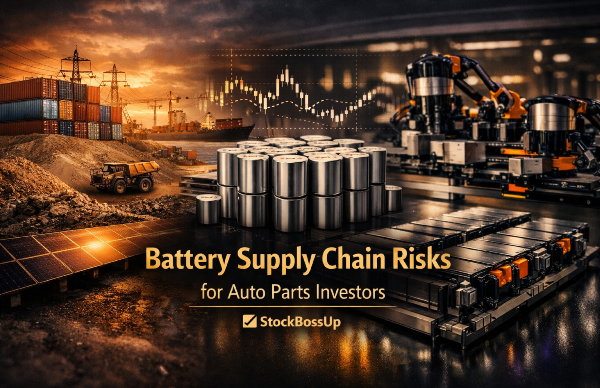
Battery Supply Chain Risks for Auto Parts Investors
Battery supply chains look modern and high-tech on the surface. Underneath, they are still tightly tied to mining, shipping routes, chemical processing, and long industrial lead times.
For auto parts investors, this matters because batteries sit at the center of both EV growth and traditional vehicle maintenance. When the battery supply chain tightens, the effects ripple through OEM production, aftermarket pricing, and even repair shop availability.
It is not a single chain. It is a web of dependencies that all need to function at the same time.
Raw Materials: Where Most of the Risk Starts
The biggest risk in the battery supply chain starts far upstream in mining and refining. Lithium, nickel, cobalt, and graphite are all required in large quantities for modern batteries.
These materials are not evenly distributed globally. They are concentrated in specific countries and regions, which creates exposure to trade policy, export restrictions, and political instability.
When raw material prices move sharply, battery manufacturers cannot always pass costs through immediately. That compresses margins across the entire auto supply chain.
| Material |
Key Risk Factor |
Supply Constraint |
| Lithium |
Price volatility |
Limited refining capacity |
| Nickel |
Geopolitical exposure |
Export concentration |
| Cobalt |
Regional dependency |
Ethical sourcing pressure |
| Graphite |
Processing bottlenecks |
Limited refinement infrastructure |
A less obvious reality is that refining capacity often matters more than raw mining output. Even when materials exist, they may not be usable at scale until they are processed correctly.
Manufacturing Bottlenecks That Don’t Show Up in Headlines
Battery manufacturing is capital-intensive and slow to expand. Building a new gigafactory can take years, not months.
Even when demand for EVs or replacement batteries spikes, production cannot instantly adjust. Equipment shortages, labor constraints, and certification requirements all slow output.
This creates a lag effect where demand outpaces supply, even in strong economic conditions.
| Constraint Type |
Impact on Supply Chain |
Risk Level |
| Factory build time |
Delayed capacity expansion |
High |
| Equipment shortages |
Slower production scaling |
Medium-high |
| Skilled labor gaps |
Operational inefficiency |
Medium |
| Quality certification |
Slow market entry |
High |
A key detail here is that battery production lines are not easily repurposed. Once optimized for a chemistry or format, switching requires significant downtime and cost.
The Dual Demand Trap: OEM vs Aftermarket
Auto battery companies do not serve a single market. They sit between OEM production and aftermarket replacement demand.
OEM demand is tied to new vehicle production. Aftermarket demand is tied to vehicle aging and failure cycles. These two cycles do not always align.
When new vehicle production slows, OEM demand drops. But aftermarket demand may still rise as older vehicles stay on the road longer.
| Demand Channel |
Behavior |
Risk Profile |
| OEM production |
Cyclical |
High sensitivity |
| Aftermarket replacement |
Stable |
Lower volatility |
| Fleet demand |
Scheduled |
Predictable |
| Retail consumers |
Irregular |
Medium volatility |
This split creates a balancing act for suppliers. Strong aftermarket demand can offset weak OEM cycles, but it rarely moves in perfect sync.
Why Supply Chain Complexity Increases Investor Risk
Battery supply chains are not linear. They involve mining companies, refiners, chemical processors, cell manufacturers, pack assemblers, and distributors.
Each layer adds delay and risk. A disruption at any point can affect the entire chain.
This complexity means that even well-positioned companies can face unexpected inventory shortages or delivery delays.
| Supply Chain Stage |
Risk Type |
Investor Impact |
| Mining |
Political + pricing |
Margin volatility |
| Refining |
Capacity limits |
Input shortages |
| Cell production |
Manufacturing delays |
Output constraints |
| Assembly |
Logistics issues |
Delivery disruption |
The important insight is that risk does not scale evenly. One weak link can slow the entire system.
Recycling Is Becoming a Strategic Pressure Valve
Battery recycling is no longer a side business. It is becoming a core part of supply chain stability.
Companies like Redwood Materials, Li-Cycle, and Umicore are building systems to recover lithium, nickel, and cobalt from used batteries. This reduces reliance on raw mining supply.
However, recycling capacity is still developing. It cannot yet fully offset global demand growth.
| Company |
Focus |
Strategic Role |
| Redwood Materials |
Closed-loop recycling |
EV supply stabilization |
| Li-Cycle |
Hydrometallurgical processing |
Material recovery scaling |
| Umicore |
Industrial recycling |
European supply support |
A subtle but important shift is that recycling is now being treated as a supply chain input, not just environmental compliance.
Why Inventory Cycles Matter More Than They Seem
Battery companies often carry significant inventory risk. Raw materials must be purchased in advance, processed, and held before final assembly.
If demand slows unexpectedly, companies can be left with expensive inventory purchased at higher input prices.
If demand spikes, shortages can appear quickly due to long lead times.
| Scenario |
Effect on Inventory |
Financial Impact |
| Demand surge |
Stockouts |
Lost sales opportunity |
| Demand slowdown |
Excess inventory |
Margin pressure |
| Price increase |
Higher carrying cost |
Profit compression |
| Price decline |
Inventory write-down risk |
Accounting pressure |
A key detail is that inventory risk is often delayed. It does not always show up immediately in earnings, which can surprise investors.
Where Risk and Opportunity Actually Meet
Battery supply chain risk is not purely negative. It also creates pricing power for companies that control key parts of the chain.
Firms with strong upstream integration, diversified sourcing, or recycling access tend to handle volatility better than pure assemblers.
At the same time, companies exposed only to one part of the chain face higher sensitivity to disruptions.
The real divide is not between winners and losers, but between integrated systems and fragmented participants.
The Structural Reality for Investors
Battery supply chains are becoming more complex, not simpler. EV growth, grid storage expansion, and aftermarket demand are all pulling on the same system at once.
That creates both opportunity and fragility.
For auto parts investors, the key takeaway is not to view batteries as a single product category. They are a layered system with multiple points of failure and multiple sources of demand.
The companies that navigate this environment best are those that can absorb shocks, reallocate supply, and maintain flexibility across markets.
In a system this interconnected, resilience is not optional. It is the real competitive advantage.







🔑 Key Takeaways
⚠️ Battery supply chains are highly exposed to global commodity and geopolitical shocks
Auto battery production depends on lithium, nickel, cobalt, and graphite. These materials are concentrated in specific regions, which creates pricing volatility and geopolitical risk that directly impacts margins for suppliers like CATL, LG Energy Solution, Panasonic Energy, and Exide Technologies.
🏭 Manufacturing bottlenecks create hidden constraints even when demand is strong
Battery factories are expensive and slow to scale. Even when EV and aftermarket demand is rising, production constraints, equipment shortages, and limited refining capacity can delay output and tighten supply for auto parts companies.
📦 Auto parts investors are exposed to both OEM demand cycles and aftermarket replacement cycles
Battery-related companies serve two overlapping markets: OEM automotive production and aftermarket replacement demand. These cycles do not always move together, which can create uneven revenue patterns and inventory risk.
🔋 Recycling and second-life battery systems are becoming a critical risk offset, not just a side business
Recycling networks and repurposed battery systems are increasingly important for stabilizing supply. Companies like Redwood Materials, Li-Cycle, and Umicore are helping reduce raw material dependence, but scaling is still uneven.
Battery Supply Chain Risks for Auto Parts Investors
Battery supply chains look modern and high-tech on the surface. Underneath, they are still tightly tied to mining, shipping routes, chemical processing, and long industrial lead times.
For auto parts investors, this matters because batteries sit at the center of both EV growth and traditional vehicle maintenance. When the battery supply chain tightens, the effects ripple through OEM production, aftermarket pricing, and even repair shop availability.
It is not a single chain. It is a web of dependencies that all need to function at the same time.
Raw Materials: Where Most of the Risk Starts
The biggest risk in the battery supply chain starts far upstream in mining and refining. Lithium, nickel, cobalt, and graphite are all required in large quantities for modern batteries.
These materials are not evenly distributed globally. They are concentrated in specific countries and regions, which creates exposure to trade policy, export restrictions, and political instability.
When raw material prices move sharply, battery manufacturers cannot always pass costs through immediately. That compresses margins across the entire auto supply chain.
A less obvious reality is that refining capacity often matters more than raw mining output. Even when materials exist, they may not be usable at scale until they are processed correctly.
Manufacturing Bottlenecks That Don’t Show Up in Headlines
Battery manufacturing is capital-intensive and slow to expand. Building a new gigafactory can take years, not months.
Even when demand for EVs or replacement batteries spikes, production cannot instantly adjust. Equipment shortages, labor constraints, and certification requirements all slow output.
This creates a lag effect where demand outpaces supply, even in strong economic conditions.
A key detail here is that battery production lines are not easily repurposed. Once optimized for a chemistry or format, switching requires significant downtime and cost.
The Dual Demand Trap: OEM vs Aftermarket
Auto battery companies do not serve a single market. They sit between OEM production and aftermarket replacement demand.
OEM demand is tied to new vehicle production. Aftermarket demand is tied to vehicle aging and failure cycles. These two cycles do not always align.
When new vehicle production slows, OEM demand drops. But aftermarket demand may still rise as older vehicles stay on the road longer.
This split creates a balancing act for suppliers. Strong aftermarket demand can offset weak OEM cycles, but it rarely moves in perfect sync.
Why Supply Chain Complexity Increases Investor Risk
Battery supply chains are not linear. They involve mining companies, refiners, chemical processors, cell manufacturers, pack assemblers, and distributors.
Each layer adds delay and risk. A disruption at any point can affect the entire chain.
This complexity means that even well-positioned companies can face unexpected inventory shortages or delivery delays.
The important insight is that risk does not scale evenly. One weak link can slow the entire system.
Recycling Is Becoming a Strategic Pressure Valve
Battery recycling is no longer a side business. It is becoming a core part of supply chain stability.
Companies like Redwood Materials, Li-Cycle, and Umicore are building systems to recover lithium, nickel, and cobalt from used batteries. This reduces reliance on raw mining supply.
However, recycling capacity is still developing. It cannot yet fully offset global demand growth.
A subtle but important shift is that recycling is now being treated as a supply chain input, not just environmental compliance.
Why Inventory Cycles Matter More Than They Seem
Battery companies often carry significant inventory risk. Raw materials must be purchased in advance, processed, and held before final assembly.
If demand slows unexpectedly, companies can be left with expensive inventory purchased at higher input prices.
If demand spikes, shortages can appear quickly due to long lead times.
A key detail is that inventory risk is often delayed. It does not always show up immediately in earnings, which can surprise investors.
Where Risk and Opportunity Actually Meet
Battery supply chain risk is not purely negative. It also creates pricing power for companies that control key parts of the chain.
Firms with strong upstream integration, diversified sourcing, or recycling access tend to handle volatility better than pure assemblers.
At the same time, companies exposed only to one part of the chain face higher sensitivity to disruptions.
The real divide is not between winners and losers, but between integrated systems and fragmented participants.
The Structural Reality for Investors
Battery supply chains are becoming more complex, not simpler. EV growth, grid storage expansion, and aftermarket demand are all pulling on the same system at once.
That creates both opportunity and fragility.
For auto parts investors, the key takeaway is not to view batteries as a single product category. They are a layered system with multiple points of failure and multiple sources of demand.
The companies that navigate this environment best are those that can absorb shocks, reallocate supply, and maintain flexibility across markets.
In a system this interconnected, resilience is not optional. It is the real competitive advantage.